

6.1 Spectrum Transformation Due to Wave Refraction in Shallow Water
255
angle is as follows:
(6.6)
If this condition is not fulfilled, it means that with decreasing depth,
when ;;,f ;;,0 is increased, the corresponding spectral component is absent at
the point with coordinate x = x'. Constructing a complete spectral solution
for this combination of parameters: w, {3, x', the following holds:
S(w,{3,x) = 0.
(6.7)
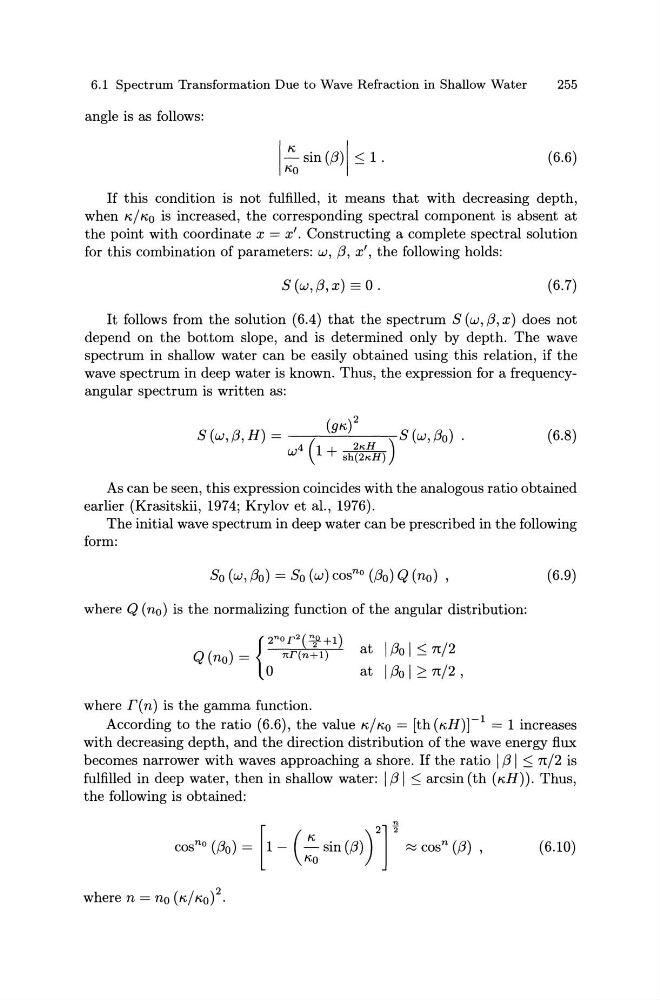
It follows from the solution (6.4) that the spectrum S (w, {3, x) does not
depend on the bottom slope, and is determined only by depth. The wave
spectrum in shallow water can be easily obtained using this relation, if the
wave spectrum in deep water is known. Thus, the expression for a frequencyangular spectrum is written as:
S(w,{3,H)=
(
)S(w,f3o)
4 1 + 2~<.H
W
sh(2~<.H)
(6.8)
As can be seen, this expression coincides with the analogous ratio obtained
earlier (Krasitskii, 1974; Krylov et al., 1976).
The initial wave spectrum in deep water can be prescribed in the following
form:
So (w, f3o) = So (w) cosno (f3o) Q (no) ,
where Q (no) is the normalizing function of the angular distribution:
{
2no r2( ;a-+I)
Q (no) = 0 7tF(n+l)
where r(n) is the gamma function.
at I f3o I 5:. n/2
at I f3o I ~ n/2 ,
(6.9)
According to the ratio (6.6), the value ;;,f ;;,0 = [th (;;,H)]- 1 = 1 increases
with decreasing depth, and the direction distribution of the wave energy flux
becomes narrower with waves approaching a shore. If the ratio I f31 5:_ n/2 is
fulfilled in deep water, then in shallow water: I f31 5:_ arcsin (th (;;,H)). Thus,
the following is obtained:
(6.10)
255
angle is as follows:
(6.6)
If this condition is not fulfilled, it means that with decreasing depth,
when ;;,f ;;,0 is increased, the corresponding spectral component is absent at
the point with coordinate x = x'. Constructing a complete spectral solution
for this combination of parameters: w, {3, x', the following holds:
S(w,{3,x) = 0.
(6.7)
It follows from the solution (6.4) that the spectrum S (w, {3, x) does not
depend on the bottom slope, and is determined only by depth. The wave
spectrum in shallow water can be easily obtained using this relation, if the
wave spectrum in deep water is known. Thus, the expression for a frequencyangular spectrum is written as:
S(w,{3,H)=
(
)S(w,f3o)
4 1 + 2~<.H
W
sh(2~<.H)
(6.8)
As can be seen, this expression coincides with the analogous ratio obtained
earlier (Krasitskii, 1974; Krylov et al., 1976).
The initial wave spectrum in deep water can be prescribed in the following
form:
So (w, f3o) = So (w) cosno (f3o) Q (no) ,
where Q (no) is the normalizing function of the angular distribution:
{
2no r2( ;a-+I)
Q (no) = 0 7tF(n+l)
where r(n) is the gamma function.
at I f3o I 5:. n/2
at I f3o I ~ n/2 ,
(6.9)
According to the ratio (6.6), the value ;;,f ;;,0 = [th (;;,H)]- 1 = 1 increases
with decreasing depth, and the direction distribution of the wave energy flux
becomes narrower with waves approaching a shore. If the ratio I f31 5:_ n/2 is
fulfilled in deep water, then in shallow water: I f31 5:_ arcsin (th (;;,H)). Thus,
the following is obtained:
(6.10)