

254
6 Wave Transformation in Shallow Water
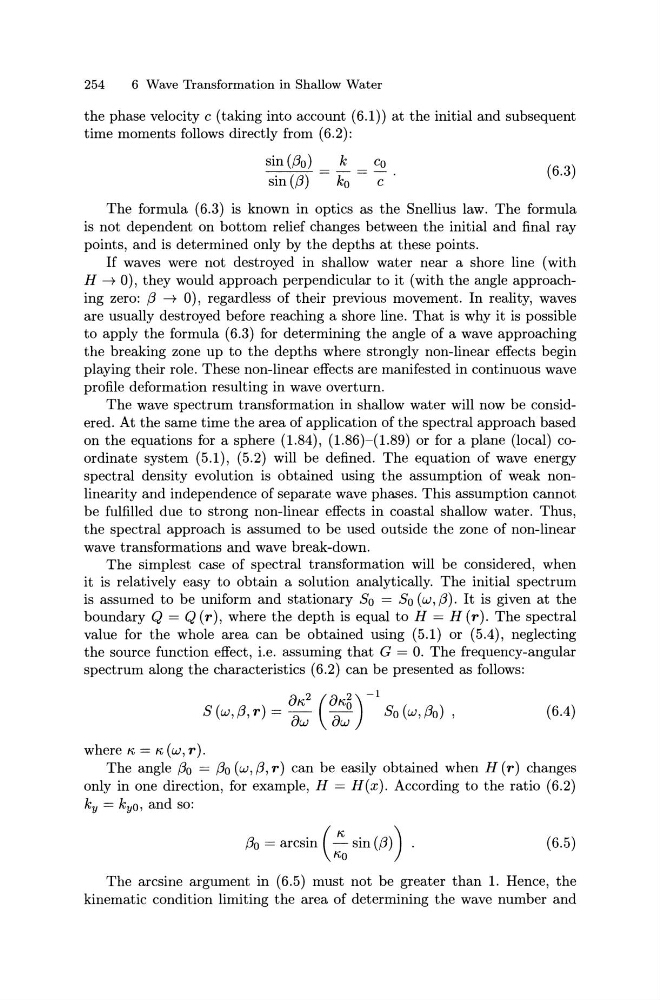
the phase velocity c (taking into account (6.1)) at the initial and subsequent
time moments follows directly from (6.2):
sin (!Jo)
sin (JJ)
k
co
ko
c
(6.3)
The formula (6.3) is known in optics as the Snellius law. The formula
is not dependent on bottom relief changes between the initial and final ray
points, and is determined only by the depths at these points.
If waves were not destroyed in shallow water near a shore line (with
H--+ 0), they would approach perpendicular to it (with the angle approaching zero: jJ --+ 0), regardless of their previous movement. In reality, waves
are usually destroyed before reaching a shore line. That is why it is possible
to apply the formula (6.3) for determining the angle of a wave approaching
the breaking zone up to the depths where strongly non-linear effects begin
playing their role. These non-linear effects are manifested in continuous wave
profile deformation resulting in wave overturn.
The wave spectrum transformation in shallow water will now be considered. At the same time the area of application of the spectral approach based
on the equations for a sphere (1.84), (1.86)-(1.89) or for a plane (local) coordinate system (5.1), (5.2) will be defined. The equation of wave energy
spectral density evolution is obtained using the assumption of weak nonlinearity and independence of separate wave phases. This assumption cannot
be fulfilled due to strong non-linear effects in coastal shallow water. Thus,
the spectral approach is assumed to be used outside the zone of non-linear
wave transformations and wave break-down.
The simplest case of spectral transformation will be considered, when
it is relatively easy to obtain a solution analytically. The initial spectrum
is assumed to be uniform and stationary S0 = S0 ( w, jJ). It is given at the
boundary Q = Q (r), where the depth is equal to H = H (r). The spectral
value for the whole area can be obtained using (5.1) or (5.4), neglecting
the source function effect, i.e. assuming that G = 0. The frequency-angular
spectrum along the characteristics (6.2) can be presented as follows:
K
Ko
8 2 (8 2)-l
S(w,jJ,r)= 0 w ow
So(w,/Jo),
(6.4)
where K = K(w,r).
The angle /Jo = !Jo ( w, jJ, r) can be easily obtained when H ( r) changes
only in one direction, for example, H = H(x). According to the ratio (6.2)
ky = kyo, and so:
/Jo = arcsin ( ~ sin (JJ)) .
(6.5)
The arcsine argument in (6.5) must not be greater than 1. Hence, the
kinematic condition limiting the area of determining the wave number and
6 Wave Transformation in Shallow Water
the phase velocity c (taking into account (6.1)) at the initial and subsequent
time moments follows directly from (6.2):
sin (!Jo)
sin (JJ)
k
co
ko
c
(6.3)
The formula (6.3) is known in optics as the Snellius law. The formula
is not dependent on bottom relief changes between the initial and final ray
points, and is determined only by the depths at these points.
If waves were not destroyed in shallow water near a shore line (with
H--+ 0), they would approach perpendicular to it (with the angle approaching zero: jJ --+ 0), regardless of their previous movement. In reality, waves
are usually destroyed before reaching a shore line. That is why it is possible
to apply the formula (6.3) for determining the angle of a wave approaching
the breaking zone up to the depths where strongly non-linear effects begin
playing their role. These non-linear effects are manifested in continuous wave
profile deformation resulting in wave overturn.
The wave spectrum transformation in shallow water will now be considered. At the same time the area of application of the spectral approach based
on the equations for a sphere (1.84), (1.86)-(1.89) or for a plane (local) coordinate system (5.1), (5.2) will be defined. The equation of wave energy
spectral density evolution is obtained using the assumption of weak nonlinearity and independence of separate wave phases. This assumption cannot
be fulfilled due to strong non-linear effects in coastal shallow water. Thus,
the spectral approach is assumed to be used outside the zone of non-linear
wave transformations and wave break-down.
The simplest case of spectral transformation will be considered, when
it is relatively easy to obtain a solution analytically. The initial spectrum
is assumed to be uniform and stationary S0 = S0 ( w, jJ). It is given at the
boundary Q = Q (r), where the depth is equal to H = H (r). The spectral
value for the whole area can be obtained using (5.1) or (5.4), neglecting
the source function effect, i.e. assuming that G = 0. The frequency-angular
spectrum along the characteristics (6.2) can be presented as follows:
K
Ko
8 2 (8 2)-l
S(w,jJ,r)= 0 w ow
So(w,/Jo),
(6.4)
where K = K(w,r).
The angle /Jo = !Jo ( w, jJ, r) can be easily obtained when H ( r) changes
only in one direction, for example, H = H(x). According to the ratio (6.2)
ky = kyo, and so:
/Jo = arcsin ( ~ sin (JJ)) .
(6.5)
The arcsine argument in (6.5) must not be greater than 1. Hence, the
kinematic condition limiting the area of determining the wave number and