

204
5 Wave Evolution in Non-uniform Currents in Deep Water
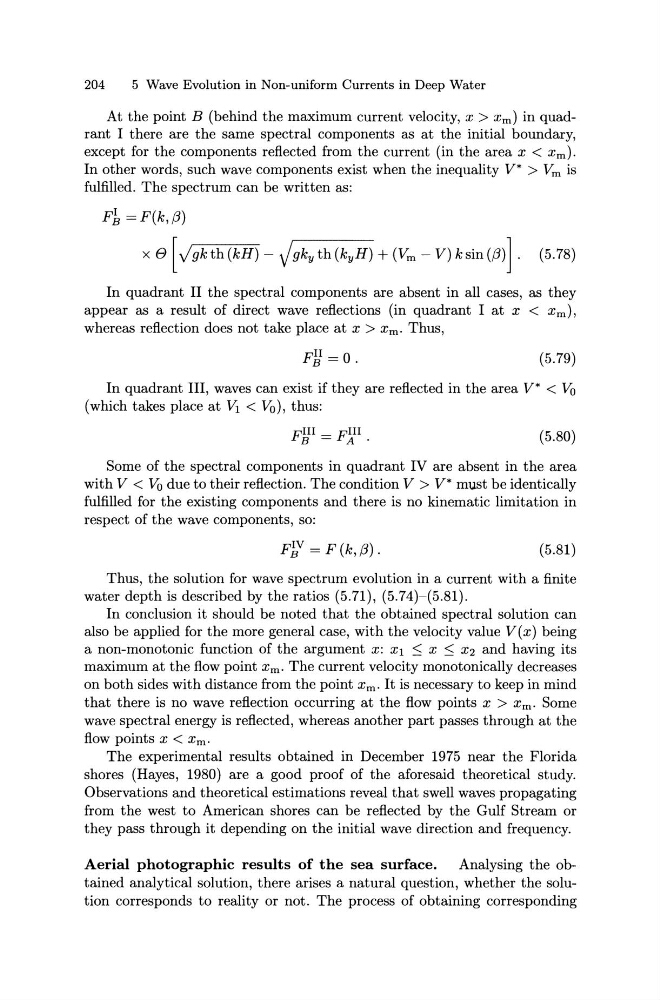
At the point B (behind the maximum current velocity, x > Xm) in quadrant I there are the same spectral components as at the initial boundary,
except for the components reflected from the current (in the area x < xm)·
In other words, such wave components exist when the inequality V* > Vm is
fulfilled. The spectrum can be written as:
F1 =F(k,{3)
X e [ J gkth (kH)- Jgky th (kyH) + (Vm- V) ksin ({3)] . (5.78)
In quadrant II the spectral components are absent in all cases, as they
appear as a result of direct wave reflections (in quadrant I at x < Xm),
whereas reflection does not take place at x > Xm· Thus,
F]J = 0.
(5.79)
In quadrant III, waves can exist if they are reflected in the area V* < V0
(which takes place at V1 < Vo), thus:
(5.80)
Some of the spectral components in quadrant IV are absent in the area
with V < Vo due to their reflection. The condition V > V* must be identically
fulfilled for the existing components and there is no kinematic limitation in
respect of the wave components, so:
F1v = F (k,{3).
(5.81)
Thus, the solution for wave spectrum evolution in a current with a finite
water depth is described by the ratios (5.71), (5.74)-(5.81).
In conclusion it should be noted that the obtained spectral solution can
also be applied for the more general case, with the velocity value V(x) being
a non-monotonic function of the argument x: XI ~ x ~ x2 and having its
maximum at the flow point Xm· The current velocity monotonically decreases
on both sides with distance from the point Xm· It is necessary to keep in mind
that there is no wave reflection occurring at the flow points x > Xm. Some
wave spectral energy is reflected, whereas another part passes through at the
flow points x < Xm·
The experimental results obtained in December 1975 near the Florida
shores (Hayes, 1980) are a good proof of the aforesaid theoretical study.
Observations and theoretical estimations reveal that swell waves propagating
from the west to American shores can be reflected by the Gulf Stream or
they pass through it depending on the initial wave direction and frequency.
Aerial photographic results of the sea surface. Analysing the obtained analytical solution, there arises a natural question, whether the solution corresponds to reality or not. The process of obtaining corresponding
5 Wave Evolution in Non-uniform Currents in Deep Water
At the point B (behind the maximum current velocity, x > Xm) in quadrant I there are the same spectral components as at the initial boundary,
except for the components reflected from the current (in the area x < xm)·
In other words, such wave components exist when the inequality V* > Vm is
fulfilled. The spectrum can be written as:
F1 =F(k,{3)
X e [ J gkth (kH)- Jgky th (kyH) + (Vm- V) ksin ({3)] . (5.78)
In quadrant II the spectral components are absent in all cases, as they
appear as a result of direct wave reflections (in quadrant I at x < Xm),
whereas reflection does not take place at x > Xm· Thus,
F]J = 0.
(5.79)
In quadrant III, waves can exist if they are reflected in the area V* < V0
(which takes place at V1 < Vo), thus:
(5.80)
Some of the spectral components in quadrant IV are absent in the area
with V < Vo due to their reflection. The condition V > V* must be identically
fulfilled for the existing components and there is no kinematic limitation in
respect of the wave components, so:
F1v = F (k,{3).
(5.81)
Thus, the solution for wave spectrum evolution in a current with a finite
water depth is described by the ratios (5.71), (5.74)-(5.81).
In conclusion it should be noted that the obtained spectral solution can
also be applied for the more general case, with the velocity value V(x) being
a non-monotonic function of the argument x: XI ~ x ~ x2 and having its
maximum at the flow point Xm· The current velocity monotonically decreases
on both sides with distance from the point Xm· It is necessary to keep in mind
that there is no wave reflection occurring at the flow points x > Xm. Some
wave spectral energy is reflected, whereas another part passes through at the
flow points x < Xm·
The experimental results obtained in December 1975 near the Florida
shores (Hayes, 1980) are a good proof of the aforesaid theoretical study.
Observations and theoretical estimations reveal that swell waves propagating
from the west to American shores can be reflected by the Gulf Stream or
they pass through it depending on the initial wave direction and frequency.
Aerial photographic results of the sea surface. Analysing the obtained analytical solution, there arises a natural question, whether the solution corresponds to reality or not. The process of obtaining corresponding