

182
5 Wave Evolution in Non-uniform Currents in Deep Water
first frequency maximum on the non-linear energy transfer. In this case there
is a tendency to make the spectral form smoother. The negative area disappears with the closing of further spectral maxima (v = 0.225) and their
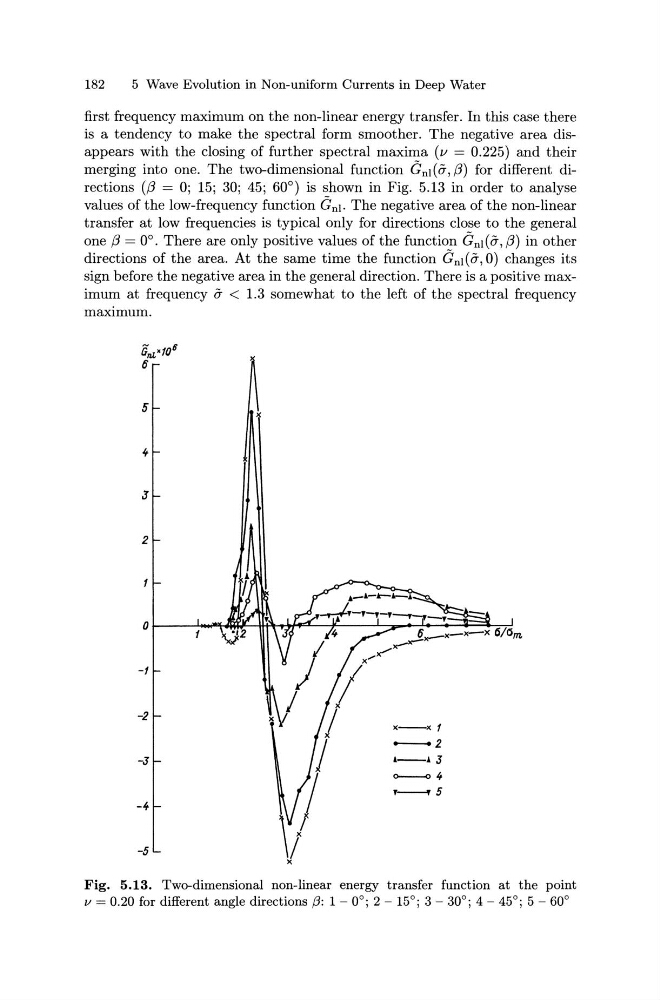
merging into one. The two-dimensional function Gnl (a' (3) for different directions ((3 = 0; 15; 30; 45; 60°) is shown in Fig. 5.13 in order to analyse
values of the low-frequency function Gnl· The negative area of the non-linear
transfer at low frequencies is typical only for directions close to the general
one (3 = 0°. There are only positive values of the function Gn1 (a, (3) in other
directions of the area. At the same time the function Gni(a, 0) changes its
sign before the negative area in the general direction. There is a positive maximum at frequency a < 1.3 somewhat to the left of the spectral frequency
maximum.
5
Fig. 5.13. Two-dimensional non-linear energy transfer function at the point
1/ = 0.20 for different angle directions (3: 1- 0°; 2- 15°; 3- 30°; 4- 45°; 5- 60°
5 Wave Evolution in Non-uniform Currents in Deep Water
first frequency maximum on the non-linear energy transfer. In this case there
is a tendency to make the spectral form smoother. The negative area disappears with the closing of further spectral maxima (v = 0.225) and their
merging into one. The two-dimensional function Gnl (a' (3) for different directions ((3 = 0; 15; 30; 45; 60°) is shown in Fig. 5.13 in order to analyse
values of the low-frequency function Gnl· The negative area of the non-linear
transfer at low frequencies is typical only for directions close to the general
one (3 = 0°. There are only positive values of the function Gn1 (a, (3) in other
directions of the area. At the same time the function Gni(a, 0) changes its
sign before the negative area in the general direction. There is a positive maximum at frequency a < 1.3 somewhat to the left of the spectral frequency
maximum.
5
Fig. 5.13. Two-dimensional non-linear energy transfer function at the point
1/ = 0.20 for different angle directions (3: 1- 0°; 2- 15°; 3- 30°; 4- 45°; 5- 60°