

5.4 Estimation of Non-Linear Wave Interaction in the Rip Spectrum
181
2
-0
6
7
-2
+--+ 1
- 2
· - - · J
- *
c>---o 5
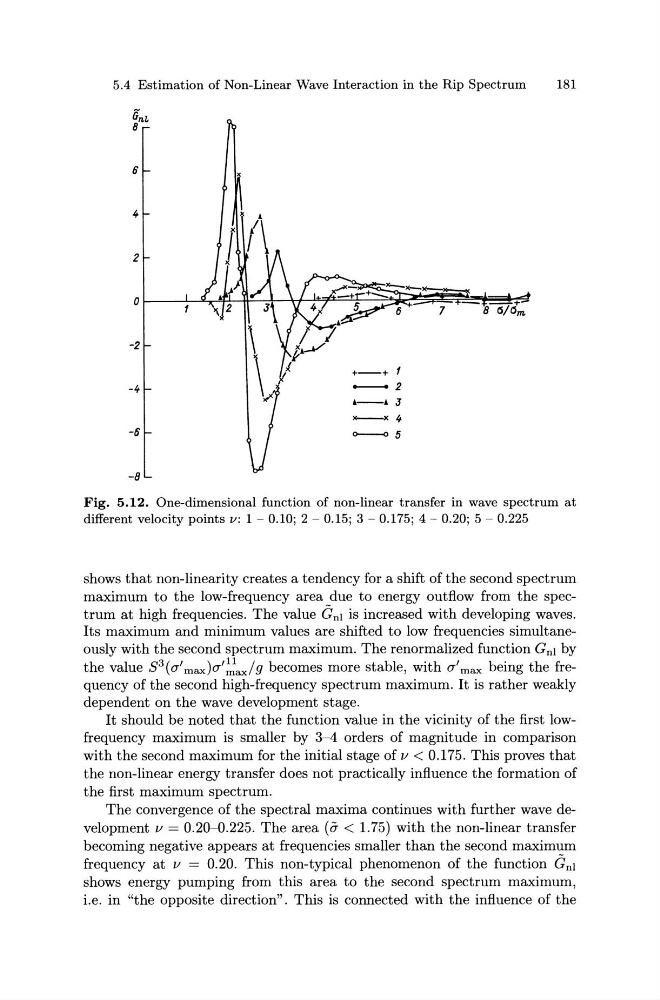
Fig. 5.12. One-dimensional function of non-linear transfer in wave spectrum at
different velocity points v: 1- 0.10; 2- 0.15; 3- 0.175; 4- 0.20; 5-0.225
shows that non-linearity creates a tendency for a shift of the second spectrum
maximum to the low-frequency area due to energy outflow from the spectrum at high frequencies. The value Gn1 is increased with developing waves.
Its maximum and minimum values are shifted to low frequencies simultaneously with the second spectrum maximum. The renormalized function Gnl by
the value S 3 (a'max)a';};ax/g becomes more stable, with a' max being the frequency of the second high-frequency spectrum maximum. It is rather weakly
dependent on the wave development stage.
It should be noted that the function value in the vicinity of the first lowfrequency maximum is smaller by 3-4 orders of magnitude in comparison
with the second maximum for the initial stage of v < 0.175. This proves that
the non-linear energy transfer does not practically influence the formation of
the first maximum spectrum.
The convergence of the spectral maxima continues with further wave development v = 0.20-0.225. The area (a< 1.75) with the non-linear transfer
becoming negative appears at frequencies smaller than the second maximum
frequency at v = 0.20. This non-typical phenomenon of the function Gnl
shows energy pumping from this area to the second spectrum maximum,
i.e. in "the opposite direction". This is connected with the influence of the
181
2
-0
6
7
-2
+--+ 1
- 2
· - - · J
- *
c>---o 5
Fig. 5.12. One-dimensional function of non-linear transfer in wave spectrum at
different velocity points v: 1- 0.10; 2- 0.15; 3- 0.175; 4- 0.20; 5-0.225
shows that non-linearity creates a tendency for a shift of the second spectrum
maximum to the low-frequency area due to energy outflow from the spectrum at high frequencies. The value Gn1 is increased with developing waves.
Its maximum and minimum values are shifted to low frequencies simultaneously with the second spectrum maximum. The renormalized function Gnl by
the value S 3 (a'max)a';};ax/g becomes more stable, with a' max being the frequency of the second high-frequency spectrum maximum. It is rather weakly
dependent on the wave development stage.
It should be noted that the function value in the vicinity of the first lowfrequency maximum is smaller by 3-4 orders of magnitude in comparison
with the second maximum for the initial stage of v < 0.175. This proves that
the non-linear energy transfer does not practically influence the formation of
the first maximum spectrum.
The convergence of the spectral maxima continues with further wave development v = 0.20-0.225. The area (a< 1.75) with the non-linear transfer
becoming negative appears at frequencies smaller than the second maximum
frequency at v = 0.20. This non-typical phenomenon of the function Gnl
shows energy pumping from this area to the second spectrum maximum,
i.e. in "the opposite direction". This is connected with the influence of the