

178
5 Wave Evolution in Non-uniform Currents in Deep Water
0.8
0.9
t.O
fl
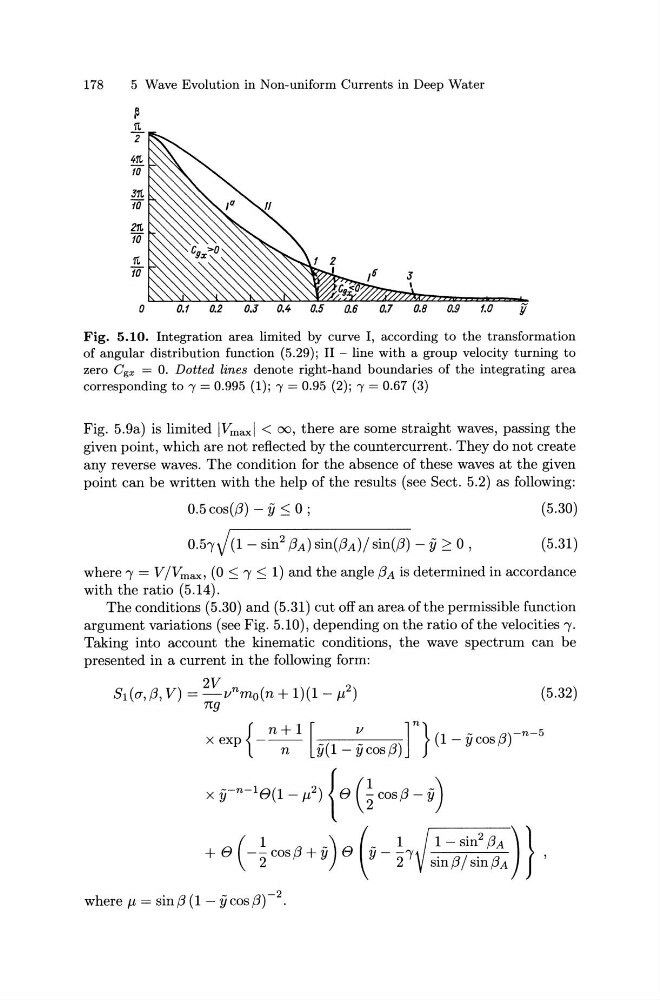
Fig. 5.10. Integration area limited by curve I, according to the transformation
of angular distribution function (5.29); II - line with a group velocity turning to
zero Cgx = 0. Dotted lines denote right-hand boundaries of the integrating area
corresponding to 1 = 0.995 (1); 1 = 0.95 (2); 1 = 0.67 (3)
Fig. 5.9a) is limited IVmaxl < oo, there are some straight waves, passing the
given point, which are not reflected by the countercurrent. They do not create
any reverse waves. The condition for the absence of these waves at the given
point can be written with the help of the results (see Sect. 5.2) as following:
0.5 cos(j3) - fj :::; 0 ;
0.5"(V(1- sin 2 f3A) sin(f3A)/ sin(j3)- fj ~ 0,
(5.30)
(5.31)
where"(= V/Vmax, (0:::; 1:::; 1) and the angle f3A is determined in accordance
with the ratio (5.14).
The conditions (5.30) and (5.31) cut off an area of the permissible function
argument variations (see Fig. 5.10), depending on the ratio of the velocities T
Taking into account the kinematic conditions, the wave spectrum can be
presented in a current in the following form:
(5.32)
where fl = sin j3 (1 - fj cos ;3) -z.
5 Wave Evolution in Non-uniform Currents in Deep Water
0.8
0.9
t.O
fl
Fig. 5.10. Integration area limited by curve I, according to the transformation
of angular distribution function (5.29); II - line with a group velocity turning to
zero Cgx = 0. Dotted lines denote right-hand boundaries of the integrating area
corresponding to 1 = 0.995 (1); 1 = 0.95 (2); 1 = 0.67 (3)
Fig. 5.9a) is limited IVmaxl < oo, there are some straight waves, passing the
given point, which are not reflected by the countercurrent. They do not create
any reverse waves. The condition for the absence of these waves at the given
point can be written with the help of the results (see Sect. 5.2) as following:
0.5 cos(j3) - fj :::; 0 ;
0.5"(V(1- sin 2 f3A) sin(f3A)/ sin(j3)- fj ~ 0,
(5.30)
(5.31)
where"(= V/Vmax, (0:::; 1:::; 1) and the angle f3A is determined in accordance
with the ratio (5.14).
The conditions (5.30) and (5.31) cut off an area of the permissible function
argument variations (see Fig. 5.10), depending on the ratio of the velocities T
Taking into account the kinematic conditions, the wave spectrum can be
presented in a current in the following form:
(5.32)
where fl = sin j3 (1 - fj cos ;3) -z.