

5.2 Frequency-Angular Spectrum Evolution in a Current
161
The wave steepness carried away by the current is sharply increased. It could
exceed the maximal permissible value that should lead to wave breaking.
An example with the initial spectrum angular distribution, in the absence
of current, being quite narrow is considered. The spectrum can be written in
the form:
So= So(w)J(;Jo),
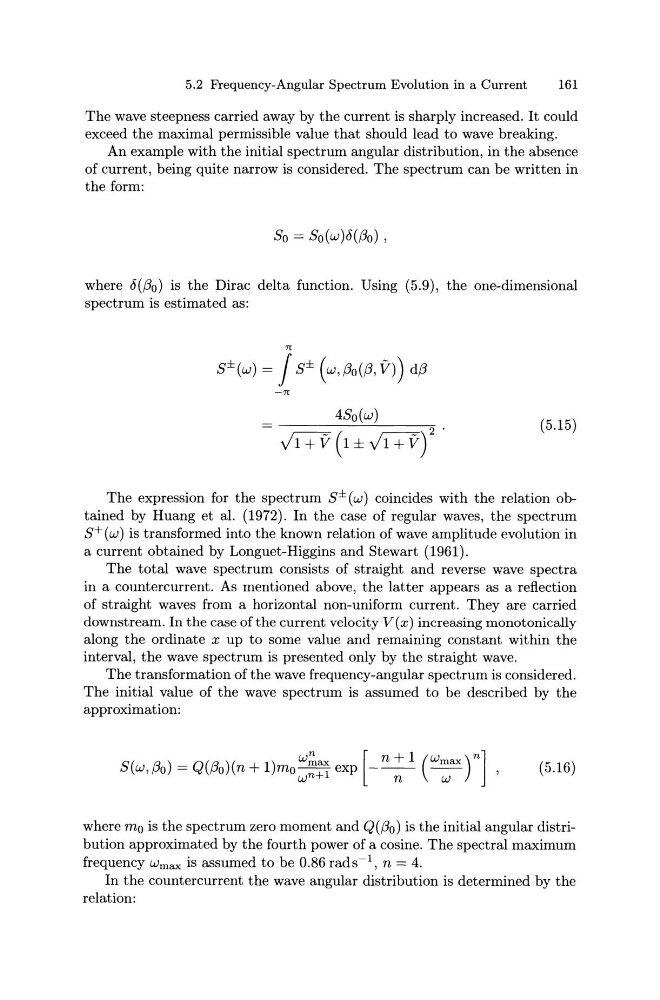
where <5(;30) is the Dirac delta function. Using (5.9), the one-dimensional
spectrum is estimated as:
7t
s±(w) = J s± (w,;Jo(;J, v)) d;J
-7{
4So(w)
(5.15)
The expression for the spectrum s±(w) coincides with the relation obtained by Huang et al. (1972). In the case of regular waves, the spectrum
s+ ( w) is transformed into the known relation of wave amplitude evolution in
a current obtained by Longuet-Higgins and Stewart (1961).
The total wave spectrum consists of straight and reverse wave spectra
in a countercurrent. As mentioned above, the latter appears as a reflection
of straight waves from a horizontal non-uniform current. They are carried
downstream. In the case of the current velocity V(x) increasing monotonically
along the ordinate x up to some value and remaining constant within the
interval, the wave spectrum is presented only by the straight wave.
The transformation of the wave frequency-angular spectrum is considered.
The initial value of the wave spectrum is assumed to be described by the
approximation:
( ) ( )(
) w;:,a.x
[ n+1 (Wmax)n]
S w,;J0 = Q ;30 n + 1 mown+l exp --n- ~
,
(5.16)
where m 0 is the spectrum zero moment and Q(;J0 ) is the initial angular distribution approximated by the fourth power of a cosine. The spectral maximum
frequency Wmax is assumed to be 0.86 rads- 1 , n = 4.
In the countercurrent the wave angular distribution is determined by the
relation:
161
The wave steepness carried away by the current is sharply increased. It could
exceed the maximal permissible value that should lead to wave breaking.
An example with the initial spectrum angular distribution, in the absence
of current, being quite narrow is considered. The spectrum can be written in
the form:
So= So(w)J(;Jo),
where <5(;30) is the Dirac delta function. Using (5.9), the one-dimensional
spectrum is estimated as:
7t
s±(w) = J s± (w,;Jo(;J, v)) d;J
-7{
4So(w)
(5.15)
The expression for the spectrum s±(w) coincides with the relation obtained by Huang et al. (1972). In the case of regular waves, the spectrum
s+ ( w) is transformed into the known relation of wave amplitude evolution in
a current obtained by Longuet-Higgins and Stewart (1961).
The total wave spectrum consists of straight and reverse wave spectra
in a countercurrent. As mentioned above, the latter appears as a reflection
of straight waves from a horizontal non-uniform current. They are carried
downstream. In the case of the current velocity V(x) increasing monotonically
along the ordinate x up to some value and remaining constant within the
interval, the wave spectrum is presented only by the straight wave.
The transformation of the wave frequency-angular spectrum is considered.
The initial value of the wave spectrum is assumed to be described by the
approximation:
( ) ( )(
) w;:,a.x
[ n+1 (Wmax)n]
S w,;J0 = Q ;30 n + 1 mown+l exp --n- ~
,
(5.16)
where m 0 is the spectrum zero moment and Q(;J0 ) is the initial angular distribution approximated by the fourth power of a cosine. The spectral maximum
frequency Wmax is assumed to be 0.86 rads- 1 , n = 4.
In the countercurrent the wave angular distribution is determined by the
relation: