

156
5 Wave Evolution in Non-uniform Currents in Deep Water
8wo
S(w,{3,r,t) = ow S0 (wo,f3,r,t),
(5.5)
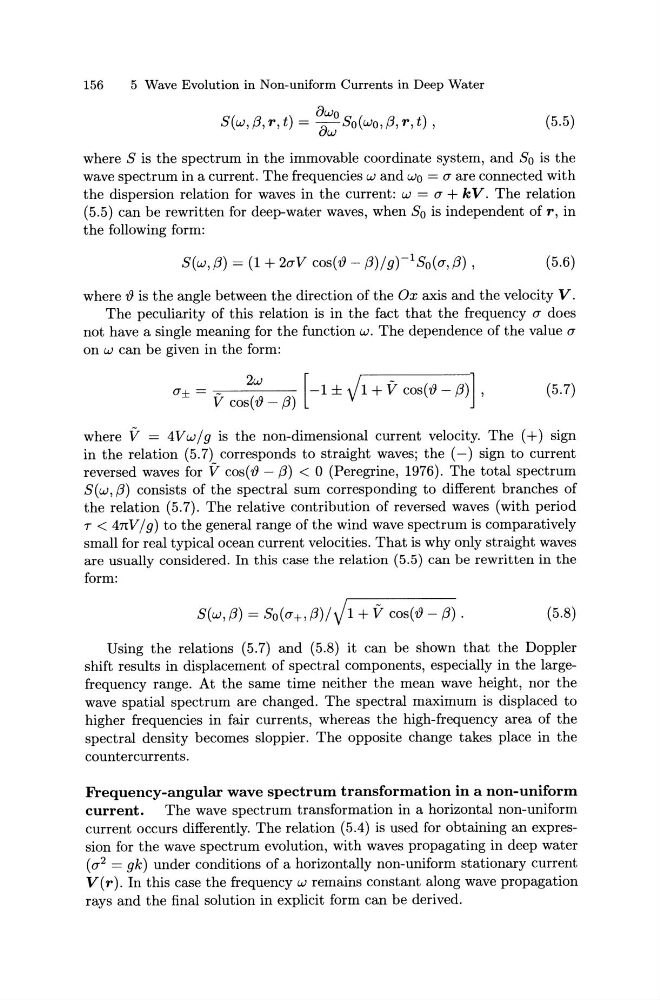
where S is the spectrum in the immovable coordinate system, and So is the
wave spectrum in a current. The frequencies w and w0 = a are connected with
the dispersion relation for waves in the current: w = a+ kV. The relation
(5.5) can be rewritten for deep-water waves, when S0 is independent of r, in
the following form:
S(w,{3) = (1 + 2aV cos(19- f3)/g)- 1 S0 (a,{3),
(5.6)
where 19 is the angle between the direction of the Ox axis and the velocity V.
The peculiarity of this relation is in the fact that the frequency a does
not have a single meaning for the function w. The dependence of the value a
on w can be given in the form:
a±=_
2 w
[-1±V1+Vcos(19-{3)],
V cos( 19 - {3)
(5.7)
where V 4 V w / g is the non-dimensional current velocity. The ( +) sign
in the relation (5. 7) corresponds to straight waves; the (-) sign to current
reversed waves for V cos(19- {3) < 0 (Peregrine, 1976). The total spectrum
S(w, {3) consists of the spectral sum corresponding to different branches of
the relation (5. 7). The relative contribution of reversed waves (with period
T < 4nV/g) to the general range of the wind wave spectrum is comparatively
small for real typical ocean current velocities. That is why only straight waves
are usually considered. In this case the relation (5.5) can be rewritten in the
form:
(5.8)
Using the relations (5.7) and (5.8) it can be shown that the Doppler
shift results in displacement of spectral components, especially in the largefrequency range. At the same time neither the mean wave height, nor the
wave spatial spectrum are changed. The spectral maximum is displaced to
higher frequencies in fair currents, whereas the high-frequency area of the
spectral density becomes sloppier. The opposite change takes place in the
countercurrents.
Frequency-angular wave spectrum transformation in a non-uniform
current. The wave spectrum transformation in a horizontal non-uniform
current occurs differently. The relation (5.4) is used for obtaining an expression for the wave spectrum evolution, with waves propagating in deep water
(a 2 = gk) under conditions of a horizontally non-uniform stationary current
V ( r). In this case the frequency w remains constant along wave propagation
rays and the final solution in explicit form can be derived.
5 Wave Evolution in Non-uniform Currents in Deep Water
8wo
S(w,{3,r,t) = ow S0 (wo,f3,r,t),
(5.5)
where S is the spectrum in the immovable coordinate system, and So is the
wave spectrum in a current. The frequencies w and w0 = a are connected with
the dispersion relation for waves in the current: w = a+ kV. The relation
(5.5) can be rewritten for deep-water waves, when S0 is independent of r, in
the following form:
S(w,{3) = (1 + 2aV cos(19- f3)/g)- 1 S0 (a,{3),
(5.6)
where 19 is the angle between the direction of the Ox axis and the velocity V.
The peculiarity of this relation is in the fact that the frequency a does
not have a single meaning for the function w. The dependence of the value a
on w can be given in the form:
a±=_
2 w
[-1±V1+Vcos(19-{3)],
V cos( 19 - {3)
(5.7)
where V 4 V w / g is the non-dimensional current velocity. The ( +) sign
in the relation (5. 7) corresponds to straight waves; the (-) sign to current
reversed waves for V cos(19- {3) < 0 (Peregrine, 1976). The total spectrum
S(w, {3) consists of the spectral sum corresponding to different branches of
the relation (5. 7). The relative contribution of reversed waves (with period
T < 4nV/g) to the general range of the wind wave spectrum is comparatively
small for real typical ocean current velocities. That is why only straight waves
are usually considered. In this case the relation (5.5) can be rewritten in the
form:
(5.8)
Using the relations (5.7) and (5.8) it can be shown that the Doppler
shift results in displacement of spectral components, especially in the largefrequency range. At the same time neither the mean wave height, nor the
wave spatial spectrum are changed. The spectral maximum is displaced to
higher frequencies in fair currents, whereas the high-frequency area of the
spectral density becomes sloppier. The opposite change takes place in the
countercurrents.
Frequency-angular wave spectrum transformation in a non-uniform
current. The wave spectrum transformation in a horizontal non-uniform
current occurs differently. The relation (5.4) is used for obtaining an expression for the wave spectrum evolution, with waves propagating in deep water
(a 2 = gk) under conditions of a horizontally non-uniform stationary current
V ( r). In this case the frequency w remains constant along wave propagation
rays and the final solution in explicit form can be derived.