

5.2 Frequency-Angular Spectrum Evolution in a Current
155
property was first described by Longuet-Higgins (1957) for the case of spatial
wave spectrum transformation in shallow water.
5.2 Frequency-Angular Spectrum Evolution
in a Current
Expression describing frequency-angular wave spectrum refraction.
The simplest case of the kinetic equation (5.1) is considered, neglecting the
source function in the right-hand side of the equation. The spectral density N
is preserved along the trajectory of wave packet propagation. The problem
of determining N, using the initial conditions N0 (k0 , r 0 , t), is reduced to
integrating the Hamiltonian equations (5.2) and defining the dependencies
k0 = k0 (k, r, t), r 0 = r 0 (k, r, t). In most cases it is possible to solve the set
of equations (5.1) only numerically.
The study proceeds from the wave action spectral density N(k) to the energy spectral density S = S(w, /3), which is dependent on the frequency wand
the angle /3 = arctan(ky/kx)· The transition from one spectral dependence
to another can be easily made applying the dependence between components
of the wave vector k, frequency w and angle /3:
kx = k(w, /3) cos(/3) ; ky = k(w, /3) sin(/3) .
The Jacobian of transition from kx, ky tow, /3 is equal to:
o(kx, ky) = k ok
a(w, /3)
ow .
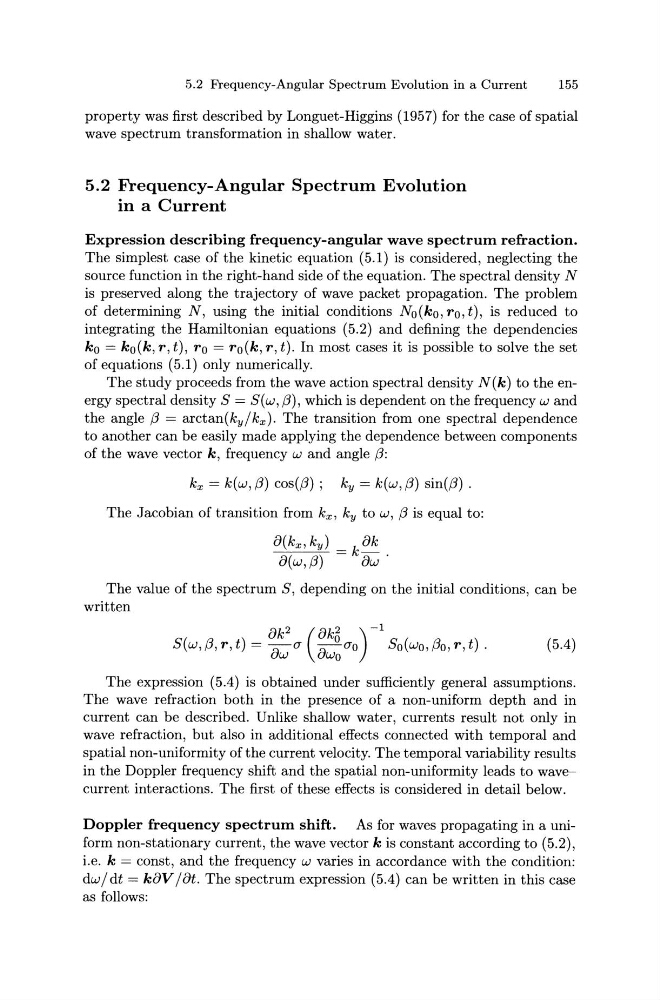
The value of the spectrum S, depending on the initial conditions, can be
written
ok
2
(ak
2
) -
1
S(w, /3, r, t) = ow (T ow~ <:To
S0 (w0 , /30 , r, t) .
(5.4)
The expression (5.4) is obtained under sufficiently general assumptions.
The wave refraction both in the presence of a non-uniform depth and in
current can be described. Unlike shallow water, currents result not only in
wave refraction, but also in additional effects connected with temporal and
spatial non-uniformity of the current velocity. The temporal variability results
in the Doppler frequency shift and the spatial non-uniformity leads to wavecurrent interactions. The first of these effects is considered in detail below.
Doppler frequency spectrum shift. As for waves propagating in a uniform non-stationary current, the wave vector k is constant according to (5.2),
i.e. k = const, and the frequency w varies in accordance with the condition:
dw/ dt = koV jot. The spectrum expression (5.4) can be written in this case
as follows:
155
property was first described by Longuet-Higgins (1957) for the case of spatial
wave spectrum transformation in shallow water.
5.2 Frequency-Angular Spectrum Evolution
in a Current
Expression describing frequency-angular wave spectrum refraction.
The simplest case of the kinetic equation (5.1) is considered, neglecting the
source function in the right-hand side of the equation. The spectral density N
is preserved along the trajectory of wave packet propagation. The problem
of determining N, using the initial conditions N0 (k0 , r 0 , t), is reduced to
integrating the Hamiltonian equations (5.2) and defining the dependencies
k0 = k0 (k, r, t), r 0 = r 0 (k, r, t). In most cases it is possible to solve the set
of equations (5.1) only numerically.
The study proceeds from the wave action spectral density N(k) to the energy spectral density S = S(w, /3), which is dependent on the frequency wand
the angle /3 = arctan(ky/kx)· The transition from one spectral dependence
to another can be easily made applying the dependence between components
of the wave vector k, frequency w and angle /3:
kx = k(w, /3) cos(/3) ; ky = k(w, /3) sin(/3) .
The Jacobian of transition from kx, ky tow, /3 is equal to:
o(kx, ky) = k ok
a(w, /3)
ow .
The value of the spectrum S, depending on the initial conditions, can be
written
ok
2
(ak
2
) -
1
S(w, /3, r, t) = ow (T ow~ <:To
S0 (w0 , /30 , r, t) .
(5.4)
The expression (5.4) is obtained under sufficiently general assumptions.
The wave refraction both in the presence of a non-uniform depth and in
current can be described. Unlike shallow water, currents result not only in
wave refraction, but also in additional effects connected with temporal and
spatial non-uniformity of the current velocity. The temporal variability results
in the Doppler frequency shift and the spatial non-uniformity leads to wavecurrent interactions. The first of these effects is considered in detail below.
Doppler frequency spectrum shift. As for waves propagating in a uniform non-stationary current, the wave vector k is constant according to (5.2),
i.e. k = const, and the frequency w varies in accordance with the condition:
dw/ dt = koV jot. The spectrum expression (5.4) can be written in this case
as follows: