

130
4 Physical Mechanisms Forming the Wave Spectrum in Deep Water
~1
02
~3
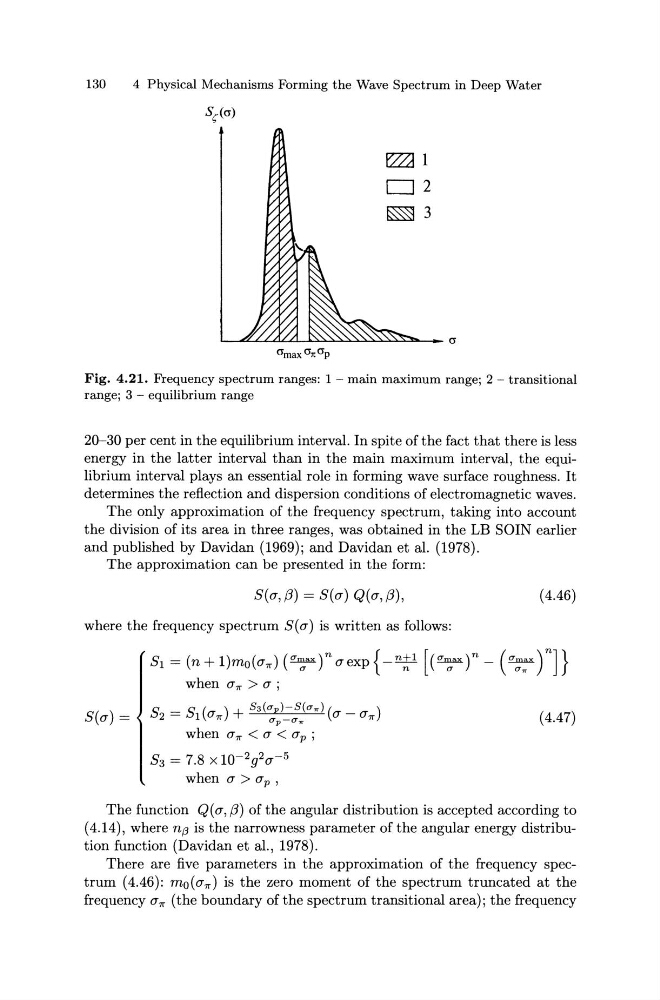
Fig. 4.21. Frequency spectrum ranges: 1 - main maximum range; 2 - transitional
range; 3- equilibrium range
20--30 per cent in the equilibrium interval. In spite of the fact that there is less
energy in the latter interval than in the main maximum interval, the equilibrium interval plays an essential role in forming wave surface roughness. It
determines the reflection and dispersion conditions of electromagnetic waves.
The only approximation of the frequency spectrum, taking into account
the division of its area in three ranges, was obtained in the LB SOIN earlier
and published by Davidan (1969); and Davidan et al. (1978).
The approximation can be presented in the form:
S(a,(3) = S(a) Q(a,(3),
( 4.46)
where the frequency spectrum S(a) is written as follows:
S 1 = ( n + 1) mo (a 7r) ( a ~ax ) n a exp { - n~ 1 [ ( a ~ax ) n _ (a ;;:x ) n J }
when a7r >a;
S(a) = S2 = S1(a1r) + 83 (';'}~:"(a,) (a- a1f)
when a7r < a < ap ;
S3 = 7.8 X 10- 2 g 2 a- 5
when a> ap,
( 4.47)
The function Q( a, (3) of the angular distribution is accepted according to
( 4.14), where np is the narrowness parameter of the angular energy distribution function (Davidan et al., 1978).
There are five parameters in the approximation of the frequency spectrum (4.46): m 0 (a7r) is the zero moment of the spectrum truncated at the
frequency an (the boundary of the spectrum transitional area); the frequency
4 Physical Mechanisms Forming the Wave Spectrum in Deep Water
~1
02
~3
Fig. 4.21. Frequency spectrum ranges: 1 - main maximum range; 2 - transitional
range; 3- equilibrium range
20--30 per cent in the equilibrium interval. In spite of the fact that there is less
energy in the latter interval than in the main maximum interval, the equilibrium interval plays an essential role in forming wave surface roughness. It
determines the reflection and dispersion conditions of electromagnetic waves.
The only approximation of the frequency spectrum, taking into account
the division of its area in three ranges, was obtained in the LB SOIN earlier
and published by Davidan (1969); and Davidan et al. (1978).
The approximation can be presented in the form:
S(a,(3) = S(a) Q(a,(3),
( 4.46)
where the frequency spectrum S(a) is written as follows:
S 1 = ( n + 1) mo (a 7r) ( a ~ax ) n a exp { - n~ 1 [ ( a ~ax ) n _ (a ;;:x ) n J }
when a7r >a;
S(a) = S2 = S1(a1r) + 83 (';'}~:"(a,) (a- a1f)
when a7r < a < ap ;
S3 = 7.8 X 10- 2 g 2 a- 5
when a> ap,
( 4.47)
The function Q( a, (3) of the angular distribution is accepted according to
( 4.14), where np is the narrowness parameter of the angular energy distribution function (Davidan et al., 1978).
There are five parameters in the approximation of the frequency spectrum (4.46): m 0 (a7r) is the zero moment of the spectrum truncated at the
frequency an (the boundary of the spectrum transitional area); the frequency