

88
ANNE- MARIE TR E G UIER
PSY2
FOAM
MFS-MOM
MFS-OPA
Vertical
diffusivity
Background
1. 1 0 - ~ m ~ s - '
3.10-~rn~s-' 3.10-~rn~s-'
Ri dependent
TKE
PP81
none
none
otherSurf.E
KPP+KT67
none
none
Vertical
viscosity
Background
1. 1 0 - ~ m ~ s - '
1.5 l ~ - ~ m ~ s - '
1.5 l ~ - ~ m ~ s - '
Ri dependent
TKE
PP81
none
none
Other
Surf.E
KPP+KT67
Convection
Adjustment
no
Yes
Yes
no
Enhanced mix- 1 m2s-'
1 m2s-I
ing u
Lateral
diffusivity
Hor.
Bihar- 3 109m4s-'
none
1.5 l ~ ' ~ m ~ s - '
3 109m4s-'
monic
Spatial varie IX 6x3
Constant
Constant
t ion
Laplacian
none
100 m2.s-I
none
none
Orientation
hor
is0
hor
hor
slope limitation no
GE91
no
no
Horizontal
background
no
10 m2.s-'
no
no
-
Lateral
viscosity
Biharmonic
9 109m4s-'
2.6 109m4s-'
5 109m4s-'
5 1 0 ~ m ~ s ~ '
Laplacian
none
30 m2.s-'
none
none
Spatial varie IX 6x3
no
no
no
t ion
Bottom
friction
Type
Quadratic
Quadratic
none
quadratic
Coefficient
Cd =1.3 10K3
Cd =1.225 10K3
cd =lo-3
Bottom
boundary
layer
P P ~
none
GOO0
none
none
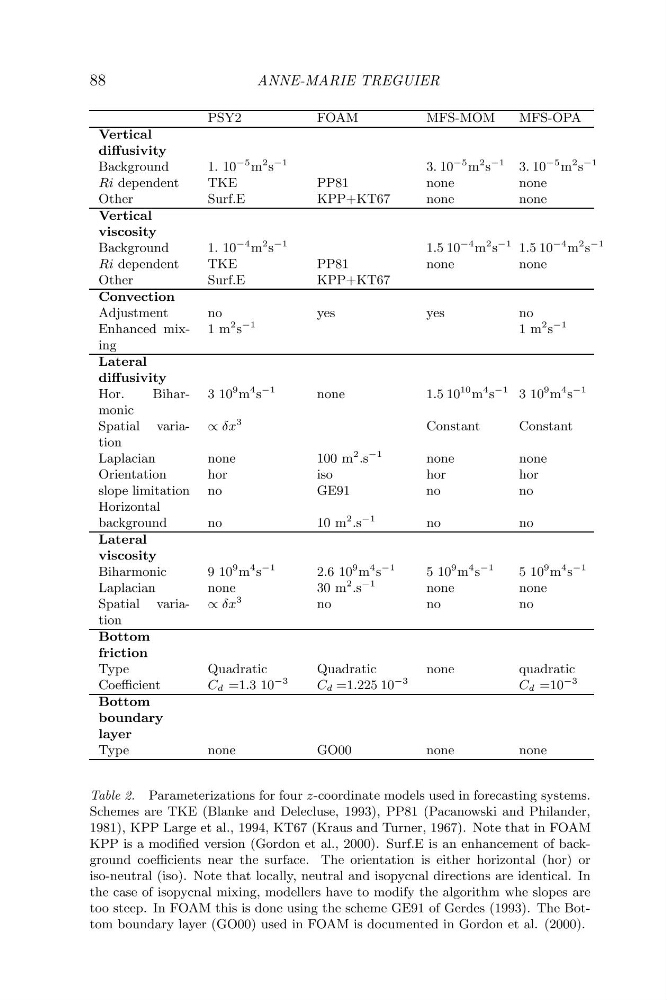
Table 2. Parameterizations for four z-coordinate models used in forecasting systems.
Schemes are TKE (Blanke and Delecluse, 1993), PP81 (Pacanowski and Philander,
1981), KPP Large et al., 1994, KT67 (Kraus and Turner, 1967). Note that in FOAM
KPP is a modified version (Gordon et al., 2000). Surf.E is an enhancement of background coefficients near the surface. The orientation is either horizontal (hor) or
is-neutral (iso). Note that locally, neutral and isopycnal directions are identical. In
the case of isopycnal mixing, modellers have to modify the algorithm whe slopes are
too steep. In FOAM this is done using the scheme GE91 of Gerdes (1993). The Bottom boundary layer (G000) used in FOAM is documented in Gordon et al. (2000).
ANNE- MARIE TR E G UIER
PSY2
FOAM
MFS-MOM
MFS-OPA
Vertical
diffusivity
Background
1. 1 0 - ~ m ~ s - '
3.10-~rn~s-' 3.10-~rn~s-'
Ri dependent
TKE
PP81
none
none
otherSurf.E
KPP+KT67
none
none
Vertical
viscosity
Background
1. 1 0 - ~ m ~ s - '
1.5 l ~ - ~ m ~ s - '
1.5 l ~ - ~ m ~ s - '
Ri dependent
TKE
PP81
none
none
Other
Surf.E
KPP+KT67
Convection
Adjustment
no
Yes
Yes
no
Enhanced mix- 1 m2s-'
1 m2s-I
ing u
Lateral
diffusivity
Hor.
Bihar- 3 109m4s-'
none
1.5 l ~ ' ~ m ~ s - '
3 109m4s-'
monic
Spatial varie IX 6x3
Constant
Constant
t ion
Laplacian
none
100 m2.s-I
none
none
Orientation
hor
is0
hor
hor
slope limitation no
GE91
no
no
Horizontal
background
no
10 m2.s-'
no
no
-
Lateral
viscosity
Biharmonic
9 109m4s-'
2.6 109m4s-'
5 109m4s-'
5 1 0 ~ m ~ s ~ '
Laplacian
none
30 m2.s-'
none
none
Spatial varie IX 6x3
no
no
no
t ion
Bottom
friction
Type
Quadratic
Quadratic
none
quadratic
Coefficient
Cd =1.3 10K3
Cd =1.225 10K3
cd =lo-3
Bottom
boundary
layer
P P ~
none
GOO0
none
none
Table 2. Parameterizations for four z-coordinate models used in forecasting systems.
Schemes are TKE (Blanke and Delecluse, 1993), PP81 (Pacanowski and Philander,
1981), KPP Large et al., 1994, KT67 (Kraus and Turner, 1967). Note that in FOAM
KPP is a modified version (Gordon et al., 2000). Surf.E is an enhancement of background coefficients near the surface. The orientation is either horizontal (hor) or
is-neutral (iso). Note that locally, neutral and isopycnal directions are identical. In
the case of isopycnal mixing, modellers have to modify the algorithm whe slopes are
too steep. In FOAM this is done using the scheme GE91 of Gerdes (1993). The Bottom boundary layer (G000) used in FOAM is documented in Gordon et al. (2000).