

OCEAN MODELS
87
Parameters
PSY2
FOAM
MFS-MOM MFS-OPA
Code
OPA
MOM
MOM
OPA
Time step
δt = 800s
δt =1200s
δt =900s
δt =600s
Domain
N. Atlantic+Med N. Atlantic
Mediterranean
Horizontal grid:
Max δx
7 km
12 km
12 km
6 km
Min δx
3 km
12 km
9.8 km
4.9 km
Vertical grid:
levels
43
20
31
72
Max δz
300 m
615 m
300 m
300 m
Min δz
6 m
10 m
10 m
3 m
Lateral boundary
condition:
partial-slip
no-slip
no-slip
no-slip
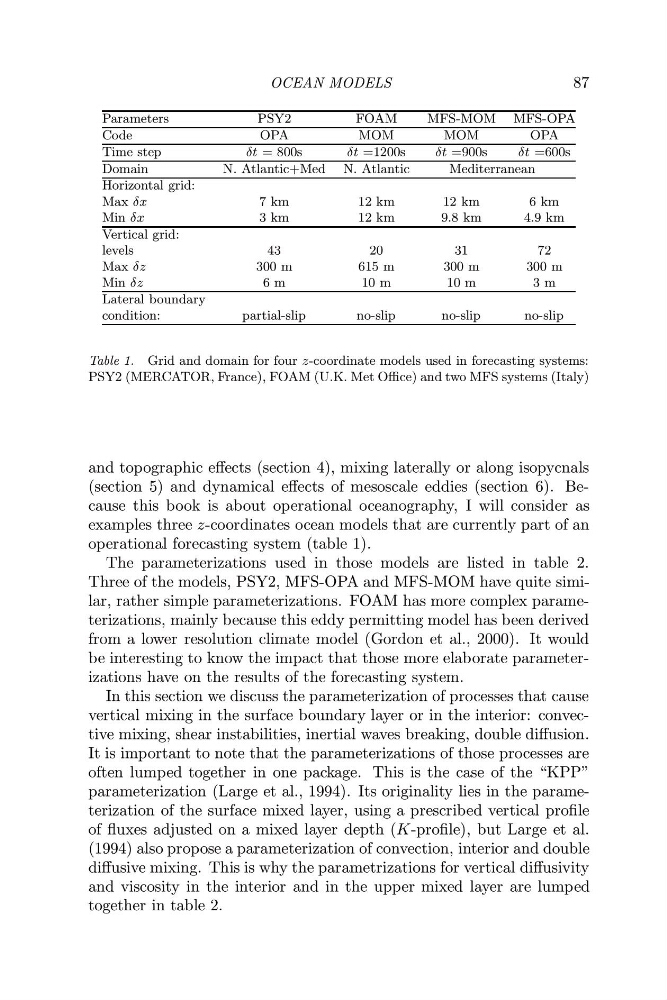
Table 1. Grid and domain for four z-coordinate models used in forecasting systems:
PSY2 (MERCATOR, France), FOAM (U.K. Met Office) and two MFS systems (Italy)
and topographic effects (section 4), mixing laterally or along isopycnals
(section 5) and dynamical effects of mesoscale eddies (section 6). Because this book is about operational oceanography, I will consider as
examples three z-coordinates ocean models that are currently part of an
operational forecasting system (table 1).
The parameterizations used in those models are listed in table 2.
Three of the models, PSY2, MFS-OPA and MFS-MOM have quite similar, rather simple parameterizations. FOAM has more complex parameterizations, mainly because this eddy permitting model has been derived
from a lower resolution climate model (Gordon et al., 2000). It would
be interesting to know the impact that those more elaborate parameterizations have on the results of the forecasting system.
In this section we discuss the parameterization of processes that cause
vertical mixing in the surface boundary layer or in the interior: convective mixing, shear instabilities, inertial waves breaking, double diffusion.
It is important to note that the parameterizations of those processes are
often lumped together in one package. This is the case of the “KPP”
parameterization (Large et al., 1994). Its originality lies in the parameterization of the surface mixed layer, using a prescribed vertical profile
of fluxes adjusted on a mixed layer depth (K-profile), but Large et al.
(1994) also propose a parameterization of convection, interior and double
diffusive mixing. This is why the parametrizations for vertical diffusivity
and viscosity in the interior and in the upper mixed layer are lumped
together in table 2.
87
Parameters
PSY2
FOAM
MFS-MOM MFS-OPA
Code
OPA
MOM
MOM
OPA
Time step
δt = 800s
δt =1200s
δt =900s
δt =600s
Domain
N. Atlantic+Med N. Atlantic
Mediterranean
Horizontal grid:
Max δx
7 km
12 km
12 km
6 km
Min δx
3 km
12 km
9.8 km
4.9 km
Vertical grid:
levels
43
20
31
72
Max δz
300 m
615 m
300 m
300 m
Min δz
6 m
10 m
10 m
3 m
Lateral boundary
condition:
partial-slip
no-slip
no-slip
no-slip
Table 1. Grid and domain for four z-coordinate models used in forecasting systems:
PSY2 (MERCATOR, France), FOAM (U.K. Met Office) and two MFS systems (Italy)
and topographic effects (section 4), mixing laterally or along isopycnals
(section 5) and dynamical effects of mesoscale eddies (section 6). Because this book is about operational oceanography, I will consider as
examples three z-coordinates ocean models that are currently part of an
operational forecasting system (table 1).
The parameterizations used in those models are listed in table 2.
Three of the models, PSY2, MFS-OPA and MFS-MOM have quite similar, rather simple parameterizations. FOAM has more complex parameterizations, mainly because this eddy permitting model has been derived
from a lower resolution climate model (Gordon et al., 2000). It would
be interesting to know the impact that those more elaborate parameterizations have on the results of the forecasting system.
In this section we discuss the parameterization of processes that cause
vertical mixing in the surface boundary layer or in the interior: convective mixing, shear instabilities, inertial waves breaking, double diffusion.
It is important to note that the parameterizations of those processes are
often lumped together in one package. This is the case of the “KPP”
parameterization (Large et al., 1994). Its originality lies in the parameterization of the surface mixed layer, using a prescribed vertical profile
of fluxes adjusted on a mixed layer depth (K-profile), but Large et al.
(1994) also propose a parameterization of convection, interior and double
diffusive mixing. This is why the parametrizations for vertical diffusivity
and viscosity in the interior and in the upper mixed layer are lumped
together in table 2.