

OCEAN MODELS
89
2.1
Local and non-local parameterizations
As reviewed in detail by Large (1998) parameterizations can be classified into local and nonloncal. Local parameterizations following (4)
assume that the eddy fluxes depend on the local properties of the large
scale flow. They are often based on one-dimensional turbulence closure
models, like the TKE model of Blanke and Delecluse (1993). The onedimensional “stand-alone” models are implemented with grid spacing
of order one meter in the vertical; it is unclear how they perform with
the typical grid spacing of ocean models (5-10 m at the surface, quickly
increasing to 20-50 m at 100 m depth). It is important to keep in mind
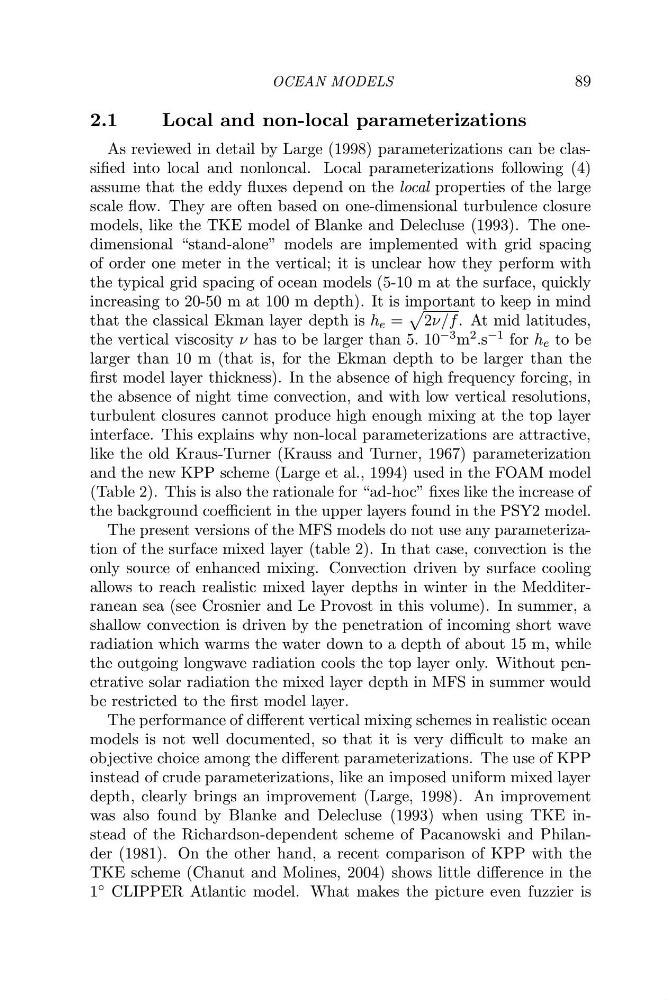
that the classical Ekman layer depth is h e =
2ν/f . At mid latitudes,
the vertical viscosity ν has to be larger than 5. 10 −3 m 2 .s −1 for h e to be
larger than 10 m (that is, for the Ekman depth to be larger than the
first model layer thickness). In the absence of high frequency forcing, in
the absence of night time convection, and with low vertical resolutions,
turbulent closures cannot produce high enough mixing at the top layer
interface. This explains why non-local parameterizations are attractive,
like the old Kraus-Turner (Krauss and Turner, 1967) parameterization
and the new KPP scheme (Large et al., 1994) used in the FOAM model
(Table 2). This is also the rationale for “ad-hoc” fixes like the increase of
the background coefficient in the upper layers found in the PSY2 model.
The present versions of the MFS models do not use any parameterization of the surface mixed layer (table 2). In that case, convection is the
only source of enhanced mixing. Convection driven by surface cooling
allows to reach realistic mixed layer depths in winter in the Medditerranean sea (see Crosnier and Le Provost in this volume). In summer, a
shallow convection is driven by the penetration of incoming short wave
radiation which warms the water down to a depth of about 15 m, while
the outgoing longwave radiation cools the top layer only. Without penetrative solar radiation the mixed layer depth in MFS in summer would
be restricted to the first model layer.
The performance of different vertical mixing schemes in realistic ocean
models is not well documented, so that it is very difficult to make an
objective choice among the different parameterizations. The use of KPP
instead of crude parameterizations, like an imposed uniform mixed layer
depth, clearly brings an improvement (Large, 1998). An improvement
was also found by Blanke and Delecluse (1993) when using TKE instead of the Richardson-dependent scheme of Pacanowski and Philander (1981). On the other hand, a recent comparison of KPP with the
TKE scheme (Chanut and Molines, 2004) shows little difference in the
1 ◦ CLIPPER Atlantic model. What makes the picture even fuzzier is
89
2.1
Local and non-local parameterizations
As reviewed in detail by Large (1998) parameterizations can be classified into local and nonloncal. Local parameterizations following (4)
assume that the eddy fluxes depend on the local properties of the large
scale flow. They are often based on one-dimensional turbulence closure
models, like the TKE model of Blanke and Delecluse (1993). The onedimensional “stand-alone” models are implemented with grid spacing
of order one meter in the vertical; it is unclear how they perform with
the typical grid spacing of ocean models (5-10 m at the surface, quickly
increasing to 20-50 m at 100 m depth). It is important to keep in mind
that the classical Ekman layer depth is h e =
2ν/f . At mid latitudes,
the vertical viscosity ν has to be larger than 5. 10 −3 m 2 .s −1 for h e to be
larger than 10 m (that is, for the Ekman depth to be larger than the
first model layer thickness). In the absence of high frequency forcing, in
the absence of night time convection, and with low vertical resolutions,
turbulent closures cannot produce high enough mixing at the top layer
interface. This explains why non-local parameterizations are attractive,
like the old Kraus-Turner (Krauss and Turner, 1967) parameterization
and the new KPP scheme (Large et al., 1994) used in the FOAM model
(Table 2). This is also the rationale for “ad-hoc” fixes like the increase of
the background coefficient in the upper layers found in the PSY2 model.
The present versions of the MFS models do not use any parameterization of the surface mixed layer (table 2). In that case, convection is the
only source of enhanced mixing. Convection driven by surface cooling
allows to reach realistic mixed layer depths in winter in the Medditerranean sea (see Crosnier and Le Provost in this volume). In summer, a
shallow convection is driven by the penetration of incoming short wave
radiation which warms the water down to a depth of about 15 m, while
the outgoing longwave radiation cools the top layer only. Without penetrative solar radiation the mixed layer depth in MFS in summer would
be restricted to the first model layer.
The performance of different vertical mixing schemes in realistic ocean
models is not well documented, so that it is very difficult to make an
objective choice among the different parameterizations. The use of KPP
instead of crude parameterizations, like an imposed uniform mixed layer
depth, clearly brings an improvement (Large, 1998). An improvement
was also found by Blanke and Delecluse (1993) when using TKE instead of the Richardson-dependent scheme of Pacanowski and Philander (1981). On the other hand, a recent comparison of KPP with the
TKE scheme (Chanut and Molines, 2004) shows little difference in the
1 ◦ CLIPPER Atlantic model. What makes the picture even fuzzier is