

82
ANNE-MARIE TREGUIER
those eddy fluxes, such as the Turbulent Kinetic Energy (TKE) equation. They involve higher order moments of the turbulent variables so
that a “closure hypothesis” is required to solve them: this consists in
using an empirical relationship to express higher moments in term of the
lower-order moments. A classical example of closure model for vertical
mixing in the ocean is provided by Mellor and Yamada (1982). The simplest closure applies to the advection of a passive tracer by homogeneous
and isotropic turbulence. Eddy fluxes in that case can be modelled by
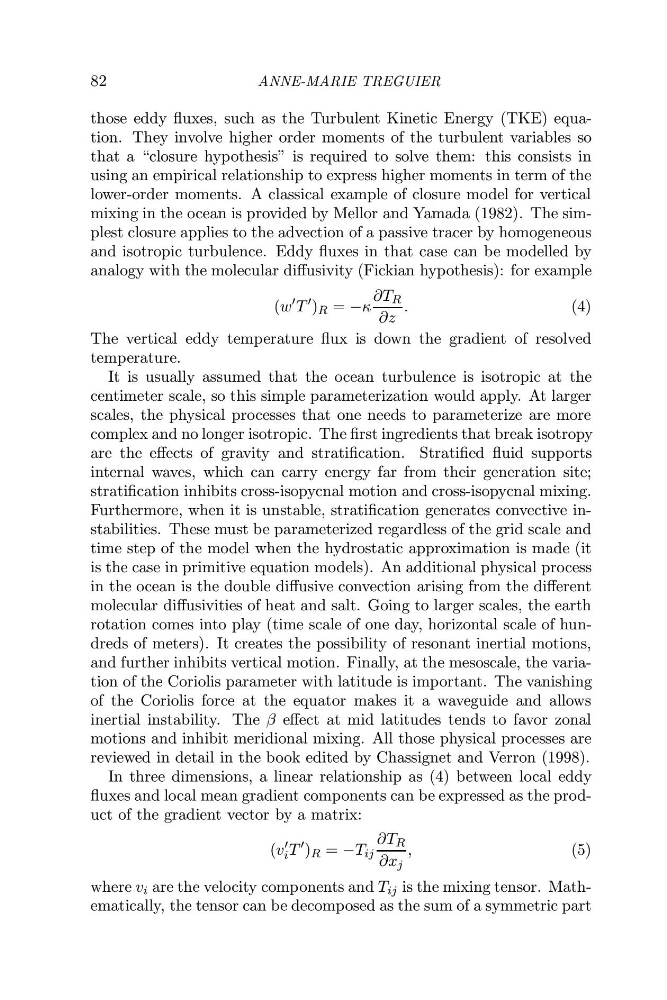
analogy with the molecular diffusivity (Fickian hypothesis): for example
(w
T
) R = −κ
∂T R
∂z
.
(4)
The vertical eddy temperature flux is down the gradient of resolved
temperature.
It is usually assumed that the ocean turbulence is isotropic at the
centimeter scale, so this simple parameterization would apply. At larger
scales, the physical processes that one needs to parameterize are more
complex and no longer isotropic. The first ingredients that break isotropy
are the effects of gravity and stratification. Stratified fluid supports
internal waves, which can carry energy far from their generation site;
stratification inhibits cross-isopycnal motion and cross-isopycnal mixing.
Furthermore, when it is unstable, stratification generates convective instabilities. These must be parameterized regardless of the grid scale and
time step of the model when the hydrostatic approximation is made (it
is the case in primitive equation models). An additional physical process
in the ocean is the double diffusive convection arising from the different
molecular diffusivities of heat and salt. Going to larger scales, the earth
rotation comes into play (time scale of one day, horizontal scale of hundreds of meters). It creates the possibility of resonant inertial motions,
and further inhibits vertical motion. Finally, at the mesoscale, the variation of the Coriolis parameter with latitude is important. The vanishing
of the Coriolis force at the equator makes it a waveguide and allows
inertial instability. The β effect at mid latitudes tends to favor zonal
motions and inhibit meridional mixing. All those physical processes are
reviewed in detail in the book edited by Chassignet and Verron (1998).
In three dimensions, a linear relationship as (4) between local eddy
fluxes and local mean gradient components can be expressed as the product of the gradient vector by a matrix:
(v
i T
) R = −T ij
∂T R
∂x j
,
(5)
where v i are the velocity components and T ij is the mixing tensor. Mathematically, the tensor can be decomposed as the sum of a symmetric part
ANNE-MARIE TREGUIER
those eddy fluxes, such as the Turbulent Kinetic Energy (TKE) equation. They involve higher order moments of the turbulent variables so
that a “closure hypothesis” is required to solve them: this consists in
using an empirical relationship to express higher moments in term of the
lower-order moments. A classical example of closure model for vertical
mixing in the ocean is provided by Mellor and Yamada (1982). The simplest closure applies to the advection of a passive tracer by homogeneous
and isotropic turbulence. Eddy fluxes in that case can be modelled by
analogy with the molecular diffusivity (Fickian hypothesis): for example
(w
T
) R = −κ
∂T R
∂z
.
(4)
The vertical eddy temperature flux is down the gradient of resolved
temperature.
It is usually assumed that the ocean turbulence is isotropic at the
centimeter scale, so this simple parameterization would apply. At larger
scales, the physical processes that one needs to parameterize are more
complex and no longer isotropic. The first ingredients that break isotropy
are the effects of gravity and stratification. Stratified fluid supports
internal waves, which can carry energy far from their generation site;
stratification inhibits cross-isopycnal motion and cross-isopycnal mixing.
Furthermore, when it is unstable, stratification generates convective instabilities. These must be parameterized regardless of the grid scale and
time step of the model when the hydrostatic approximation is made (it
is the case in primitive equation models). An additional physical process
in the ocean is the double diffusive convection arising from the different
molecular diffusivities of heat and salt. Going to larger scales, the earth
rotation comes into play (time scale of one day, horizontal scale of hundreds of meters). It creates the possibility of resonant inertial motions,
and further inhibits vertical motion. Finally, at the mesoscale, the variation of the Coriolis parameter with latitude is important. The vanishing
of the Coriolis force at the equator makes it a waveguide and allows
inertial instability. The β effect at mid latitudes tends to favor zonal
motions and inhibit meridional mixing. All those physical processes are
reviewed in detail in the book edited by Chassignet and Verron (1998).
In three dimensions, a linear relationship as (4) between local eddy
fluxes and local mean gradient components can be expressed as the product of the gradient vector by a matrix:
(v
i T
) R = −T ij
∂T R
∂x j
,
(5)
where v i are the velocity components and T ij is the mixing tensor. Mathematically, the tensor can be decomposed as the sum of a symmetric part