

OCEAN MODELS
8 1
(1997) present such a setting: an aquaplanet (no topography), a dry
atmosphere, with a large scale forcing including prescribed heating and
weak relaxation to a temperature profile. In the ocean it is much more
difficult to find test problems that are relevant to climate. Two similar
problems have been submitted to a convergence test. The first one is the
flat-bottom, quasigeostrophic basin, relevant to the study of the upper
ocean wind forced response (Siege1 et al., 2001). The domain had a width
of 3500 km with six layers in the vertical; the smallest dynamical spatial
scale, the sixth internal Rossby radius, was close to 10 km. The second
test case is a layered model of the North Atlantic (Hurlburt and Hogan,
2000) with 6 layers in the vertical, realistic coastline and topography
restricted to the bottom layer. In both studies the authors still found
significant differences between horizontal resolutions of 3 and 1.5 km
(1/32"and 1/64"), either in energy and potential vorticity fluxes or in
local aspects of the circulation. However, the differences were smaller
than between lower resolution cases (say, between 1/8"and 1/16"), suggesting that the highest resolution cases approached convergence.
It is possible to relate the oceanic case to the atmospheric case considering the different dynamical scales (Rossby radii) in the two fluids.
Boer and Denis (1997) consider in their test case that the dynamics have
converged at T63, that is, a resolution of 1.87" (about 150 km at mid latitudes). This is 18% of the first internal Rossby radius R, which is about
800 km in the atmosphere. An equivalent resolution in the ocean would
be 7 km in the subtropics (R, = 40 km) and 2 km in subpolar regions
(R, = 12 km). Those results suggest that none of today's basin scale
models can be called "eddy resolving" in the subpolar regions, and that
parameterizations should take into account the part of the mesoscale
spectrum that is not resolved.
1.2
Subgrid scale turbulence
The first subgrid scale effects that usually come to mind are those
related to the nonlinear advection terms, that is, the first term on the
rhs of (2). To develop parameterizations one further assumes that
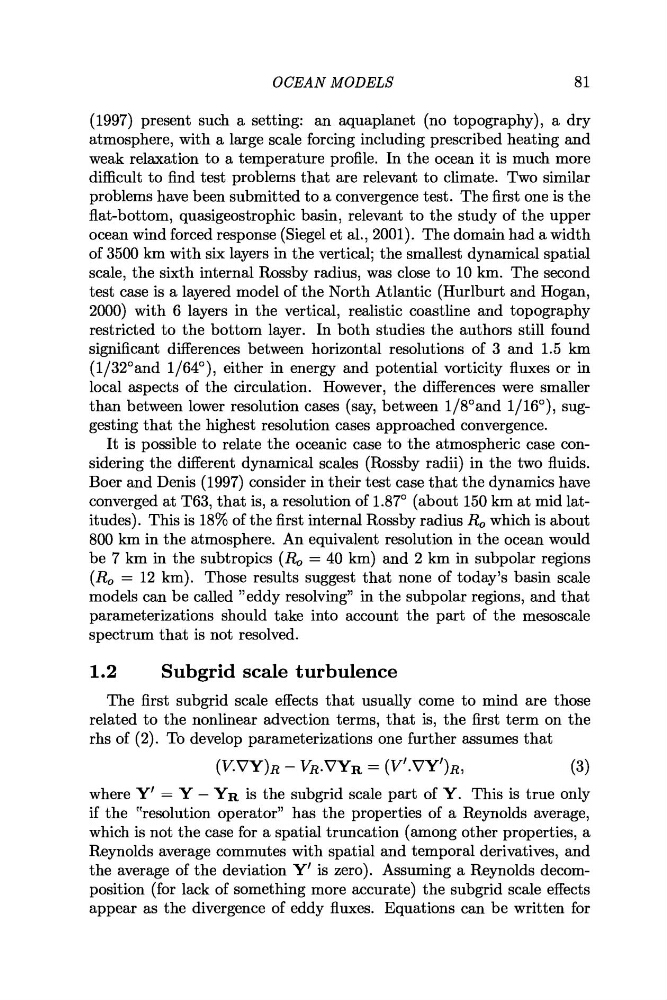
(V.VY)R - VR.VYR = (V'.VY')R,
(3)
where Y' = Y - YR is the subgrid scale part of Y. This is true only
if the "resolution operator" has the properties of a Reynolds average,
which is not the case for a spatial truncation (among other properties, a
Reynolds average commutes with spatial and temporal derivatives, and
the average of the deviation Y' is zero). Assuming a Reynolds decomposition (for lack of something more accurate) the subgrid scale effects
appear as the divergence of eddy fluxes. Equations can be written for
8 1
(1997) present such a setting: an aquaplanet (no topography), a dry
atmosphere, with a large scale forcing including prescribed heating and
weak relaxation to a temperature profile. In the ocean it is much more
difficult to find test problems that are relevant to climate. Two similar
problems have been submitted to a convergence test. The first one is the
flat-bottom, quasigeostrophic basin, relevant to the study of the upper
ocean wind forced response (Siege1 et al., 2001). The domain had a width
of 3500 km with six layers in the vertical; the smallest dynamical spatial
scale, the sixth internal Rossby radius, was close to 10 km. The second
test case is a layered model of the North Atlantic (Hurlburt and Hogan,
2000) with 6 layers in the vertical, realistic coastline and topography
restricted to the bottom layer. In both studies the authors still found
significant differences between horizontal resolutions of 3 and 1.5 km
(1/32"and 1/64"), either in energy and potential vorticity fluxes or in
local aspects of the circulation. However, the differences were smaller
than between lower resolution cases (say, between 1/8"and 1/16"), suggesting that the highest resolution cases approached convergence.
It is possible to relate the oceanic case to the atmospheric case considering the different dynamical scales (Rossby radii) in the two fluids.
Boer and Denis (1997) consider in their test case that the dynamics have
converged at T63, that is, a resolution of 1.87" (about 150 km at mid latitudes). This is 18% of the first internal Rossby radius R, which is about
800 km in the atmosphere. An equivalent resolution in the ocean would
be 7 km in the subtropics (R, = 40 km) and 2 km in subpolar regions
(R, = 12 km). Those results suggest that none of today's basin scale
models can be called "eddy resolving" in the subpolar regions, and that
parameterizations should take into account the part of the mesoscale
spectrum that is not resolved.
1.2
Subgrid scale turbulence
The first subgrid scale effects that usually come to mind are those
related to the nonlinear advection terms, that is, the first term on the
rhs of (2). To develop parameterizations one further assumes that
(V.VY)R - VR.VYR = (V'.VY')R,
(3)
where Y' = Y - YR is the subgrid scale part of Y. This is true only
if the "resolution operator" has the properties of a Reynolds average,
which is not the case for a spatial truncation (among other properties, a
Reynolds average commutes with spatial and temporal derivatives, and
the average of the deviation Y' is zero). Assuming a Reynolds decomposition (for lack of something more accurate) the subgrid scale effects
appear as the divergence of eddy fluxes. Equations can be written for