

80
ANNE-MARIE TREGUIER
The model solves for YR which is the resolved state of the ocean, on
spatial scales of a grid cell, at discrete times. Using the terminology of
Boer and Denis (1997), YR results from applying a "numeric resolution"
operator
to the state vector Y. The definition of the "resolvedyy
scales involves some kind of averaging: appropriate averaging operators
for ocean dynamics are discussed extensively by Griffies (2004). Let us
apply the operator
to (1):
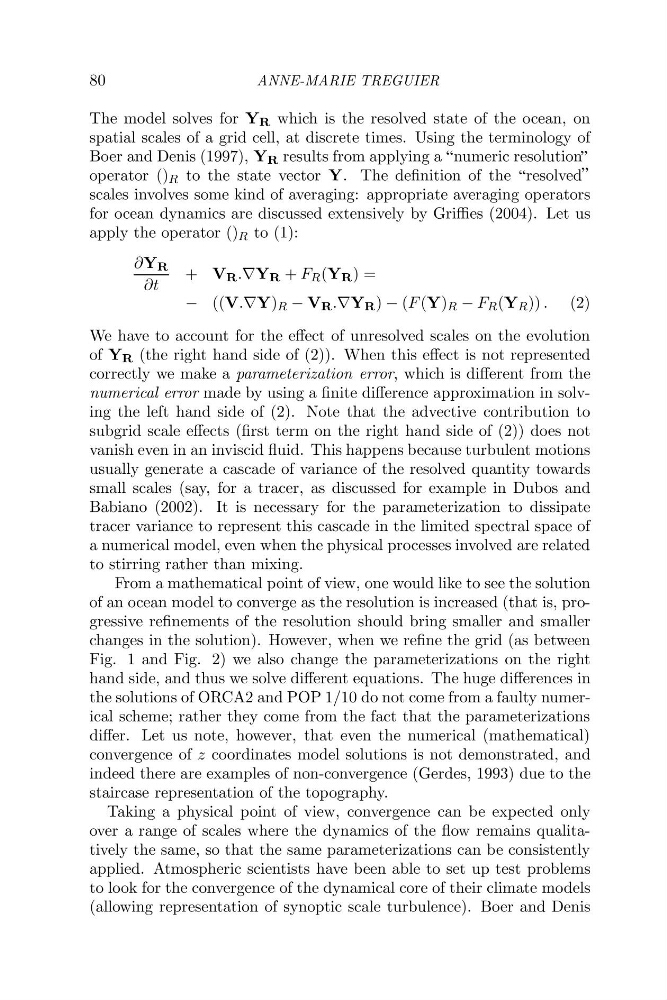
We have to account for the effect of unresolved scales on the evolution
of YR (the right hand side of (2)). When this effect is not represented
correctly we make a parameterization e m r , which is different from the
numerical error made by using a finite difference approximation in solving the left hand side of (2). Note that the advective contribution to
subgrid scale effects (first term on the right hand side of (2)) does not
vanish even in an inviscid fluid. This happens because turbulent motions
usually generate a cascade of variance of the resolved quantity towards
small scales (say, for a tracer, as discussed for example in Dubos and
Babiano (2002). It is necessary for the parameterization to dissipate
tracer variance to represent this cascade in the limited spectral space of
a numerical model, even when the physical processes involved are related
to stirring rather than mixing.
From a mathematical point of view, one would like to see the solution
of an ocean model to converge as the resolution is increased (that is, progressive refinements of the resolution should bring smaller and smaller
changes in the solution). However, when we refine the grid (as between
Fig. 1 and Fig. 2) we also change the parameterizations on the right
hand side, and thus we solve different equations. The huge differences in
the solutions of ORCA2 and POP 1/10 do not come from a faulty numerical scheme; rather they come from the fact that the parameterizations
differ. Let us note, however, that even the numerical (mathematical)
convergence of z coordinates model solutions is not demonstrated, and
indeed there are examples of non-convergence (Gerdes, 1993) due to the
staircase representation of the topography.
Taking a physical point of view, convergence can be expected only
over a range of scales where the dynamics of the flow remains qualitatively the same, so that the same parameterizations can be consistently
applied. Atmospheric scientists have been able to set up test problems
to look for the convergence of the dynamical core of their climate models
(allowing representation of synoptic scale turbulence). Boer and Denis
ANNE-MARIE TREGUIER
The model solves for YR which is the resolved state of the ocean, on
spatial scales of a grid cell, at discrete times. Using the terminology of
Boer and Denis (1997), YR results from applying a "numeric resolution"
operator
to the state vector Y. The definition of the "resolvedyy
scales involves some kind of averaging: appropriate averaging operators
for ocean dynamics are discussed extensively by Griffies (2004). Let us
apply the operator
to (1):
We have to account for the effect of unresolved scales on the evolution
of YR (the right hand side of (2)). When this effect is not represented
correctly we make a parameterization e m r , which is different from the
numerical error made by using a finite difference approximation in solving the left hand side of (2). Note that the advective contribution to
subgrid scale effects (first term on the right hand side of (2)) does not
vanish even in an inviscid fluid. This happens because turbulent motions
usually generate a cascade of variance of the resolved quantity towards
small scales (say, for a tracer, as discussed for example in Dubos and
Babiano (2002). It is necessary for the parameterization to dissipate
tracer variance to represent this cascade in the limited spectral space of
a numerical model, even when the physical processes involved are related
to stirring rather than mixing.
From a mathematical point of view, one would like to see the solution
of an ocean model to converge as the resolution is increased (that is, progressive refinements of the resolution should bring smaller and smaller
changes in the solution). However, when we refine the grid (as between
Fig. 1 and Fig. 2) we also change the parameterizations on the right
hand side, and thus we solve different equations. The huge differences in
the solutions of ORCA2 and POP 1/10 do not come from a faulty numerical scheme; rather they come from the fact that the parameterizations
differ. Let us note, however, that even the numerical (mathematical)
convergence of z coordinates model solutions is not demonstrated, and
indeed there are examples of non-convergence (Gerdes, 1993) due to the
staircase representation of the topography.
Taking a physical point of view, convergence can be expected only
over a range of scales where the dynamics of the flow remains qualitatively the same, so that the same parameterizations can be consistently
applied. Atmospheric scientists have been able to set up test problems
to look for the convergence of the dynamical core of their climate models
(allowing representation of synoptic scale turbulence). Boer and Denis