

78
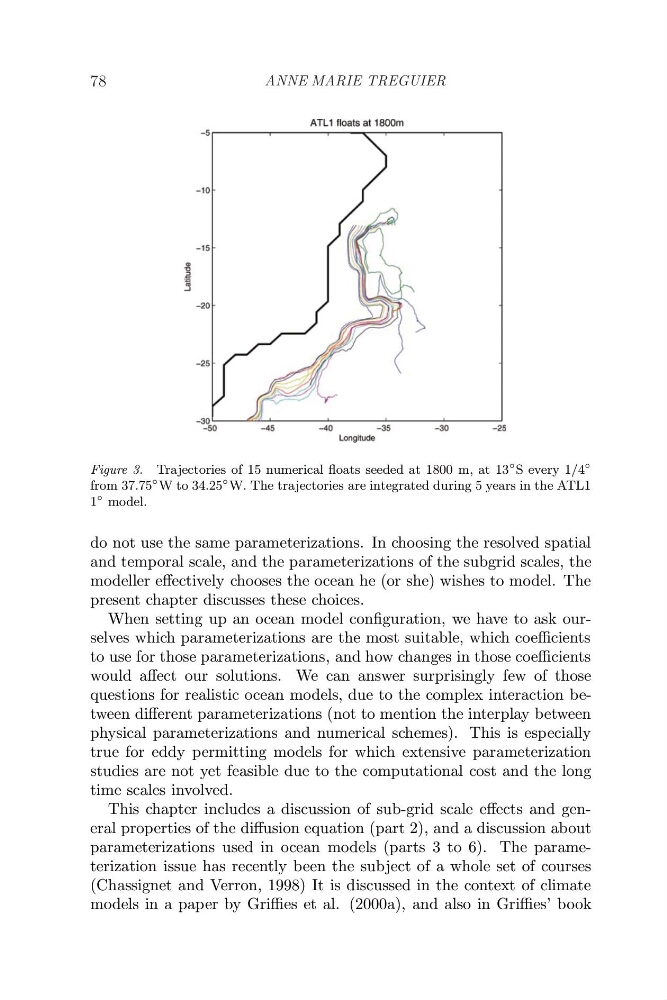
Figure 3. Trajectories of 15 numerical floats seeded at 1800 m, at 13
◦ S every 1/4
◦
from 37.75
◦ W to 34.25
◦ W. The trajectories are integrated during 5 years in the ATL1
1
◦ model.
do not use the same parameterizations. In choosing the resolved spatial
and temporal scale, and the parameterizations of the subgrid scales, the
modeller effectively chooses the ocean he (or she) wishes to model. The
present chapter discusses these choices.
When setting up an ocean model configuration, we have to ask ourselves which parameterizations are the most suitable, which coefficients
to use for those parameterizations, and how changes in those coefficients
would affect our solutions. We can answer surprisingly few of those
questions for realistic ocean models, due to the complex interaction between different parameterizations (not to mention the interplay between
physical parameterizations and numerical schemes). This is especially
true for eddy permitting models for which extensive parameterization
studies are not yet feasible due to the computational cost and the long
time scales involved.
This chapter includes a discussion of sub-grid scale effects and general properties of the diffusion equation (part 2), and a discussion about
parameterizations used in ocean models (parts 3 to 6). The parameterization issue has recently been the subject of a whole set of courses
(Chassignet and Verron, 1998) It is discussed in the context of climate
models in a paper by Griffies et al. (2000a), and also in Griffies’ book
ANNE MARIE TREGUIER
Figure 3. Trajectories of 15 numerical floats seeded at 1800 m, at 13
◦ S every 1/4
◦
from 37.75
◦ W to 34.25
◦ W. The trajectories are integrated during 5 years in the ATL1
1
◦ model.
do not use the same parameterizations. In choosing the resolved spatial
and temporal scale, and the parameterizations of the subgrid scales, the
modeller effectively chooses the ocean he (or she) wishes to model. The
present chapter discusses these choices.
When setting up an ocean model configuration, we have to ask ourselves which parameterizations are the most suitable, which coefficients
to use for those parameterizations, and how changes in those coefficients
would affect our solutions. We can answer surprisingly few of those
questions for realistic ocean models, due to the complex interaction between different parameterizations (not to mention the interplay between
physical parameterizations and numerical schemes). This is especially
true for eddy permitting models for which extensive parameterization
studies are not yet feasible due to the computational cost and the long
time scales involved.
This chapter includes a discussion of sub-grid scale effects and general properties of the diffusion equation (part 2), and a discussion about
parameterizations used in ocean models (parts 3 to 6). The parameterization issue has recently been the subject of a whole set of courses
(Chassignet and Verron, 1998) It is discussed in the context of climate
models in a paper by Griffies et al. (2000a), and also in Griffies’ book
ANNE MARIE TREGUIER