

OCEAN MODELS
77
−60
−50
−40
−30
−20
−10
0
10
20
−70
−60
−50
−40
−30
−20
−10
Longitude
Latitude
Sea surface height, POP 1/10
0. 1
−0. 1
−0.1
−0.2
−1 .9
−2
− 1 . 3
− 0 . 3
− 1 .6
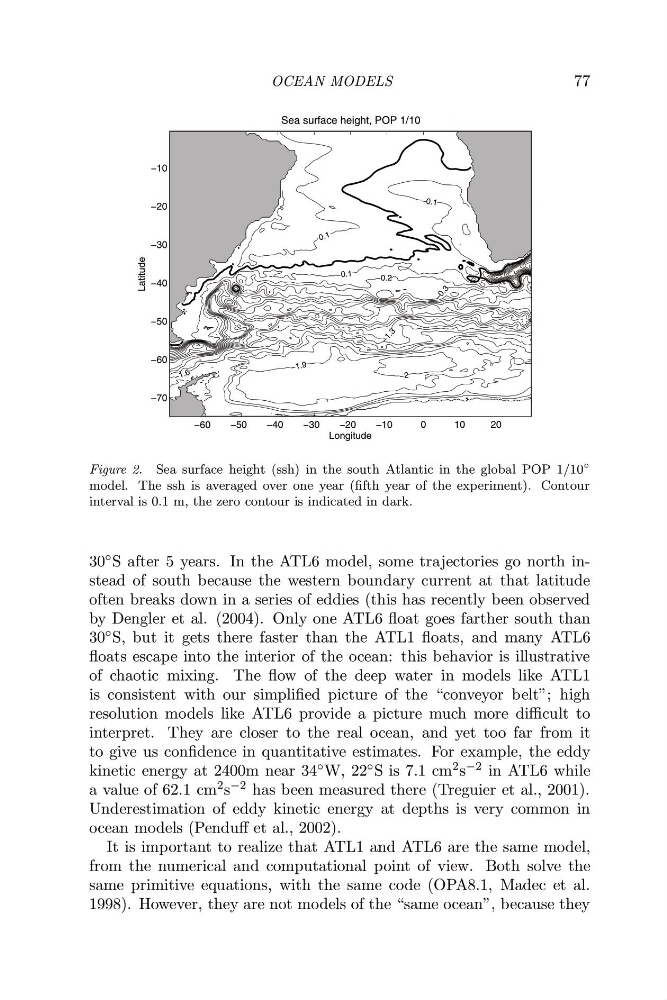
Figure 2. Sea surface height (ssh) in the south Atlantic in the global POP 1/10
◦
model. The ssh is averaged over one year (fifth year of the experiment). Contour
interval is 0.1 m, the zero contour is indicated in dark.
30 ◦ S after 5 years. In the ATL6 model, some trajectories go north instead of south because the western boundary current at that latitude
often breaks down in a series of eddies (this has recently been observed
by Dengler et al. (2004). Only one ATL6 float goes farther south than
30 ◦ S, but it gets there faster than the ATL1 floats, and many ATL6
floats escape into the interior of the ocean: this behavior is illustrative
of chaotic mixing. The flow of the deep water in models like ATL1
is consistent with our simplified picture of the “conveyor belt”; high
resolution models like ATL6 provide a picture much more difficult to
interpret. They are closer to the real ocean, and yet too far from it
to give us confidence in quantitative estimates. For example, the eddy
kinetic energy at 2400m near 34 ◦ W, 22 ◦ S is 7.1 cm 2 s −2 in ATL6 while
a value of 62.1 cm 2 s −2 has been measured there (Treguier et al., 2001).
Underestimation of eddy kinetic energy at depths is very common in
ocean models (Penduff et al., 2002).
It is important to realize that ATL1 and ATL6 are the same model,
from the numerical and computational point of view. Both solve the
same primitive equations, with the same code (OPA8.1, Madec et al.
1998). However, they are not models of the “same ocean”, because they
77
−60
−50
−40
−30
−20
−10
0
10
20
−70
−60
−50
−40
−30
−20
−10
Longitude
Latitude
Sea surface height, POP 1/10
0. 1
−0. 1
−0.1
−0.2
−1 .9
−2
− 1 . 3
− 0 . 3
− 1 .6
Figure 2. Sea surface height (ssh) in the south Atlantic in the global POP 1/10
◦
model. The ssh is averaged over one year (fifth year of the experiment). Contour
interval is 0.1 m, the zero contour is indicated in dark.
30 ◦ S after 5 years. In the ATL6 model, some trajectories go north instead of south because the western boundary current at that latitude
often breaks down in a series of eddies (this has recently been observed
by Dengler et al. (2004). Only one ATL6 float goes farther south than
30 ◦ S, but it gets there faster than the ATL1 floats, and many ATL6
floats escape into the interior of the ocean: this behavior is illustrative
of chaotic mixing. The flow of the deep water in models like ATL1
is consistent with our simplified picture of the “conveyor belt”; high
resolution models like ATL6 provide a picture much more difficult to
interpret. They are closer to the real ocean, and yet too far from it
to give us confidence in quantitative estimates. For example, the eddy
kinetic energy at 2400m near 34 ◦ W, 22 ◦ S is 7.1 cm 2 s −2 in ATL6 while
a value of 62.1 cm 2 s −2 has been measured there (Treguier et al., 2001).
Underestimation of eddy kinetic energy at depths is very common in
ocean models (Penduff et al., 2002).
It is important to realize that ATL1 and ATL6 are the same model,
from the numerical and computational point of view. Both solve the
same primitive equations, with the same code (OPA8.1, Madec et al.
1998). However, they are not models of the “same ocean”, because they