

562
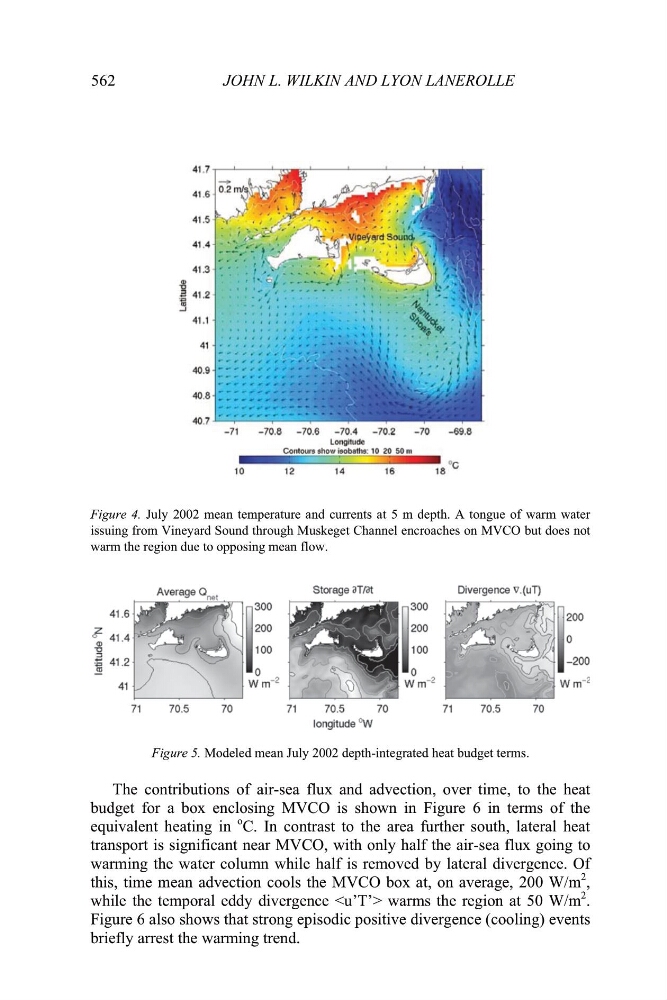
Figure 4. July 2002 mean temperature and currents at 5 m depth. A tongue of warm water
issuing from Vineyard Sound through Muskeget Channel encroaches on MVCO but does not
warm the region due to opposing mean flow.
Figure 5. Modeled mean July 2002 depth-integrated heat budget terms.
The contributions of air-sea flux and advection, over time, to the heat
budget for a box enclosing MVCO is shown in Figure 6 in terms of the
equivalent heating in
o
C. In contrast to the area further south, lateral heat
transport is significant near MVCO, with only half the air-sea flux going to
warming the water column while half is removed by lateral divergence. Of
this, time mean advection cools the MVCO box at, on average, 200 W/m
2 ,
2
Figure 6 also shows that strong episodic positive divergence (cooling) events
briefly arrest the warming trend.
JOHN L. WILKIN AND LYON LANEROLLE
while the temporal eddy divergence warms the region at 50 W/m .
Figure 4. July 2002 mean temperature and currents at 5 m depth. A tongue of warm water
issuing from Vineyard Sound through Muskeget Channel encroaches on MVCO but does not
warm the region due to opposing mean flow.
Figure 5. Modeled mean July 2002 depth-integrated heat budget terms.
The contributions of air-sea flux and advection, over time, to the heat
budget for a box enclosing MVCO is shown in Figure 6 in terms of the
equivalent heating in
o
C. In contrast to the area further south, lateral heat
transport is significant near MVCO, with only half the air-sea flux going to
warming the water column while half is removed by lateral divergence. Of
this, time mean advection cools the MVCO box at, on average, 200 W/m
2 ,
2
Figure 6 also shows that strong episodic positive divergence (cooling) events
briefly arrest the warming trend.
JOHN L. WILKIN AND LYON LANEROLLE
while the temporal eddy divergence