

FORECASTING DRIFT
511
Allen and Plourde, 1999 have assembled tables of the leeway parameters for 63 leeway categories of floating object. These tables consist of
the linear regression coefficients, and their standard deviations, for each
of the 63 categories. They are mainly based on observations and field
experiments, although some of the values have been extracted by converting values derived from other ways of calculating the off-wind drift
of a floating object.
In implementing the leeway drift in the met.no operational service,
the DWL and CWL components are calculated in a straightforward manner from the linear regression formulae as functions of the wind speed,
once the object type is specified. The standard deviations are used in
estimating the uncertainty in the drift speed and direction. An interesting result of the field experiments is that both positive and negative
values of the CWL component can occur for a given category of objects.
Apparently, small differences in the initial orientation of the object relative to the wind can result in the object drifting either to the left or
to the right of the wind direction, with about the same likelihood. The
initial orientation is normally unknown, so the prediction is obliged to
account for both possibilities.
2.2
Ship drift
The drift of ships has been approached in a different, more analytical
manner, based on knowledge from marine architecture and hydrodynamics. The ship drift model at met.no is based on work at Det norske
Veritas (DnV), reported by Sørg˚ ard and Vada, 1998 in which estimates
of the wind and wave-generated forces acting on the vessel, rather than
empirical regressions, are used to calculate the velocity relative to the
water (V rel ). The advantage of this approach is, of course, that knowledge of the object may be reduced to a few key parameters.
Case studies by Sørg˚ ard and Vada, 1998 show that the relative drift
speed of the ship will increase rapidly (in a matter of 2-10 minutes)
towards a stationary solution. Therefore it is not necessary to integrate
the acceleration over time when the relative drift speed is calculated for
simulations over several hours or more; the stationary solution may be
applied to good approximation. This means among other things that it
is not necessary to know the mass of the ship.
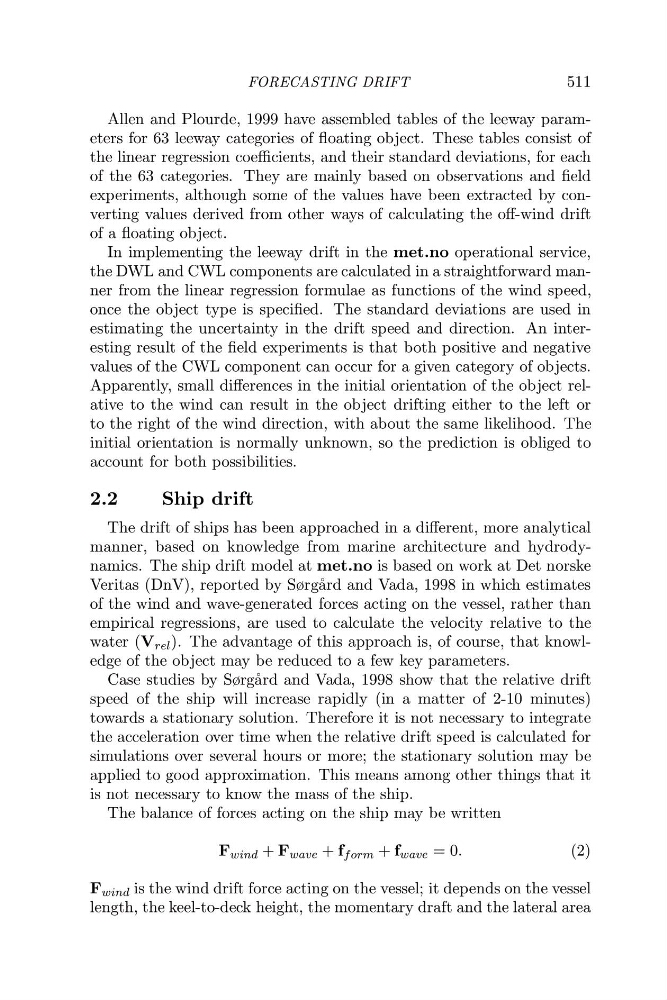
The balance of forces acting on the ship may be written
F wind + F wave + f form + f wave = 0.
(2)
F wind is the wind drift force acting on the vessel; it depends on the vessel
length, the keel-to-deck height, the momentary draft and the lateral area
511
Allen and Plourde, 1999 have assembled tables of the leeway parameters for 63 leeway categories of floating object. These tables consist of
the linear regression coefficients, and their standard deviations, for each
of the 63 categories. They are mainly based on observations and field
experiments, although some of the values have been extracted by converting values derived from other ways of calculating the off-wind drift
of a floating object.
In implementing the leeway drift in the met.no operational service,
the DWL and CWL components are calculated in a straightforward manner from the linear regression formulae as functions of the wind speed,
once the object type is specified. The standard deviations are used in
estimating the uncertainty in the drift speed and direction. An interesting result of the field experiments is that both positive and negative
values of the CWL component can occur for a given category of objects.
Apparently, small differences in the initial orientation of the object relative to the wind can result in the object drifting either to the left or
to the right of the wind direction, with about the same likelihood. The
initial orientation is normally unknown, so the prediction is obliged to
account for both possibilities.
2.2
Ship drift
The drift of ships has been approached in a different, more analytical
manner, based on knowledge from marine architecture and hydrodynamics. The ship drift model at met.no is based on work at Det norske
Veritas (DnV), reported by Sørg˚ ard and Vada, 1998 in which estimates
of the wind and wave-generated forces acting on the vessel, rather than
empirical regressions, are used to calculate the velocity relative to the
water (V rel ). The advantage of this approach is, of course, that knowledge of the object may be reduced to a few key parameters.
Case studies by Sørg˚ ard and Vada, 1998 show that the relative drift
speed of the ship will increase rapidly (in a matter of 2-10 minutes)
towards a stationary solution. Therefore it is not necessary to integrate
the acceleration over time when the relative drift speed is calculated for
simulations over several hours or more; the stationary solution may be
applied to good approximation. This means among other things that it
is not necessary to know the mass of the ship.
The balance of forces acting on the ship may be written
F wind + F wave + f form + f wave = 0.
(2)
F wind is the wind drift force acting on the vessel; it depends on the vessel
length, the keel-to-deck height, the momentary draft and the lateral area