

510
BRUCE HACKETT ET AL.
some 10's of meters), where wave forces may be ignored and wind forces
are of variable importance, depending on the ovenvater structure of the
object. Objects in this class include wreckage, bodies, rafts, small craft,
etc. Drift due to wind forces is commonly referred to as leeway drift, also
called the windage. The other module is for larger objects - conveniently
lumped together under the heading of "ships" - where both wind and
wave forces on the object must be taken into account.
2.1
Leeway drift
The maritime term leeway refers to an object's motion relative to
the wind. It is well known that, due to the asymmetry of almost any
floating object, there will be a net side force causing the object to drift
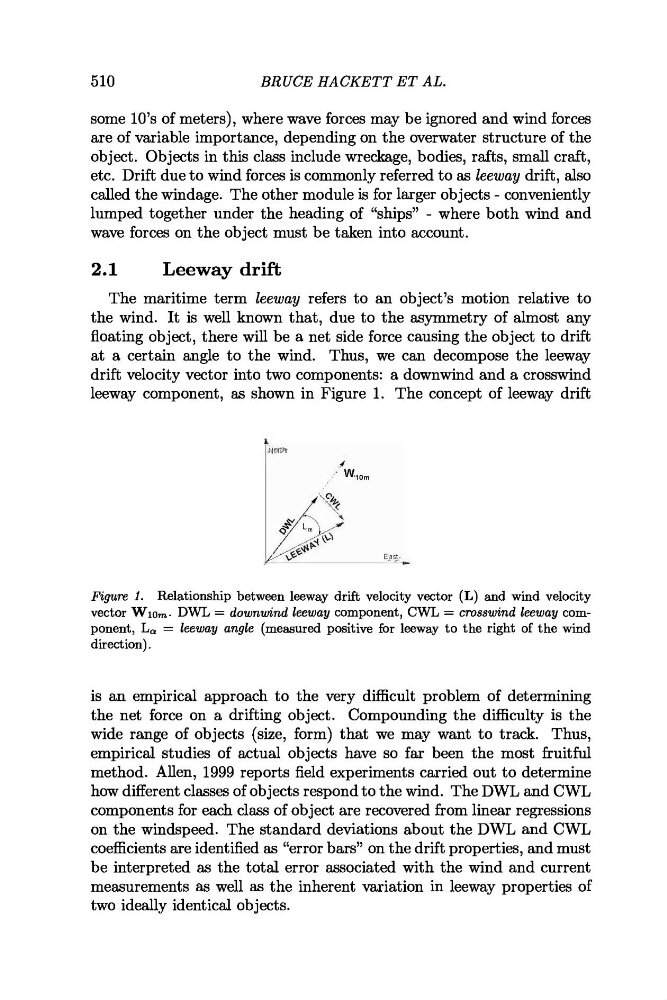
at a certain angle to the wind. Thus, we can decompose the leeway
drift velocity vector into two components: a downwind and a crosswind
leeway component, as shown in Figure 1. The concept of leeway drift
Figum 1. Relationship between leeway drift velocity vector (L) and wind velocity
vector Wlo,. DWL = downwind leeway component, CWL = crosswind leeway component, L, = leeway angle (measured positive for leeway to the right of the wind
direction).
is an empirical approach to the very difficult problem of determining
the net force on a drifting object. Compounding the difficulty is the
wide range of objects (size, form) that we may want to track. Thus,
empirical studies of actual objects have so far been the most fruitful
method. Allen, 1999 reports field experiments carried out to determine
how different classes of objects respond to the wind. The DWL and CWL
components for each class of object are recovered from linear regressions
on the windspeed. The standard deviations about the DWL and CWL
coefficients are identified as "error bars" on the drift properties, and must
be interpreted as the total error associated with the wind and current
measurements as well as the inherent variation in leeway properties of
two ideally identical objects.
BRUCE HACKETT ET AL.
some 10's of meters), where wave forces may be ignored and wind forces
are of variable importance, depending on the ovenvater structure of the
object. Objects in this class include wreckage, bodies, rafts, small craft,
etc. Drift due to wind forces is commonly referred to as leeway drift, also
called the windage. The other module is for larger objects - conveniently
lumped together under the heading of "ships" - where both wind and
wave forces on the object must be taken into account.
2.1
Leeway drift
The maritime term leeway refers to an object's motion relative to
the wind. It is well known that, due to the asymmetry of almost any
floating object, there will be a net side force causing the object to drift
at a certain angle to the wind. Thus, we can decompose the leeway
drift velocity vector into two components: a downwind and a crosswind
leeway component, as shown in Figure 1. The concept of leeway drift
Figum 1. Relationship between leeway drift velocity vector (L) and wind velocity
vector Wlo,. DWL = downwind leeway component, CWL = crosswind leeway component, L, = leeway angle (measured positive for leeway to the right of the wind
direction).
is an empirical approach to the very difficult problem of determining
the net force on a drifting object. Compounding the difficulty is the
wide range of objects (size, form) that we may want to track. Thus,
empirical studies of actual objects have so far been the most fruitful
method. Allen, 1999 reports field experiments carried out to determine
how different classes of objects respond to the wind. The DWL and CWL
components for each class of object are recovered from linear regressions
on the windspeed. The standard deviations about the DWL and CWL
coefficients are identified as "error bars" on the drift properties, and must
be interpreted as the total error associated with the wind and current
measurements as well as the inherent variation in leeway properties of
two ideally identical objects.