

478
JOHN HARDING AND JAMES RIGNEY
directionally depending if acoustic propagation is along or across crests.
Sperry et al. (2003) describe “interesting time-and-range-variable population
of the acoustic normal modes” due to tidally generated soliton packets in the
shelf-slope region off the eastern United States. Ramp et al. (2002) present
the interesting result that some of the largest soliton signals in the
northeastern South China Sea are generated, not locally in the South China
Sea but in the Luzon Strait, another example of the importance of remote
forcing. NAVOCEANO, in partnership with ONR and Dave Fratantoni of
Woods Hole Oceanographic Institution, deployed Slocum Gliders in the
Philippine Sea in 2004. They found internal waves to be a notable temporal
signal in the upper ocean thermal structure in the open western Pacific with
significant impact on the sound speed structure of the upper ocean (Lorens,
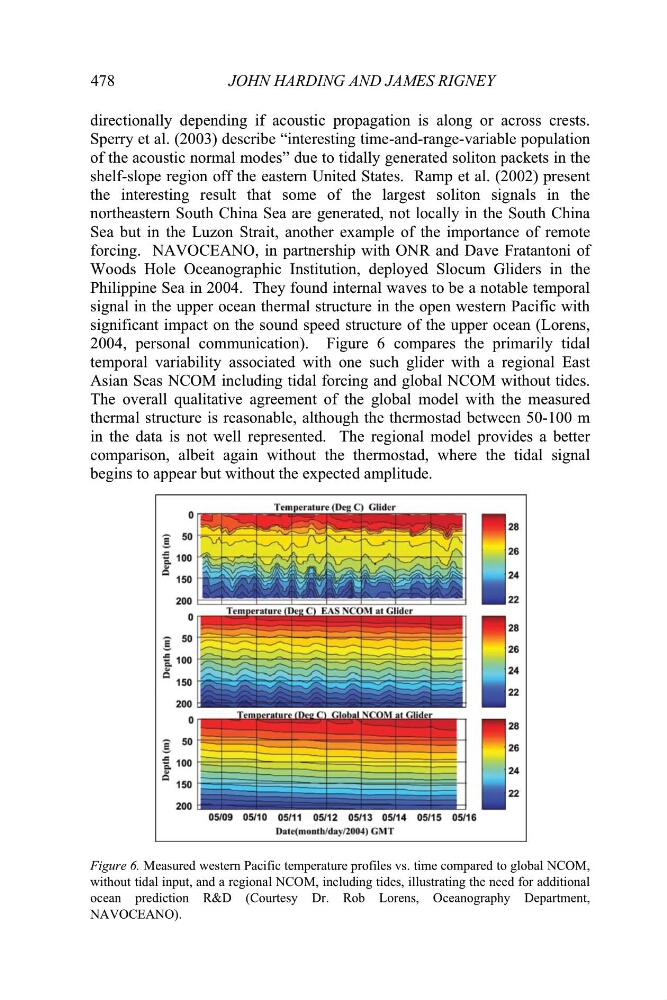
2004, personal communication). Figure 6 compares the primarily tidal
temporal variability associated with one such glider with a regional East
Asian Seas NCOM including tidal forcing and global NCOM without tides.
The overall qualitative agreement of the global model with the measured
thermal structure is reasonable, although the thermostad between 50-100 m
in the data is not well represented. The regional model provides a better
comparison, albeit again without the thermostad, where the tidal signal
begins to appear but without the expected amplitude.
Figure 6. Measured western Pacific temperature profiles vs. time compared to global NCOM,
without tidal input, and a regional NCOM, including tides, illustrating the need for additional
ocean prediction R&D (Courtesy Dr. Rob Lorens, Oceanography Department,
NAVOCEANO).
JOHN HARDING AND JAMES RIGNEY
directionally depending if acoustic propagation is along or across crests.
Sperry et al. (2003) describe “interesting time-and-range-variable population
of the acoustic normal modes” due to tidally generated soliton packets in the
shelf-slope region off the eastern United States. Ramp et al. (2002) present
the interesting result that some of the largest soliton signals in the
northeastern South China Sea are generated, not locally in the South China
Sea but in the Luzon Strait, another example of the importance of remote
forcing. NAVOCEANO, in partnership with ONR and Dave Fratantoni of
Woods Hole Oceanographic Institution, deployed Slocum Gliders in the
Philippine Sea in 2004. They found internal waves to be a notable temporal
signal in the upper ocean thermal structure in the open western Pacific with
significant impact on the sound speed structure of the upper ocean (Lorens,
2004, personal communication). Figure 6 compares the primarily tidal
temporal variability associated with one such glider with a regional East
Asian Seas NCOM including tidal forcing and global NCOM without tides.
The overall qualitative agreement of the global model with the measured
thermal structure is reasonable, although the thermostad between 50-100 m
in the data is not well represented. The regional model provides a better
comparison, albeit again without the thermostad, where the tidal signal
begins to appear but without the expected amplitude.
Figure 6. Measured western Pacific temperature profiles vs. time compared to global NCOM,
without tidal input, and a regional NCOM, including tides, illustrating the need for additional
ocean prediction R&D (Courtesy Dr. Rob Lorens, Oceanography Department,
NAVOCEANO).