

303
space, and the di!culty remains of inversing this information back to
the model space.
Similarly, the expectation of the residual r i = y i Hx
a
i should be zero
for an optimal system as well as the mean increment H(x a
i x
f
i ) = d i r i
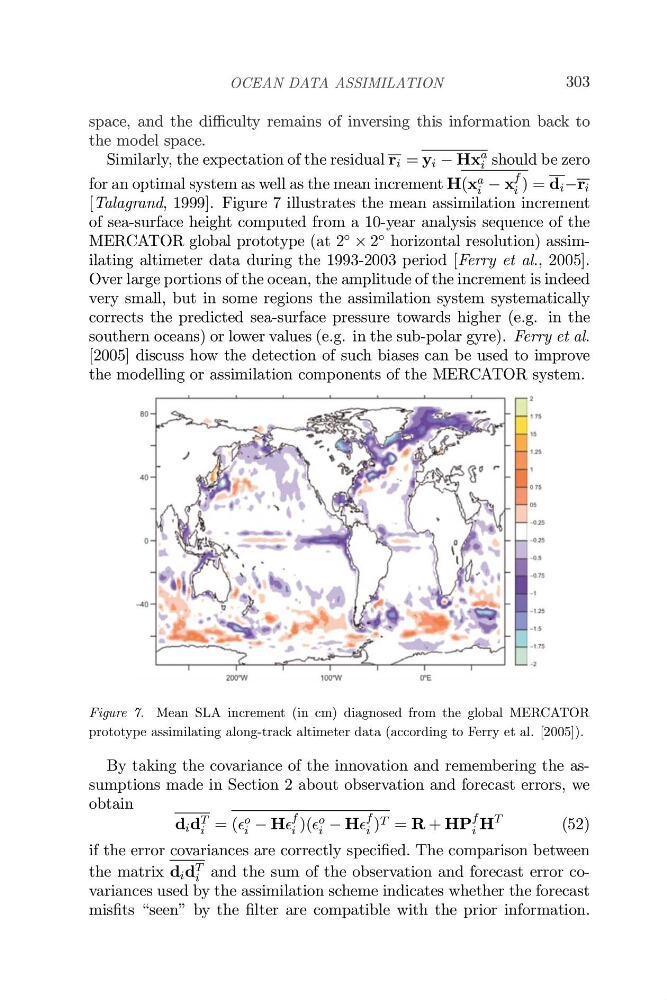
[Talagrand, 1999]. Figure 7 illustrates the mean assimilation increment
of sea-surface height computed from a 10-year analysis sequence of the
MERCATOR global prototype (at 2 × 2 horizontal resolution) assimilating altimeter data during the 1993-2003 period [Ferry et al., 2005].
Over large portions of the ocean, the amplitude of the increment is indeed
very small, but in some regions the assimilation system systematically
corrects the predicted sea-surface pressure towards higher (e.g. in the
southern oceans) or lower values (e.g. in the sub-polar gyre). Ferry et al.
[2005] discuss how the detection of such biases can be used to improve
the modelling or assimilation components of the MERCATOR system.
Figure 7. Mean SLA increment (in cm) diagnosed from the global MERCATOR
prototype assimilating along-track altimeter data (according to Ferry et al. [2005]).
By taking the covariance of the innovation and remembering the assumptions made in Section 2 about observation and forecast errors, we
obtain
d i d T
i = ( o
i H
f
i )( o
i H
f
i ) T = R + HP
f
i H
T
(52)
if the error covariances are correctly specified. The comparison between
the matrix d i d T
i and the sum of the observation and forecast error covariances used by the assimilation scheme indicates whether the forecast
misfits “seen” by the filter are compatible with the prior information.
OCEAN DATA ASSIMILATION
space, and the di!culty remains of inversing this information back to
the model space.
Similarly, the expectation of the residual r i = y i Hx
a
i should be zero
for an optimal system as well as the mean increment H(x a
i x
f
i ) = d i r i
[Talagrand, 1999]. Figure 7 illustrates the mean assimilation increment
of sea-surface height computed from a 10-year analysis sequence of the
MERCATOR global prototype (at 2 × 2 horizontal resolution) assimilating altimeter data during the 1993-2003 period [Ferry et al., 2005].
Over large portions of the ocean, the amplitude of the increment is indeed
very small, but in some regions the assimilation system systematically
corrects the predicted sea-surface pressure towards higher (e.g. in the
southern oceans) or lower values (e.g. in the sub-polar gyre). Ferry et al.
[2005] discuss how the detection of such biases can be used to improve
the modelling or assimilation components of the MERCATOR system.
Figure 7. Mean SLA increment (in cm) diagnosed from the global MERCATOR
prototype assimilating along-track altimeter data (according to Ferry et al. [2005]).
By taking the covariance of the innovation and remembering the assumptions made in Section 2 about observation and forecast errors, we
obtain
d i d T
i = ( o
i H
f
i )( o
i H
f
i ) T = R + HP
f
i H
T
(52)
if the error covariances are correctly specified. The comparison between
the matrix d i d T
i and the sum of the observation and forecast error covariances used by the assimilation scheme indicates whether the forecast
misfits “seen” by the filter are compatible with the prior information.
OCEAN DATA ASSIMILATION