

302
PIERRE BRASSEUR
are available in real cases, it is necessary to verify the consistency of the
underlying assumptions.
Comparisons with independent information provide, of course, the
ideal way to assess the quality of the assimilation and to detect what
has possibly gone wrong in the system. Testing the ability to produce a
forecast from an analyzed state (i.e., using data that have yet to be assimilated) is also very helpful in checking whether the dynamical model
and assimilation scheme are consistent with one another. The most common test is to compare the forecast to persistence [De Mey et al., 2002].
Additionally, information acquired during system operation can be used
to verify if the prior error statistics have been prescribed in a way which
represents the actual errors in the model and the observations. The
dierence between the observations y used in the assimilation system
and the forecast or analysis fields (called innovations d and residuals
r, respectively) provide two series of data that contain a wealth of important information about the consistency of the prior error estimates.
It can be shown that examining diagnostics on the innovation vector is
essentially equivalent to examining them on the residual vector, but in
practice some features of the analysis may be easier to diagnose from
one or the other vector [Talagrand, 1999].
In the section below, we will examine a number of useful criteria that
can be diagnosed from the sequence of innovations and residuals to detect imperfections in the specification of the error statistics. Since such
imperfections can be a source of drift in the assimilation system or, even
more dramatically, can aect the stability of the filter, we will introduce
the concept of adaptivity, the aim of which is to enforce consistency between the error statistics predicted by the filter and the observed misfits.
7.1
Verification of statistical consistency
Simple diagnostics can be implemented quite easily in assimilation
systems, providing interesting tools to monitor overall performance and
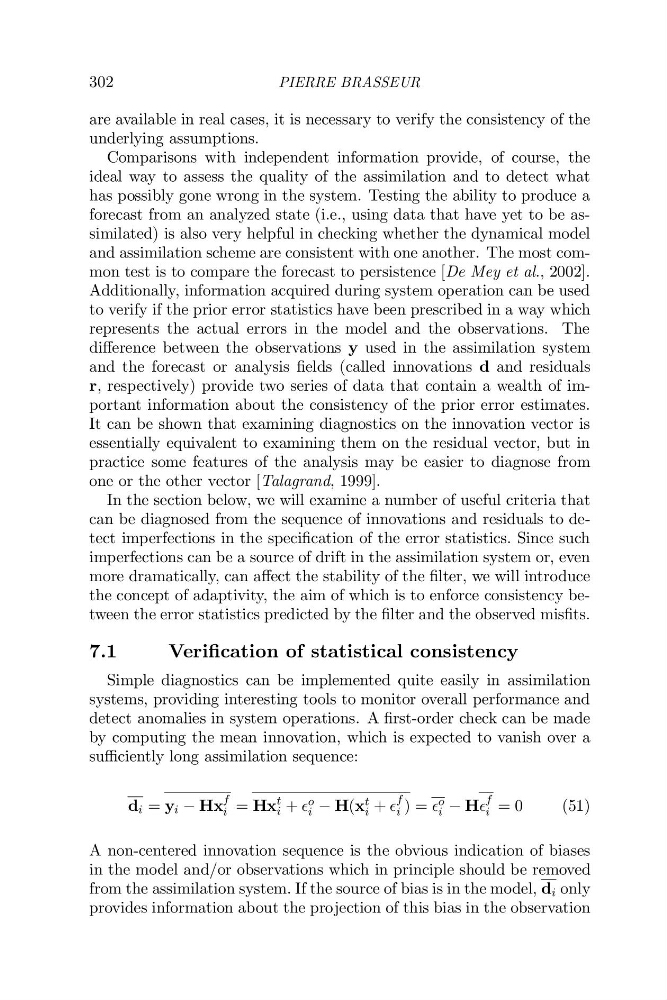
detect anomalies in system operations. A first-order check can be made
by computing the mean innovation, which is expected to vanish over a
su!ciently long assimilation sequence:
d i = y i Hx
f
i = Hx
t
i + o
i H(x t
i +
f
i ) = o
i H
f
i = 0
(51)
A non-centered innovation sequence is the obvious indication of biases
in the model and/or observations which in principle should be removed
from the assimilation system. If the source of bias is in the model, d i only
provides information about the projection of this bias in the observation
PIERRE BRASSEUR
are available in real cases, it is necessary to verify the consistency of the
underlying assumptions.
Comparisons with independent information provide, of course, the
ideal way to assess the quality of the assimilation and to detect what
has possibly gone wrong in the system. Testing the ability to produce a
forecast from an analyzed state (i.e., using data that have yet to be assimilated) is also very helpful in checking whether the dynamical model
and assimilation scheme are consistent with one another. The most common test is to compare the forecast to persistence [De Mey et al., 2002].
Additionally, information acquired during system operation can be used
to verify if the prior error statistics have been prescribed in a way which
represents the actual errors in the model and the observations. The
dierence between the observations y used in the assimilation system
and the forecast or analysis fields (called innovations d and residuals
r, respectively) provide two series of data that contain a wealth of important information about the consistency of the prior error estimates.
It can be shown that examining diagnostics on the innovation vector is
essentially equivalent to examining them on the residual vector, but in
practice some features of the analysis may be easier to diagnose from
one or the other vector [Talagrand, 1999].
In the section below, we will examine a number of useful criteria that
can be diagnosed from the sequence of innovations and residuals to detect imperfections in the specification of the error statistics. Since such
imperfections can be a source of drift in the assimilation system or, even
more dramatically, can aect the stability of the filter, we will introduce
the concept of adaptivity, the aim of which is to enforce consistency between the error statistics predicted by the filter and the observed misfits.
7.1
Verification of statistical consistency
Simple diagnostics can be implemented quite easily in assimilation
systems, providing interesting tools to monitor overall performance and
detect anomalies in system operations. A first-order check can be made
by computing the mean innovation, which is expected to vanish over a
su!ciently long assimilation sequence:
d i = y i Hx
f
i = Hx
t
i + o
i H(x t
i +
f
i ) = o
i H
f
i = 0
(51)
A non-centered innovation sequence is the obvious indication of biases
in the model and/or observations which in principle should be removed
from the assimilation system. If the source of bias is in the model, d i only
provides information about the projection of this bias in the observation