

301
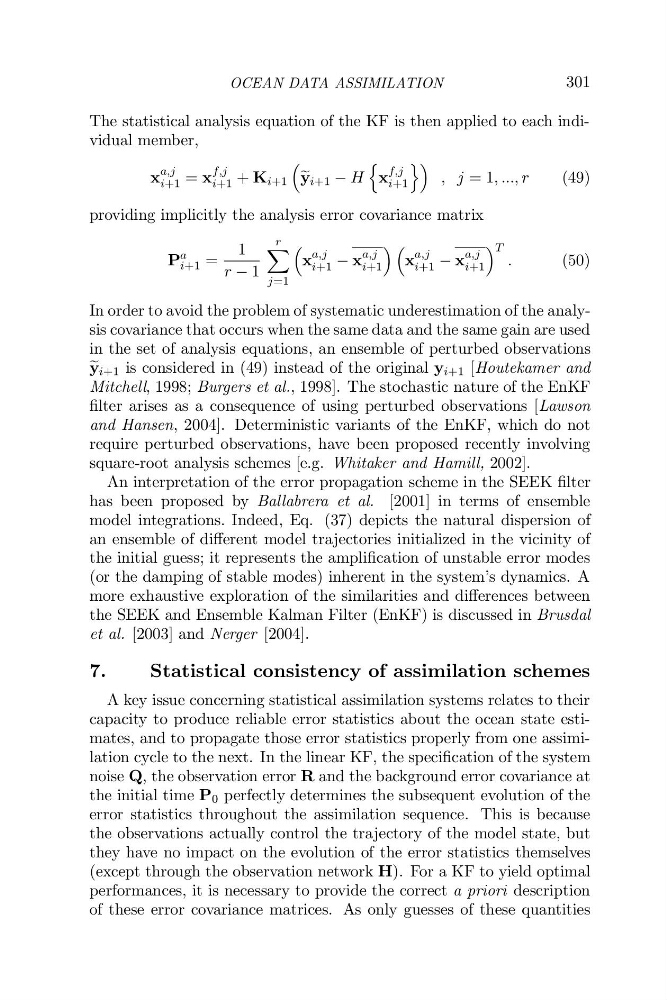
The statistical analysis equation of the KF is then applied to each individual member,
x
a,j
i+1 = x
f,j
i+1 + K i+1
h
y i+1 H
q
x
f,j
i+1
r
, j = 1, ..., r
(49)
providing implicitly the analysis error covariance matrix
P
a
i+1 =
1
r 1
r
[
j=1
x
a,j
i+1 x
a,j
i+1
x
a,j
i+1 x
a,j
i+1
T
.
(50)
In order to avoid the problem of systematic underestimation of the analysis covariance that occurs when the same data and the same gain are used
in the set of analysis equations, an ensemble of perturbed observations
h
y i+1 is considered in (49) instead of the original y i+1 [Houtekamer and
Mitchell, 1998; Burgers et al., 1998]. The stochastic nature of the EnKF
filter arises as a consequence of using perturbed observations [Lawson
and Hansen, 2004]. Deterministic variants of the EnKF, which do not
require perturbed observations, have been proposed recently involving
square-root analysis schemes [e.g. Whitaker and Hamill, 2002].
An interpretation of the error propagation scheme in the SEEK filter
has been proposed by Ballabrera et al. [2001] in terms of ensemble
model integrations. Indeed, Eq. (37) depicts the natural dispersion of
an ensemble of dierent model trajectories initialized in the vicinity of
the initial guess; it represents the amplification of unstable error modes
(or the damping of stable modes) inherent in the system’s dynamics. A
more exhaustive exploration of the similarities and dierences between
the SEEK and Ensemble Kalman Filter (EnKF) is discussed in Brusdal
et al. [2003] and Nerger [2004].
7.
Statistical consistency of assimilation schemes
A key issue concerning statistical assimilation systems relates to their
capacity to produce reliable error statistics about the ocean state estimates, and to propagate those error statistics properly from one assimilation cycle to the next. In the linear KF, the specification of the system
noise Q, the observation error R and the background error covariance at
the initial time P 0 perfectly determines the subsequent evolution of the
error statistics throughout the assimilation sequence. This is because
the observations actually control the trajectory of the model state, but
they have no impact on the evolution of the error statistics themselves
(except through the observation network H). For a KF to yield optimal
performances, it is necessary to provide the correct a priori description
of these error covariance matrices. As only guesses of these quantities
OCEAN DATA ASSIMILATION
The statistical analysis equation of the KF is then applied to each individual member,
x
a,j
i+1 = x
f,j
i+1 + K i+1
h
y i+1 H
q
x
f,j
i+1
r
, j = 1, ..., r
(49)
providing implicitly the analysis error covariance matrix
P
a
i+1 =
1
r 1
r
[
j=1
x
a,j
i+1 x
a,j
i+1
x
a,j
i+1 x
a,j
i+1
T
.
(50)
In order to avoid the problem of systematic underestimation of the analysis covariance that occurs when the same data and the same gain are used
in the set of analysis equations, an ensemble of perturbed observations
h
y i+1 is considered in (49) instead of the original y i+1 [Houtekamer and
Mitchell, 1998; Burgers et al., 1998]. The stochastic nature of the EnKF
filter arises as a consequence of using perturbed observations [Lawson
and Hansen, 2004]. Deterministic variants of the EnKF, which do not
require perturbed observations, have been proposed recently involving
square-root analysis schemes [e.g. Whitaker and Hamill, 2002].
An interpretation of the error propagation scheme in the SEEK filter
has been proposed by Ballabrera et al. [2001] in terms of ensemble
model integrations. Indeed, Eq. (37) depicts the natural dispersion of
an ensemble of dierent model trajectories initialized in the vicinity of
the initial guess; it represents the amplification of unstable error modes
(or the damping of stable modes) inherent in the system’s dynamics. A
more exhaustive exploration of the similarities and dierences between
the SEEK and Ensemble Kalman Filter (EnKF) is discussed in Brusdal
et al. [2003] and Nerger [2004].
7.
Statistical consistency of assimilation schemes
A key issue concerning statistical assimilation systems relates to their
capacity to produce reliable error statistics about the ocean state estimates, and to propagate those error statistics properly from one assimilation cycle to the next. In the linear KF, the specification of the system
noise Q, the observation error R and the background error covariance at
the initial time P 0 perfectly determines the subsequent evolution of the
error statistics throughout the assimilation sequence. This is because
the observations actually control the trajectory of the model state, but
they have no impact on the evolution of the error statistics themselves
(except through the observation network H). For a KF to yield optimal
performances, it is necessary to provide the correct a priori description
of these error covariance matrices. As only guesses of these quantities
OCEAN DATA ASSIMILATION