

304
PIERRE BRASSEUR
As all these quantities are full covariance matrices in the data space, the
comparison is often made by looking only at a few selected diagnostics
such as the trace of the matrix or its diagonal elements. After simple
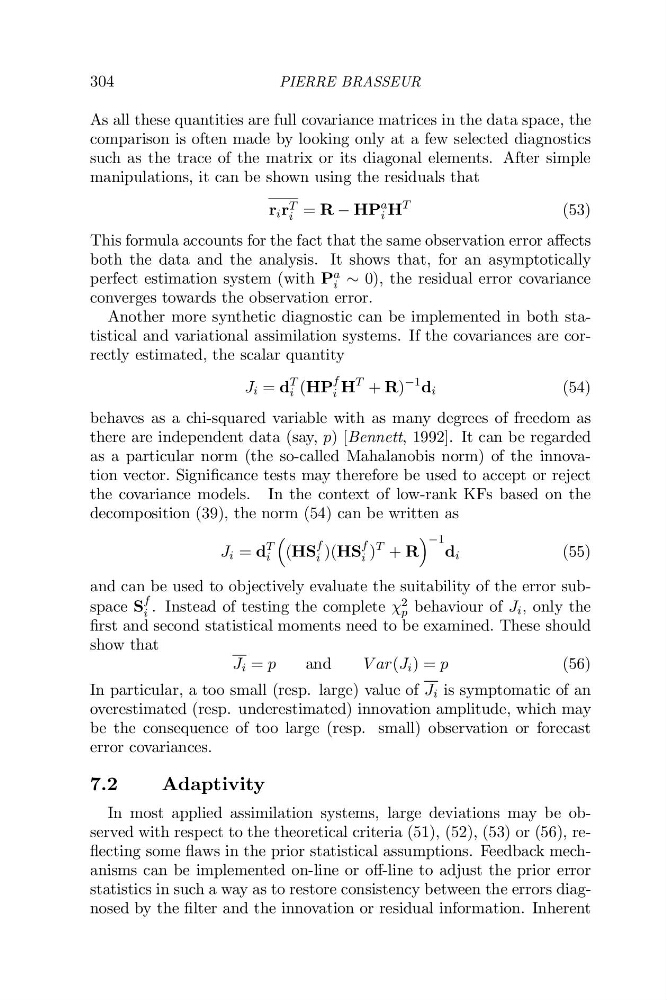
manipulations, it can be shown using the residuals that
r i r T
i = R HP
a
i H
T
(53)
This formula accounts for the fact that the same observation error aects
both the data and the analysis. It shows that, for an asymptotically
perfect estimation system (with P a
i 0), the residual error covariance
converges towards the observation error.
Another more synthetic diagnostic can be implemented in both statistical and variational assimilation systems. If the covariances are correctly estimated, the scalar quantity
J i = d
T
i (HP
f
i H
T
+ R)
31 d i
(54)
behaves as a chi-squared variable with as many degrees of freedom as
there are independent data (say, p) [Bennett, 1992]. It can be regarded
as a particular norm (the so-called Mahalanobis norm) of the innovation vector. Significance tests may therefore be used to accept or reject
the covariance models. In the context of low-rank KFs based on the
decomposition (39), the norm (54) can be written as
J i = d
T
i
(HS
f
i )(HS
f
i )
T
+ R
31
d i
(55)
and can be used to objectively evaluate the suitability of the error subspace S
f
i . Instead of testing the complete " 2
p behaviour of J i , only the
first and second statistical moments need to be examined. These should
show that
J i = p
and
V ar(J i ) = p
(56)
In particular, a too small (resp. large) value of J i is symptomatic of an
overestimated (resp. underestimated) innovation amplitude, which may
be the consequence of too large (resp. small) observation or forecast
error covariances.
7.2
Adaptivity
In most applied assimilation systems, large deviations may be observed with respect to the theoretical criteria (51), (52), (53) or (56), reflecting some flaws in the prior statistical assumptions. Feedback mechanisms can be implemented on-line or o-line to adjust the prior error
statistics in such a way as to restore consistency between the errors diagnosed by the filter and the innovation or residual information. Inherent
PIERRE BRASSEUR
As all these quantities are full covariance matrices in the data space, the
comparison is often made by looking only at a few selected diagnostics
such as the trace of the matrix or its diagonal elements. After simple
manipulations, it can be shown using the residuals that
r i r T
i = R HP
a
i H
T
(53)
This formula accounts for the fact that the same observation error aects
both the data and the analysis. It shows that, for an asymptotically
perfect estimation system (with P a
i 0), the residual error covariance
converges towards the observation error.
Another more synthetic diagnostic can be implemented in both statistical and variational assimilation systems. If the covariances are correctly estimated, the scalar quantity
J i = d
T
i (HP
f
i H
T
+ R)
31 d i
(54)
behaves as a chi-squared variable with as many degrees of freedom as
there are independent data (say, p) [Bennett, 1992]. It can be regarded
as a particular norm (the so-called Mahalanobis norm) of the innovation vector. Significance tests may therefore be used to accept or reject
the covariance models. In the context of low-rank KFs based on the
decomposition (39), the norm (54) can be written as
J i = d
T
i
(HS
f
i )(HS
f
i )
T
+ R
31
d i
(55)
and can be used to objectively evaluate the suitability of the error subspace S
f
i . Instead of testing the complete " 2
p behaviour of J i , only the
first and second statistical moments need to be examined. These should
show that
J i = p
and
V ar(J i ) = p
(56)
In particular, a too small (resp. large) value of J i is symptomatic of an
overestimated (resp. underestimated) innovation amplitude, which may
be the consequence of too large (resp. small) observation or forecast
error covariances.
7.2
Adaptivity
In most applied assimilation systems, large deviations may be observed with respect to the theoretical criteria (51), (52), (53) or (56), reflecting some flaws in the prior statistical assumptions. Feedback mechanisms can be implemented on-line or o-line to adjust the prior error
statistics in such a way as to restore consistency between the errors diagnosed by the filter and the innovation or residual information. Inherent