

293
5.5
Examples of sub-spaces based on EOFs
The EOFs calculated with primitive-equation models are fully multivariate and three-dimensional, and cover the whole model domain: all
the variables of the state vector (SSH, temperature, salinity, zonal and
meridional velocities) are considered together in a dynamically consistent
manner. The extrapolation of the data from observed to non-observed
variables is performed along the directions represented by these EOFs
which connect all grid points of the numerical domain.
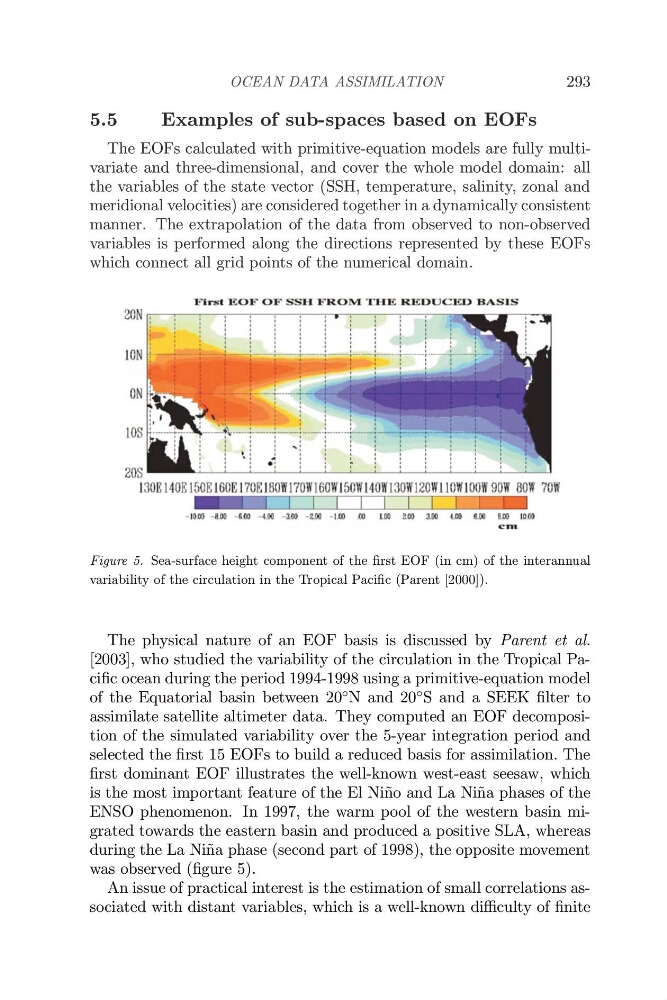
Figure 5. Sea-surface height component of the first EOF (in cm) of the interannual
variability of the circulation in the Tropical Pacific (Parent [2000]).
The physical nature of an EOF basis is discussed by Parent et al.
[2003], who studied the variability of the circulation in the Tropical Pacific ocean during the period 1994-1998 using a primitive-equation model
of the Equatorial basin between 20 N and 20 S and a SEEK filter to
assimilate satellite altimeter data. They computed an EOF decomposition of the simulated variability over the 5-year integration period and
selected the first 15 EOFs to build a reduced basis for assimilation. The
first dominant EOF illustrates the well-known west-east seesaw, which
is the most important feature of the El Niño and La Niña phases of the
ENSO phenomenon. In 1997, the warm pool of the western basin migrated towards the eastern basin and produced a positive SLA, whereas
during the La Niña phase (second part of 1998), the opposite movement
was observed (figure 5).
An issue of practical interest is the estimation of small correlations associated with distant variables, which is a well-known di!culty of finite
OCEAN DATA ASSIMILATION
5.5
Examples of sub-spaces based on EOFs
The EOFs calculated with primitive-equation models are fully multivariate and three-dimensional, and cover the whole model domain: all
the variables of the state vector (SSH, temperature, salinity, zonal and
meridional velocities) are considered together in a dynamically consistent
manner. The extrapolation of the data from observed to non-observed
variables is performed along the directions represented by these EOFs
which connect all grid points of the numerical domain.
Figure 5. Sea-surface height component of the first EOF (in cm) of the interannual
variability of the circulation in the Tropical Pacific (Parent [2000]).
The physical nature of an EOF basis is discussed by Parent et al.
[2003], who studied the variability of the circulation in the Tropical Pacific ocean during the period 1994-1998 using a primitive-equation model
of the Equatorial basin between 20 N and 20 S and a SEEK filter to
assimilate satellite altimeter data. They computed an EOF decomposition of the simulated variability over the 5-year integration period and
selected the first 15 EOFs to build a reduced basis for assimilation. The
first dominant EOF illustrates the well-known west-east seesaw, which
is the most important feature of the El Niño and La Niña phases of the
ENSO phenomenon. In 1997, the warm pool of the western basin migrated towards the eastern basin and produced a positive SLA, whereas
during the La Niña phase (second part of 1998), the opposite movement
was observed (figure 5).
An issue of practical interest is the estimation of small correlations associated with distant variables, which is a well-known di!culty of finite
OCEAN DATA ASSIMILATION