

292
PIERRE BRASSEUR
eigenvalues is noted 0 . The covariance can be approximated by the
matrix
XX
T z N 0 0 N 0
T
= S 0 S
T
0
(34)
of rank r, where S 0 = N 0
s
0 contains dimensional quantities. Assimilation experiments can be initialized using S 0 S T
0 as a guess of the initial
error covariance.
The minimum dimension of the error sub-space has to be determined
by practical considerations. A condition of stability for a reduced-rank
KF in idealized conditions (linear model and autonomous system) is
shown to be that r should be larger than r W , where r W is the number
of eigenvalues of M having an absolute value larger than or equal to 1
(Pham et al. [1998]; Carme et al., [2001]). Since this number cannot be
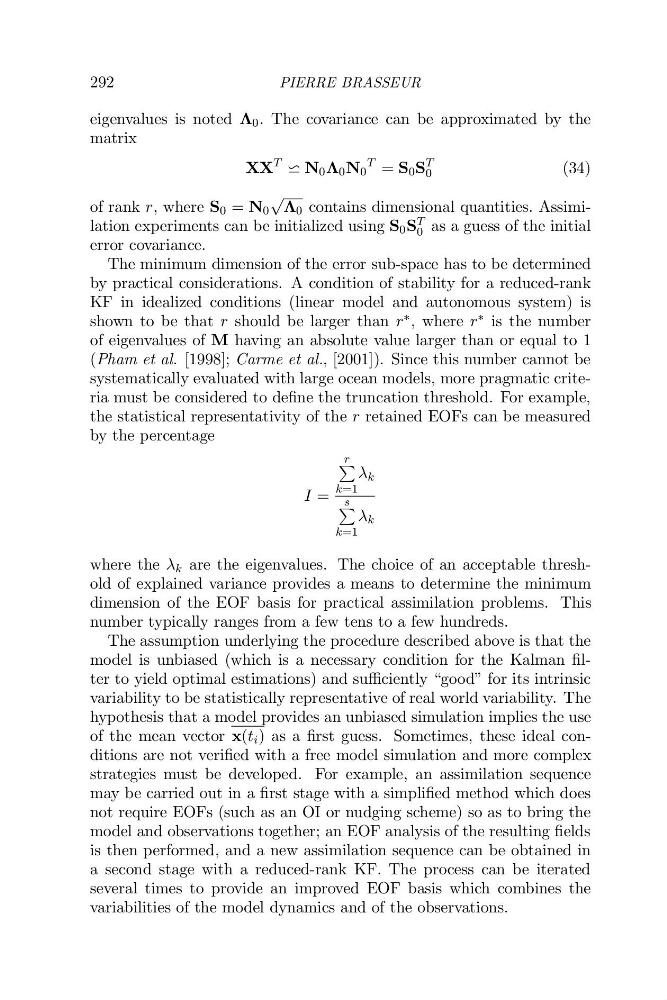
systematically evaluated with large ocean models, more pragmatic criteria must be considered to define the truncation threshold. For example,
the statistical representativity of the r retained EOFs can be measured
by the percentage
I =
r
S
k=1
k
s
S
k=1
k
where the k are the eigenvalues. The choice of an acceptable threshold of explained variance provides a means to determine the minimum
dimension of the EOF basis for practical assimilation problems. This
number typically ranges from a few tens to a few hundreds.
The assumption underlying the procedure described above is that the
model is unbiased (which is a necessary condition for the Kalman filter to yield optimal estimations) and su!ciently “good” for its intrinsic
variability to be statistically representative of real world variability. The
hypothesis that a model provides an unbiased simulation implies the use
of the mean vector x(t i ) as a first guess. Sometimes, these ideal conditions are not verified with a free model simulation and more complex
strategies must be developed. For example, an assimilation sequence
may be carried out in a first stage with a simplified method which does
not require EOFs (such as an OI or nudging scheme) so as to bring the
model and observations together; an EOF analysis of the resulting fields
is then performed, and a new assimilation sequence can be obtained in
a second stage with a reduced-rank KF. The process can be iterated
several times to provide an improved EOF basis which combines the
variabilities of the model dynamics and of the observations.
PIERRE BRASSEUR
eigenvalues is noted 0 . The covariance can be approximated by the
matrix
XX
T z N 0 0 N 0
T
= S 0 S
T
0
(34)
of rank r, where S 0 = N 0
s
0 contains dimensional quantities. Assimilation experiments can be initialized using S 0 S T
0 as a guess of the initial
error covariance.
The minimum dimension of the error sub-space has to be determined
by practical considerations. A condition of stability for a reduced-rank
KF in idealized conditions (linear model and autonomous system) is
shown to be that r should be larger than r W , where r W is the number
of eigenvalues of M having an absolute value larger than or equal to 1
(Pham et al. [1998]; Carme et al., [2001]). Since this number cannot be
systematically evaluated with large ocean models, more pragmatic criteria must be considered to define the truncation threshold. For example,
the statistical representativity of the r retained EOFs can be measured
by the percentage
I =
r
S
k=1
k
s
S
k=1
k
where the k are the eigenvalues. The choice of an acceptable threshold of explained variance provides a means to determine the minimum
dimension of the EOF basis for practical assimilation problems. This
number typically ranges from a few tens to a few hundreds.
The assumption underlying the procedure described above is that the
model is unbiased (which is a necessary condition for the Kalman filter to yield optimal estimations) and su!ciently “good” for its intrinsic
variability to be statistically representative of real world variability. The
hypothesis that a model provides an unbiased simulation implies the use
of the mean vector x(t i ) as a first guess. Sometimes, these ideal conditions are not verified with a free model simulation and more complex
strategies must be developed. For example, an assimilation sequence
may be carried out in a first stage with a simplified method which does
not require EOFs (such as an OI or nudging scheme) so as to bring the
model and observations together; an EOF analysis of the resulting fields
is then performed, and a new assimilation sequence can be obtained in
a second stage with a reduced-rank KF. The process can be iterated
several times to provide an improved EOF basis which combines the
variabilities of the model dynamics and of the observations.