

291
(e.g., Miller and Erhet [2002]). An approach based on EOFs was put
forward by Cane et al. [1996] to elaborate a reduced state Kalman
filter, and by Pham et al. [1998] in the context of the Singular Evolutive
Extended Kalman (SEEK) filter.
A practical way to estimate a low-rank error covariance matrix is to
perform an EOF analysis of state vectors generated by a prior model
simulation. The EOF analysis provides a compact description of the
spatial and temporal variability of the model in terms of orthogonal
functions. Usually, most of the variance of the time sequence is described
by the first few orthogonal functions whose patterns may then be linked
to dynamical mechanisms [Emery and Thomson, 1998]. In order to
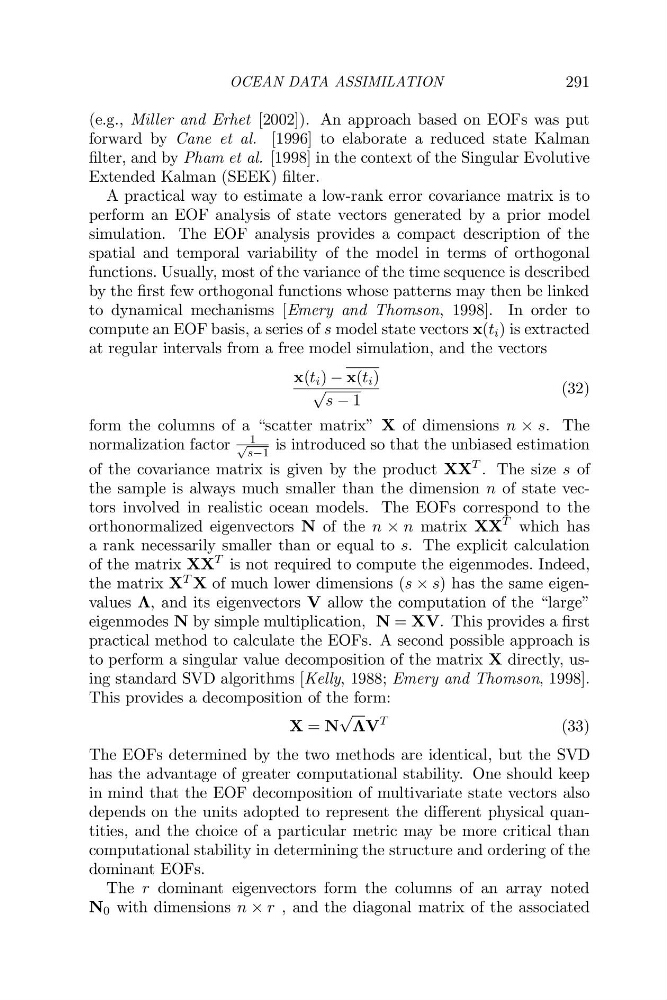
compute an EOF basis, a series of s model state vectors x(t i ) is extracted
at regular intervals from a free model simulation, and the vectors
x(t i ) x(t i )
s
s 1
(32)
form the columns of a “scatter matrix” X of dimensions n × s. The
normalization factor
1
I s31
is introduced so that the unbiased estimation
of the covariance matrix is given by the product XX
T . The size s of
the sample is always much smaller than the dimension n of state vectors involved in realistic ocean models. The EOFs correspond to the
orthonormalized eigenvectors N of the n × n matrix XX
T which has
a rank necessarily smaller than or equal to s. The explicit calculation
of the matrix XX
T is not required to compute the eigenmodes. Indeed,
the matrix X T X of much lower dimensions (s × s) has the same eigenvalues , and its eigenvectors V allow the computation of the “large”
eigenmodes N by simple multiplication, N = XV. This provides a first
practical method to calculate the EOFs. A second possible approach is
to perform a singular value decomposition of the matrix X directly, using standard SVD algorithms [Kelly, 1988; Emery and Thomson, 1998].
This provides a decomposition of the form:
X = N
s
V
T
(33)
The EOFs determined by the two methods are identical, but the SVD
has the advantage of greater computational stability. One should keep
in mind that the EOF decomposition of multivariate state vectors also
depends on the units adopted to represent the dierent physical quantities, and the choice of a particular metric may be more critical than
computational stability in determining the structure and ordering of the
dominant EOFs.
The r dominant eigenvectors form the columns of an array noted
N 0 with dimensions n × r , and the diagonal matrix of the associated
OCEAN DATA ASSIMILATION
(e.g., Miller and Erhet [2002]). An approach based on EOFs was put
forward by Cane et al. [1996] to elaborate a reduced state Kalman
filter, and by Pham et al. [1998] in the context of the Singular Evolutive
Extended Kalman (SEEK) filter.
A practical way to estimate a low-rank error covariance matrix is to
perform an EOF analysis of state vectors generated by a prior model
simulation. The EOF analysis provides a compact description of the
spatial and temporal variability of the model in terms of orthogonal
functions. Usually, most of the variance of the time sequence is described
by the first few orthogonal functions whose patterns may then be linked
to dynamical mechanisms [Emery and Thomson, 1998]. In order to
compute an EOF basis, a series of s model state vectors x(t i ) is extracted
at regular intervals from a free model simulation, and the vectors
x(t i ) x(t i )
s
s 1
(32)
form the columns of a “scatter matrix” X of dimensions n × s. The
normalization factor
1
I s31
is introduced so that the unbiased estimation
of the covariance matrix is given by the product XX
T . The size s of
the sample is always much smaller than the dimension n of state vectors involved in realistic ocean models. The EOFs correspond to the
orthonormalized eigenvectors N of the n × n matrix XX
T which has
a rank necessarily smaller than or equal to s. The explicit calculation
of the matrix XX
T is not required to compute the eigenmodes. Indeed,
the matrix X T X of much lower dimensions (s × s) has the same eigenvalues , and its eigenvectors V allow the computation of the “large”
eigenmodes N by simple multiplication, N = XV. This provides a first
practical method to calculate the EOFs. A second possible approach is
to perform a singular value decomposition of the matrix X directly, using standard SVD algorithms [Kelly, 1988; Emery and Thomson, 1998].
This provides a decomposition of the form:
X = N
s
V
T
(33)
The EOFs determined by the two methods are identical, but the SVD
has the advantage of greater computational stability. One should keep
in mind that the EOF decomposition of multivariate state vectors also
depends on the units adopted to represent the dierent physical quantities, and the choice of a particular metric may be more critical than
computational stability in determining the structure and ordering of the
dominant EOFs.
The r dominant eigenvectors form the columns of an array noted
N 0 with dimensions n × r , and the diagonal matrix of the associated
OCEAN DATA ASSIMILATION