

290
PIERRE BRASSEUR
ber of applications have been conducted successfully along these lines
in the tropical oceans, where the dynamics is “slow” and nearly linear
[Verron et al., 1999]. Alternatively, the error sub-space can be allowed
to evolve using deterministic or stochastic approaches, or a mixture of
both. Evolving sub-spaces are in general more suitable to track the nonlinear evolution of “fast” energetic error modes, or to dynamically adjust the unbalanced components of the sub-space [Lermusiaux, 2001].
Related concepts have been introduced in the context of atmospheric
data assimilation by Cohn and Todling [1996], who proposed approximate schemes for error covariance propagation in the case of stable and
unstable dynamics.
5.3
Low-rank error covariance matrix
By construction, a covariance matrix is symmetric and positive definite and can always be decomposed as P = NN
T . The columns of
N are formed by the orthonormalized eigenvectors n k of P, and is
a diagonal matrix formed with the corresponding eigenvalues k . The
inverse of P is then given by P 31 = N
31 N T . The pdf defined by (9)
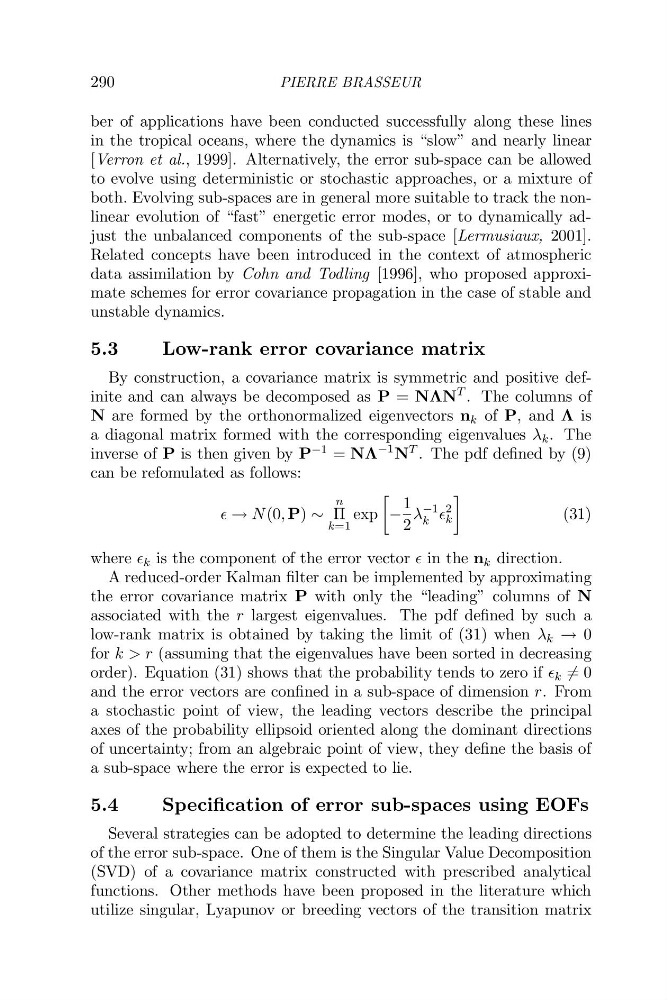
can be refomulated as follows:
$ N (0, P)
n
k=1
exp
1
2
31
k
2
k
(31)
where k is the component of the error vector in the n k direction.
A reduced-order Kalman filter can be implemented by approximating
the error covariance matrix P with only the “leading” columns of N
associated with the r largest eigenvalues. The pdf defined by such a
low-rank matrix is obtained by taking the limit of (31) when k $ 0
for k > r (assuming that the eigenvalues have been sorted in decreasing
order). Equation (31) shows that the probability tends to zero if k 9 = 0
and the error vectors are confined in a sub-space of dimension r. From
a stochastic point of view, the leading vectors describe the principal
axes of the probability ellipsoid oriented along the dominant directions
of uncertainty; from an algebraic point of view, they define the basis of
a sub-space where the error is expected to lie.
5.4
Specification of error sub-spaces using EOFs
Several strategies can be adopted to determine the leading directions
of the error sub-space. One of them is the Singular Value Decomposition
(SVD) of a covariance matrix constructed with prescribed analytical
functions. Other methods have been proposed in the literature which
utilize singular, Lyapunov or breeding vectors of the transition matrix
PIERRE BRASSEUR
ber of applications have been conducted successfully along these lines
in the tropical oceans, where the dynamics is “slow” and nearly linear
[Verron et al., 1999]. Alternatively, the error sub-space can be allowed
to evolve using deterministic or stochastic approaches, or a mixture of
both. Evolving sub-spaces are in general more suitable to track the nonlinear evolution of “fast” energetic error modes, or to dynamically adjust the unbalanced components of the sub-space [Lermusiaux, 2001].
Related concepts have been introduced in the context of atmospheric
data assimilation by Cohn and Todling [1996], who proposed approximate schemes for error covariance propagation in the case of stable and
unstable dynamics.
5.3
Low-rank error covariance matrix
By construction, a covariance matrix is symmetric and positive definite and can always be decomposed as P = NN
T . The columns of
N are formed by the orthonormalized eigenvectors n k of P, and is
a diagonal matrix formed with the corresponding eigenvalues k . The
inverse of P is then given by P 31 = N
31 N T . The pdf defined by (9)
can be refomulated as follows:
$ N (0, P)
n
k=1
exp
1
2
31
k
2
k
(31)
where k is the component of the error vector in the n k direction.
A reduced-order Kalman filter can be implemented by approximating
the error covariance matrix P with only the “leading” columns of N
associated with the r largest eigenvalues. The pdf defined by such a
low-rank matrix is obtained by taking the limit of (31) when k $ 0
for k > r (assuming that the eigenvalues have been sorted in decreasing
order). Equation (31) shows that the probability tends to zero if k 9 = 0
and the error vectors are confined in a sub-space of dimension r. From
a stochastic point of view, the leading vectors describe the principal
axes of the probability ellipsoid oriented along the dominant directions
of uncertainty; from an algebraic point of view, they define the basis of
a sub-space where the error is expected to lie.
5.4
Specification of error sub-spaces using EOFs
Several strategies can be adopted to determine the leading directions
of the error sub-space. One of them is the Singular Value Decomposition
(SVD) of a covariance matrix constructed with prescribed analytical
functions. Other methods have been proposed in the literature which
utilize singular, Lyapunov or breeding vectors of the transition matrix