

SURFACE FLUXES
257
in conjunction with observed SST to produce an observationally based
air-sea flux climatology over 43 years. A necessary achievement of the
exercise is to lower the global air-sea heat flux over 17 years (1984–
2000) from 31W/m 2 heating to a more reasonable 1W/m 2 (Table 3). A
freshwater imbalance of 3.4mg/s/m 2 is over compensated by increased
evaporation, so an overall increase in precipitation is used to give a
nearly balance (−0.1mg/s/m 2 ) global mean budget. The impact on
these global budgets of the following corrections is summarized in Table
3.
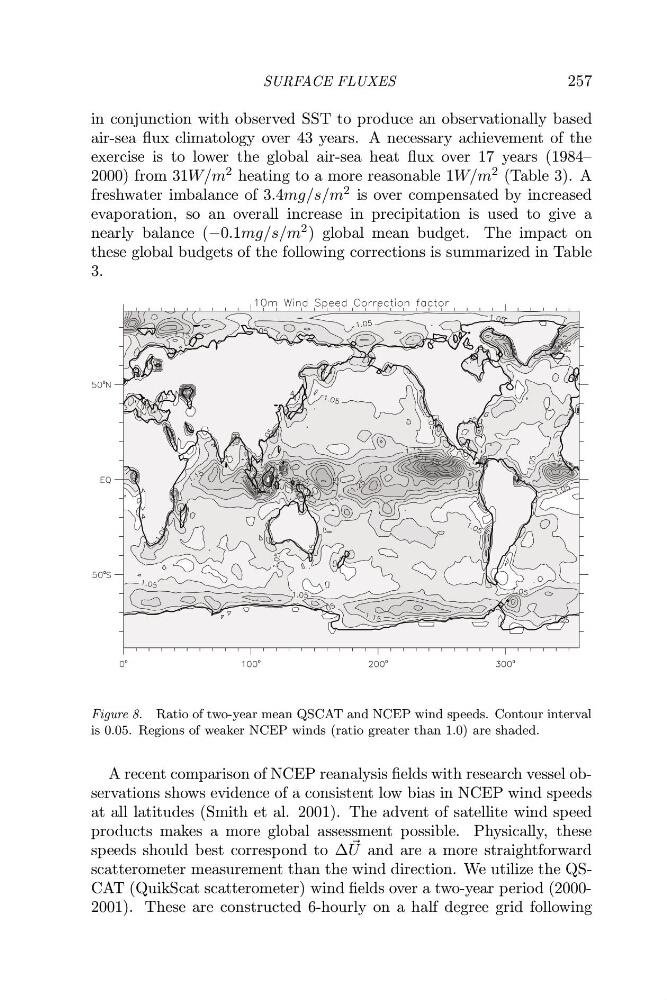
Figure 8. Ratio of two-year mean QSCAT and NCEP wind speeds. Contour interval
is 0.05. Regions of weaker NCEP winds (ratio greater than 1.0) are shaded.
A recent comparison of NCEP reanalysis fields with research vessel observations shows evidence of a consistent low bias in NCEP wind speeds
at all latitudes (Smith et al. 2001). The advent of satellite wind speed
products makes a more global assessment possible. Physically, these
speeds should best correspond to ∆
U and are a more straightforward
scatterometer measurement than the wind direction. We utilize the QSCAT (QuikScat scatterometer) wind fields over a two-year period (20002001). These are constructed 6-hourly on a half degree grid following
257
in conjunction with observed SST to produce an observationally based
air-sea flux climatology over 43 years. A necessary achievement of the
exercise is to lower the global air-sea heat flux over 17 years (1984–
2000) from 31W/m 2 heating to a more reasonable 1W/m 2 (Table 3). A
freshwater imbalance of 3.4mg/s/m 2 is over compensated by increased
evaporation, so an overall increase in precipitation is used to give a
nearly balance (−0.1mg/s/m 2 ) global mean budget. The impact on
these global budgets of the following corrections is summarized in Table
3.
Figure 8. Ratio of two-year mean QSCAT and NCEP wind speeds. Contour interval
is 0.05. Regions of weaker NCEP winds (ratio greater than 1.0) are shaded.
A recent comparison of NCEP reanalysis fields with research vessel observations shows evidence of a consistent low bias in NCEP wind speeds
at all latitudes (Smith et al. 2001). The advent of satellite wind speed
products makes a more global assessment possible. Physically, these
speeds should best correspond to ∆
U and are a more straightforward
scatterometer measurement than the wind direction. We utilize the QSCAT (QuikScat scatterometer) wind fields over a two-year period (20002001). These are constructed 6-hourly on a half degree grid following