

256
WILLIAM B. LARGE
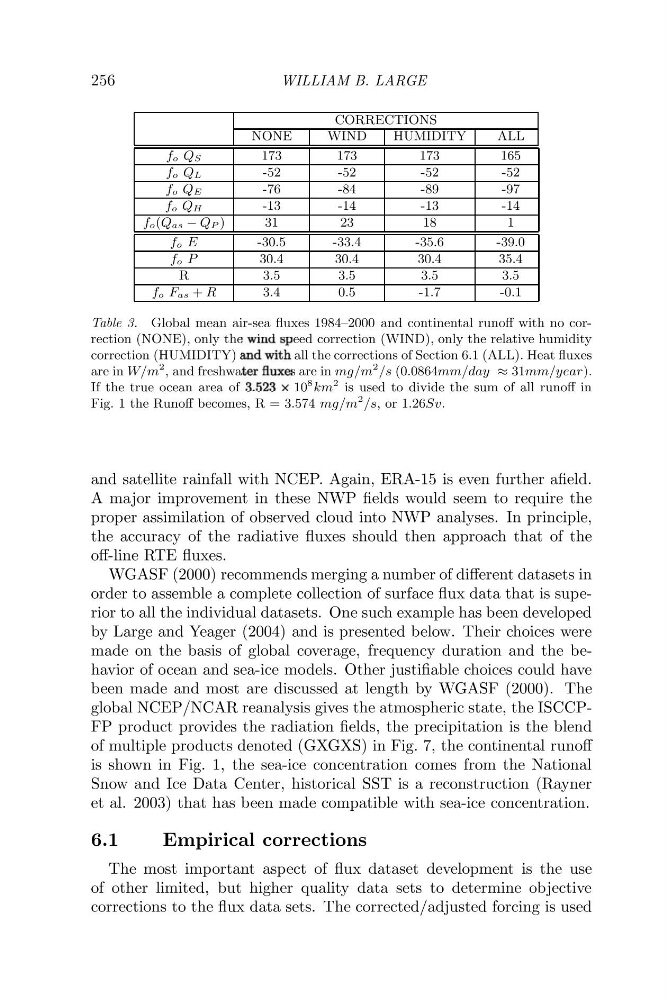
CORRECTIONS
NONE I WIND I HUMIDITY I ALL
Table 3. Global mean air-sea fluxes 1984-2000 and continental runoff with no correction (NONE), only the wind speed correction (WIND), only the relative humidity
correction (HUMIDITY) and with all the corrections of Section 6.1 (ALL). Heat fluxes
are in w/m2, and freshwater fluxes are in mg/m2/s (0.0864mm/day m 3lmmlyear).
If the true ocean area of 3.523 x 10⁸km2 is used to divide the sum of all runoff in
Fig. 1 the Runoff becomes, R = 3.574 mg/m2/s, or 1.26Sv.
and satellite rainfall with NCEP. Again, ERA-15 is even further afield.
A major improvement in these NWP fields would seem to require the
proper assimilation of observed cloud into NWP analyses. In principle,
the accuracy of the radiative fluxes should then approach that of the
off-line RTE fluxes.
WGASF (2000) recommends merging a number of different datasets in
order to assemble a complete collection of surface flux data that is superior to all the individual datasets. One such example has been developed
by Large and Yeager (2004) and is presented below. Their choices were
made on the basis of global coverage, frequency duration and the behavior of ocean and sea-ice models. Other justifiable choices could have
been made and most are discussed at length by WGASF (2000). The
global NCEP/NCAR reanalysis gives the atmospheric state, the ISCCPF P product provides the radiation fields, the precipitation is the blend
of multiple products denoted (GXGXS) in Fig. 7, the continental runoff
is shown in Fig. 1, the sea-ice concentration comes from the National
Snow and Ice Data Center, historical SST is a reconstruction (Rayner
et al. 2003) that has been made compatible with sea-ice concentration.
6.1
Empirical corrections
The most important aspect of flux dataset development is the use
of other limited, but higher quality data sets to determine objective
corrections to the flux data sets. The corrected/adjusted forcing is used
WILLIAM B. LARGE
CORRECTIONS
NONE I WIND I HUMIDITY I ALL
Table 3. Global mean air-sea fluxes 1984-2000 and continental runoff with no correction (NONE), only the wind speed correction (WIND), only the relative humidity
correction (HUMIDITY) and with all the corrections of Section 6.1 (ALL). Heat fluxes
are in w/m2, and freshwater fluxes are in mg/m2/s (0.0864mm/day m 3lmmlyear).
If the true ocean area of 3.523 x 10⁸km2 is used to divide the sum of all runoff in
Fig. 1 the Runoff becomes, R = 3.574 mg/m2/s, or 1.26Sv.
and satellite rainfall with NCEP. Again, ERA-15 is even further afield.
A major improvement in these NWP fields would seem to require the
proper assimilation of observed cloud into NWP analyses. In principle,
the accuracy of the radiative fluxes should then approach that of the
off-line RTE fluxes.
WGASF (2000) recommends merging a number of different datasets in
order to assemble a complete collection of surface flux data that is superior to all the individual datasets. One such example has been developed
by Large and Yeager (2004) and is presented below. Their choices were
made on the basis of global coverage, frequency duration and the behavior of ocean and sea-ice models. Other justifiable choices could have
been made and most are discussed at length by WGASF (2000). The
global NCEP/NCAR reanalysis gives the atmospheric state, the ISCCPF P product provides the radiation fields, the precipitation is the blend
of multiple products denoted (GXGXS) in Fig. 7, the continental runoff
is shown in Fig. 1, the sea-ice concentration comes from the National
Snow and Ice Data Center, historical SST is a reconstruction (Rayner
et al. 2003) that has been made compatible with sea-ice concentration.
6.1
Empirical corrections
The most important aspect of flux dataset development is the use
of other limited, but higher quality data sets to determine objective
corrections to the flux data sets. The corrected/adjusted forcing is used