

244
WILLIAM B. LARGE
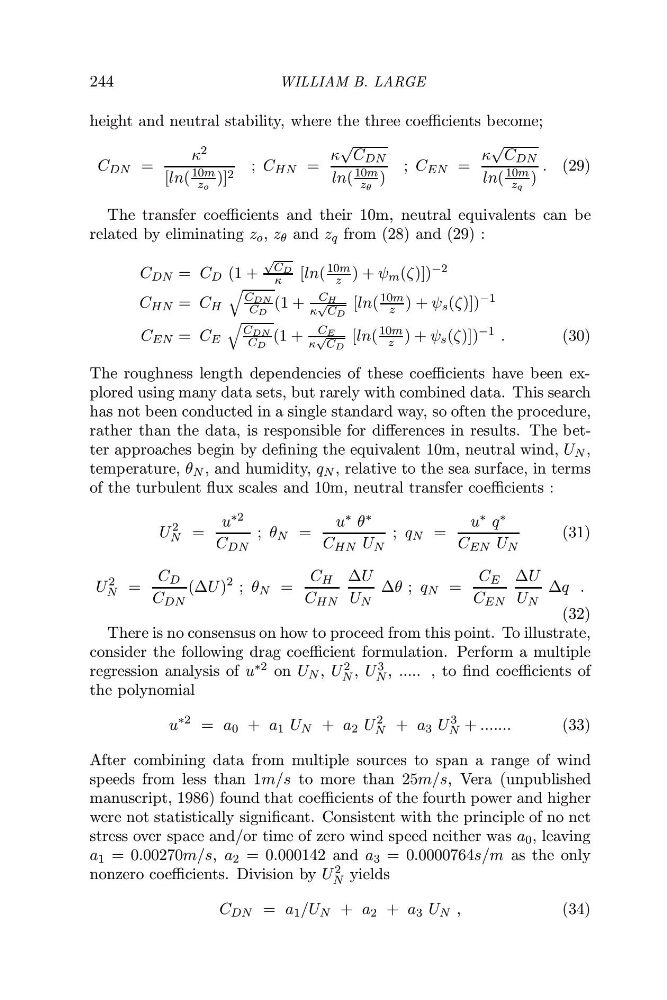
height and neutral stability, where the three coefficients become;
C DN =
κ 2
[ln(
10m
zo )] 2 ; C HN =
κ
√
C DN
ln(
10m
z θ
)
; C EN =
κ
√
C DN
ln(
10m
zq )
. (29)
The transfer coefficients and their 10m, neutral equivalents can be
related by eliminating z o , z θ and z q from (28) and (29) :
C DN = C D (1 +
√
C D
κ
[ln(
10m
z ) + ψ m (ζ)]) −2
C HN = C H
C DN
C D
(1 +
C H
κ
√
C D
[ln(
10m
z ) + ψ s (ζ)]) −1
C EN = C E
C DN
C D
(1 +
C E
κ
√
C D
[ln(
10m
z ) + ψ s (ζ)]) −1 .
(30)
The roughness length dependencies of these coefficients have been explored using many data sets, but rarely with combined data. This search
has not been conducted in a single standard way, so often the procedure,
rather than the data, is responsible for differences in results. The better approaches begin by defining the equivalent 10m, neutral wind, U N ,
temperature, θ N , and humidity, q N , relative to the sea surface, in terms
of the turbulent flux scales and 10m, neutral transfer coefficients :
U
2
N =
u ∗2
C DN
; θ N =
u ∗ θ ∗
C HN U N
; q N =
u ∗ q ∗
C EN U N
(31)
U
2
N =
C D
C DN
(∆U )
2 ; θ N =
C H
C HN
∆U
U N
∆θ ; q N =
C E
C EN
∆U
U N
∆q .
(32)
There is no consensus on how to proceed from this point. To illustrate,
consider the following drag coefficient formulation. Perform a multiple
regression analysis of u ∗2 on U N , U 2
N , U 3
N , ..... , to find coefficients of
the polynomial
u
∗2 = a 0 + a 1 U N + a 2 U
2
N + a 3 U
3
N + .......
(33)
After combining data from multiple sources to span a range of wind
speeds from less than 1m/s to more than 25m/s, Vera (unpublished
manuscript, 1986) found that coefficients of the fourth power and higher
were not statistically significant. Consistent with the principle of no net
stress over space and/or time of zero wind speed neither was a 0 , leaving
a 1 = 0.00270m/s, a 2 = 0.000142 and a 3 = 0.0000764s/m as the only
nonzero coefficients. Division by U 2
N yields
C DN = a 1 /U N + a 2 + a 3 U N ,
(34)
WILLIAM B. LARGE
height and neutral stability, where the three coefficients become;
C DN =
κ 2
[ln(
10m
zo )] 2 ; C HN =
κ
√
C DN
ln(
10m
z θ
)
; C EN =
κ
√
C DN
ln(
10m
zq )
. (29)
The transfer coefficients and their 10m, neutral equivalents can be
related by eliminating z o , z θ and z q from (28) and (29) :
C DN = C D (1 +
√
C D
κ
[ln(
10m
z ) + ψ m (ζ)]) −2
C HN = C H
C DN
C D
(1 +
C H
κ
√
C D
[ln(
10m
z ) + ψ s (ζ)]) −1
C EN = C E
C DN
C D
(1 +
C E
κ
√
C D
[ln(
10m
z ) + ψ s (ζ)]) −1 .
(30)
The roughness length dependencies of these coefficients have been explored using many data sets, but rarely with combined data. This search
has not been conducted in a single standard way, so often the procedure,
rather than the data, is responsible for differences in results. The better approaches begin by defining the equivalent 10m, neutral wind, U N ,
temperature, θ N , and humidity, q N , relative to the sea surface, in terms
of the turbulent flux scales and 10m, neutral transfer coefficients :
U
2
N =
u ∗2
C DN
; θ N =
u ∗ θ ∗
C HN U N
; q N =
u ∗ q ∗
C EN U N
(31)
U
2
N =
C D
C DN
(∆U )
2 ; θ N =
C H
C HN
∆U
U N
∆θ ; q N =
C E
C EN
∆U
U N
∆q .
(32)
There is no consensus on how to proceed from this point. To illustrate,
consider the following drag coefficient formulation. Perform a multiple
regression analysis of u ∗2 on U N , U 2
N , U 3
N , ..... , to find coefficients of
the polynomial
u
∗2 = a 0 + a 1 U N + a 2 U
2
N + a 3 U
3
N + .......
(33)
After combining data from multiple sources to span a range of wind
speeds from less than 1m/s to more than 25m/s, Vera (unpublished
manuscript, 1986) found that coefficients of the fourth power and higher
were not statistically significant. Consistent with the principle of no net
stress over space and/or time of zero wind speed neither was a 0 , leaving
a 1 = 0.00270m/s, a 2 = 0.000142 and a 3 = 0.0000764s/m as the only
nonzero coefficients. Division by U 2
N yields
C DN = a 1 /U N + a 2 + a 3 U N ,
(34)