

SUR FA CE FL UXES
243
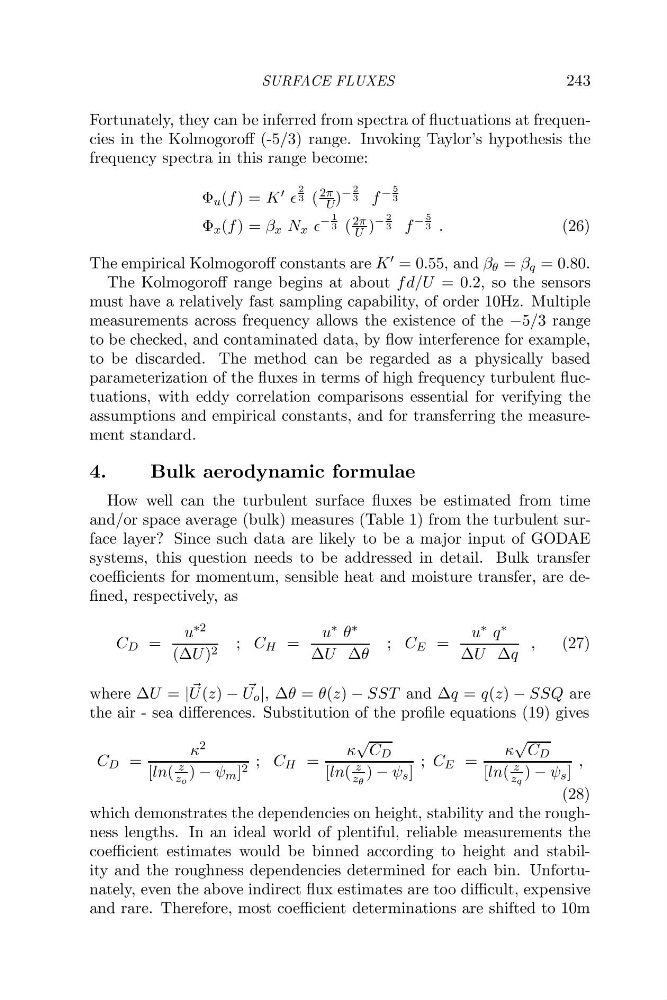
Fortunately, they can be inferred from spectra of fluctuations at frequencies in the Kolmogoroff (-513) range. Invoking Taylor's hypothesis the
frequency spectra in this range become:
The empirical Kolmogoroff constants are K' = 0.55, and Do = Dq = 0.80.
The Kolmogoroff range begins at about fd/U = 0.2, so the sensors
must have a relatively fast sampling capability, of order 10Hz. Multiple
measurements across frequency allows the existence of the -513 range
to be checked, and contaminated data, by flow interference for example,
to be discarded. The method can be regarded as a physically based
parameterization of the fluxes in terms of high frequency turbulent fluctuations, with eddy correlation comparisons essential for verifying the
assumptions and empirical constants, and for transferring the measurement standard.
4.
Bulk aerodynamic formulae
How well can the turbulent surface fluxes be estimated from time
and/or space average (bulk) measures (Table 1) from the turbulent surface layer? Since such data are likely to be a major input of GODAE
systems, this question needs to be addressed in detail. Bulk transfer
coefficients for momentum, sensible heat and moisture transfer, are defined, respectively, as
where AU = lfi(z) - ~ o l , A0 = e(z) - SST and Aq = q(z) - SSQ are
the air - sea differences. Substitution of the profile equations (19) gives
(28)
which demonstrates the dependencies on height, stability and the roughness lengths. In an ideal world of plentiful, reliable measurements the
coefficient estimates would be binned according to height and stability and the roughness dependencies determined for each bin. Unfortunately, even the above indirect flux estimates are too difficult, expensive
and rare. Therefore, most coefficient determinations are shifted to 10m
243
Fortunately, they can be inferred from spectra of fluctuations at frequencies in the Kolmogoroff (-513) range. Invoking Taylor's hypothesis the
frequency spectra in this range become:
The empirical Kolmogoroff constants are K' = 0.55, and Do = Dq = 0.80.
The Kolmogoroff range begins at about fd/U = 0.2, so the sensors
must have a relatively fast sampling capability, of order 10Hz. Multiple
measurements across frequency allows the existence of the -513 range
to be checked, and contaminated data, by flow interference for example,
to be discarded. The method can be regarded as a physically based
parameterization of the fluxes in terms of high frequency turbulent fluctuations, with eddy correlation comparisons essential for verifying the
assumptions and empirical constants, and for transferring the measurement standard.
4.
Bulk aerodynamic formulae
How well can the turbulent surface fluxes be estimated from time
and/or space average (bulk) measures (Table 1) from the turbulent surface layer? Since such data are likely to be a major input of GODAE
systems, this question needs to be addressed in detail. Bulk transfer
coefficients for momentum, sensible heat and moisture transfer, are defined, respectively, as
where AU = lfi(z) - ~ o l , A0 = e(z) - SST and Aq = q(z) - SSQ are
the air - sea differences. Substitution of the profile equations (19) gives
(28)
which demonstrates the dependencies on height, stability and the roughness lengths. In an ideal world of plentiful, reliable measurements the
coefficient estimates would be binned according to height and stability and the roughness dependencies determined for each bin. Unfortunately, even the above indirect flux estimates are too difficult, expensive
and rare. Therefore, most coefficient determinations are shifted to 10m