

242
WILLIAM B. LARGE
indicate that the limits of integration should be about fl = 4 x 10W4~/d
and f2 = 30Uld. An ensemble of heat flux cospectra is similar, with the
same stability dependence (e.g., Large and Pond, 1982). Thus at a given
height the same five decades of eddy sizes transport both the heat and
the momentum vertically. However, these limits may not apply to an
individual realization, where the low frequency cospectrum can be large
and of opposite sign than the integral. There is no standard treatment
of such cases, which adds an element of uncertainty that is difficult to
quantify without the benefit of a direct flux measurement. Practical
problems with eddy covariance measurements include the accuracy, response (set by f2) and orientation of the sensors, especially on ships and
buoys at sea. It is critical to know the alignment with the vertical so
that the measured vertical velocity is not seriously contaminated by the
much larger horizontal velocity. This problem is particularly acute in
the case of the momentum flux, because erroneous U in the w measure
ment correlates perfectly with u. The distortion of boundary layer flow
by large platforms such as ships raises similar issues as orientation.
3.2
Inertial dissipation
The inertial dissipation method is particularly well suited to moving platforms at sea, because the vertical velocity is not involved, and
a considerable degree of flow distortion can be tolerated. It is relatively indirect, but can be regarded as an acceptable standard because
of extensive comparison with eddy correlation measurements from stable platforms where flow distortion was minimal (e.g. Large and Pond,
1981; Yelland and Taylor, 1996). Measurements of the various terms in
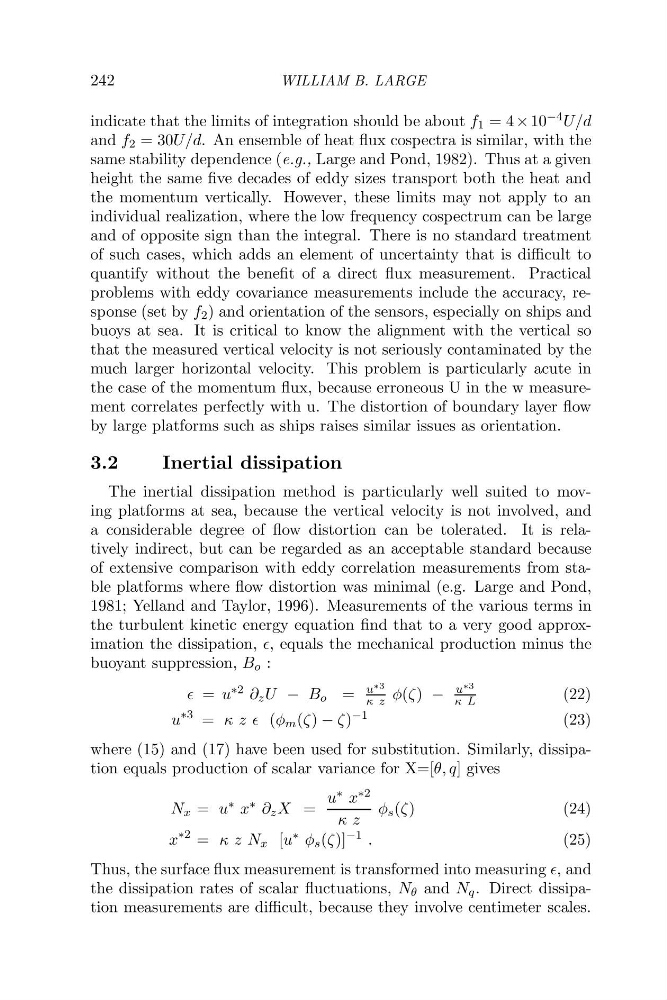
the turbulent kinetic energy equation find that to a very good approximation the dissipation, E, equals the mechanical production minus the
buoyant suppression, Bo :
where (15) and (17) have been used for substitution. Similarly, dissipation equals production of scalar variance for X=[8, q] gives
Thus, the surface flux measurement is transformed into measuring E, and
the dissipation rates of scalar fluctuations, Ne and Nq. Direct dissipation measurements are difficult, because they involve centimeter scales.
WILLIAM B. LARGE
indicate that the limits of integration should be about fl = 4 x 10W4~/d
and f2 = 30Uld. An ensemble of heat flux cospectra is similar, with the
same stability dependence (e.g., Large and Pond, 1982). Thus at a given
height the same five decades of eddy sizes transport both the heat and
the momentum vertically. However, these limits may not apply to an
individual realization, where the low frequency cospectrum can be large
and of opposite sign than the integral. There is no standard treatment
of such cases, which adds an element of uncertainty that is difficult to
quantify without the benefit of a direct flux measurement. Practical
problems with eddy covariance measurements include the accuracy, response (set by f2) and orientation of the sensors, especially on ships and
buoys at sea. It is critical to know the alignment with the vertical so
that the measured vertical velocity is not seriously contaminated by the
much larger horizontal velocity. This problem is particularly acute in
the case of the momentum flux, because erroneous U in the w measure
ment correlates perfectly with u. The distortion of boundary layer flow
by large platforms such as ships raises similar issues as orientation.
3.2
Inertial dissipation
The inertial dissipation method is particularly well suited to moving platforms at sea, because the vertical velocity is not involved, and
a considerable degree of flow distortion can be tolerated. It is relatively indirect, but can be regarded as an acceptable standard because
of extensive comparison with eddy correlation measurements from stable platforms where flow distortion was minimal (e.g. Large and Pond,
1981; Yelland and Taylor, 1996). Measurements of the various terms in
the turbulent kinetic energy equation find that to a very good approximation the dissipation, E, equals the mechanical production minus the
buoyant suppression, Bo :
where (15) and (17) have been used for substitution. Similarly, dissipation equals production of scalar variance for X=[8, q] gives
Thus, the surface flux measurement is transformed into measuring E, and
the dissipation rates of scalar fluctuations, Ne and Nq. Direct dissipation measurements are difficult, because they involve centimeter scales.