

80
3 Basics of Nonhydrostatic Modelling
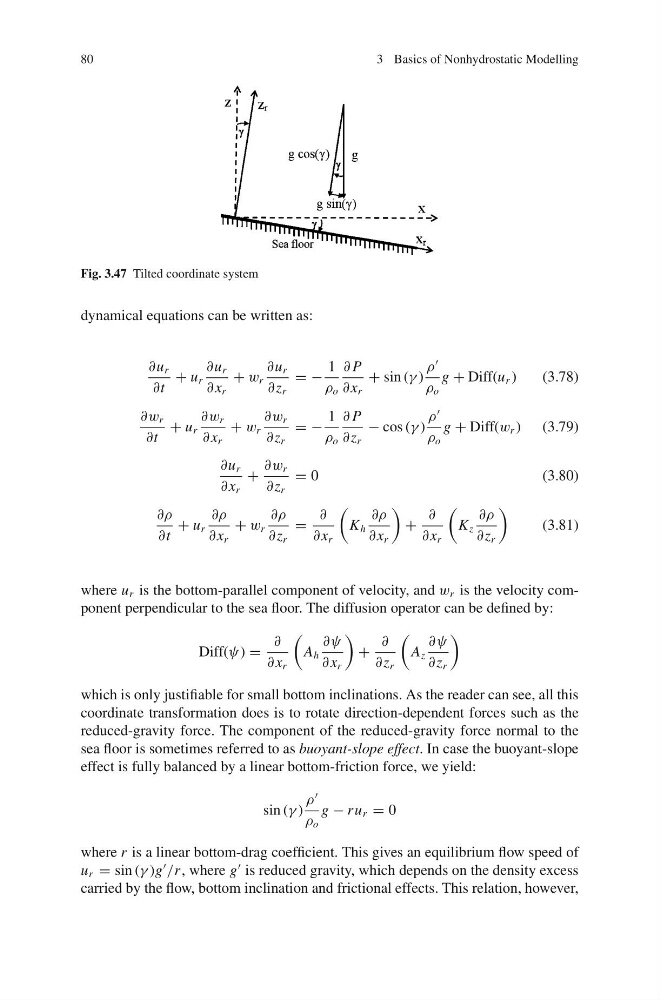
Fig. 3.47 Tilted coordinate system
dynamical equations can be written as:
∂u r
∂t
+ u r
∂u r
∂ x r
+ w r
∂u r
∂z r
= −
1
ρ o
∂ P
∂ x r
+ sin (γ )
ρ
ρ o
g + Diff(u r )
(3.78)
∂w r
∂t
+ u r
∂w r
∂ x r
+ w r
∂w r
∂z r
= −
1
ρ o
∂ P
∂z r
− cos (γ )
ρ
ρ o
g + Diff(w r ) (3.79)
∂u r
∂ x r
+
∂w r
∂z r
= 0
(3.80)
∂ρ
∂t
+ u r
∂ρ
∂ x r
+ w r
∂ρ
∂z r
=
∂
∂ x r
K h
∂ρ
∂ x r
+
∂
∂ x r
K z
∂ρ
∂z r
(3.81)
where u r is the bottom-parallel component of velocity, and w r is the velocity component perpendicular to the sea floor. The diffusion operator can be defined by:
Diff(ψ) =
∂
∂ x r
A h
∂ψ
∂ x r
+
∂
∂z r
A z
∂ψ
∂z r
which is only justifiable for small bottom inclinations. As the reader can see, all this
coordinate transformation does is to rotate direction-dependent forces such as the
reduced-gravity force. The component of the reduced-gravity force normal to the
sea floor is sometimes referred to as buoyant-slope effect. In case the buoyant-slope
effect is fully balanced by a linear bottom-friction force, we yield:
sin (γ )
ρ
ρ o
g − ru r = 0
where r is a linear bottom-drag coefficient. This gives an equilibrium flow speed of
u r = sin (γ )g
/r , where g
is reduced gravity, which depends on the density excess
carried by the flow, bottom inclination and frictional effects. This relation, however,
3 Basics of Nonhydrostatic Modelling
Fig. 3.47 Tilted coordinate system
dynamical equations can be written as:
∂u r
∂t
+ u r
∂u r
∂ x r
+ w r
∂u r
∂z r
= −
1
ρ o
∂ P
∂ x r
+ sin (γ )
ρ
ρ o
g + Diff(u r )
(3.78)
∂w r
∂t
+ u r
∂w r
∂ x r
+ w r
∂w r
∂z r
= −
1
ρ o
∂ P
∂z r
− cos (γ )
ρ
ρ o
g + Diff(w r ) (3.79)
∂u r
∂ x r
+
∂w r
∂z r
= 0
(3.80)
∂ρ
∂t
+ u r
∂ρ
∂ x r
+ w r
∂ρ
∂z r
=
∂
∂ x r
K h
∂ρ
∂ x r
+
∂
∂ x r
K z
∂ρ
∂z r
(3.81)
where u r is the bottom-parallel component of velocity, and w r is the velocity component perpendicular to the sea floor. The diffusion operator can be defined by:
Diff(ψ) =
∂
∂ x r
A h
∂ψ
∂ x r
+
∂
∂z r
A z
∂ψ
∂z r
which is only justifiable for small bottom inclinations. As the reader can see, all this
coordinate transformation does is to rotate direction-dependent forces such as the
reduced-gravity force. The component of the reduced-gravity force normal to the
sea floor is sometimes referred to as buoyant-slope effect. In case the buoyant-slope
effect is fully balanced by a linear bottom-friction force, we yield:
sin (γ )
ρ
ρ o
g − ru r = 0
where r is a linear bottom-drag coefficient. This gives an equilibrium flow speed of
u r = sin (γ )g
/r , where g
is reduced gravity, which depends on the density excess
carried by the flow, bottom inclination and frictional effects. This relation, however,