

3.21 Tilted Coordinate Systems
79
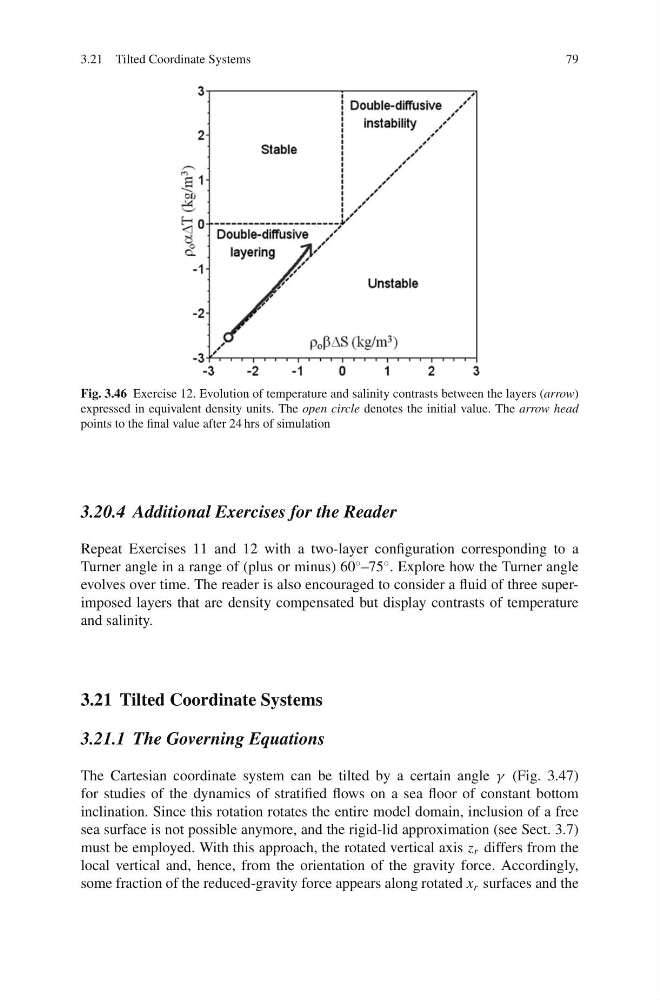
Fig. 3.46 Exercise 12. Evolution of temperature and salinity contrasts between the layers (arrow)
expressed in equivalent density units. The open circle denotes the initial value. The arrow head
points to the final value after 24 hrs of simulation
3.20.4 Additional Exercises for the Reader
Repeat Exercises 11 and 12 with a two-layer configuration corresponding to a
Turner angle in a range of (plus or minus) 60
◦ –75
◦ . Explore how the Turner angle
evolves over time. The reader is also encouraged to consider a fluid of three superimposed layers that are density compensated but display contrasts of temperature
and salinity.
3.21 Tilted Coordinate Systems
3.21.1 The Governing Equations
The Cartesian coordinate system can be tilted by a certain angle γ (Fig. 3.47)
for studies of the dynamics of stratified flows on a sea floor of constant bottom
inclination. Since this rotation rotates the entire model domain, inclusion of a free
sea surface is not possible anymore, and the rigid-lid approximation (see Sect. 3.7)
must be employed. With this approach, the rotated vertical axis z r differs from the
local vertical and, hence, from the orientation of the gravity force. Accordingly,
some fraction of the reduced-gravity force appears along rotated x r surfaces and the
79
Fig. 3.46 Exercise 12. Evolution of temperature and salinity contrasts between the layers (arrow)
expressed in equivalent density units. The open circle denotes the initial value. The arrow head
points to the final value after 24 hrs of simulation
3.20.4 Additional Exercises for the Reader
Repeat Exercises 11 and 12 with a two-layer configuration corresponding to a
Turner angle in a range of (plus or minus) 60
◦ –75
◦ . Explore how the Turner angle
evolves over time. The reader is also encouraged to consider a fluid of three superimposed layers that are density compensated but display contrasts of temperature
and salinity.
3.21 Tilted Coordinate Systems
3.21.1 The Governing Equations
The Cartesian coordinate system can be tilted by a certain angle γ (Fig. 3.47)
for studies of the dynamics of stratified flows on a sea floor of constant bottom
inclination. Since this rotation rotates the entire model domain, inclusion of a free
sea surface is not possible anymore, and the rigid-lid approximation (see Sect. 3.7)
must be employed. With this approach, the rotated vertical axis z r differs from the
local vertical and, hence, from the orientation of the gravity force. Accordingly,
some fraction of the reduced-gravity force appears along rotated x r surfaces and the