

60
3 Basics of Nonhydrostatic Modelling
throughout the surface mixed layer equals that found at depth h; that is,
ρ mi x = ρ o
1 +
N
2
g
h
The temporal derivative of the latter equation gives:
dρ mi x
dt
= ρ o
N
2
g
dh
dt
Using Eq. (3.66) gives the relation (Turner, 1973):
h
dh
dt
= 0.5
dh
2
dt
=
B
N 2
(3.67)
which has the solution:
h(t) =
2 B
N 2 · t
Accordingly, for a constant surface buoyancy flux, convective mixed-layer deepening slows down with time in a square-root fashion. For a given surface buoyancy
flux, on the other hand, weaker ambient density stratification promotes a more rapid
convective mixed-layer deepening.
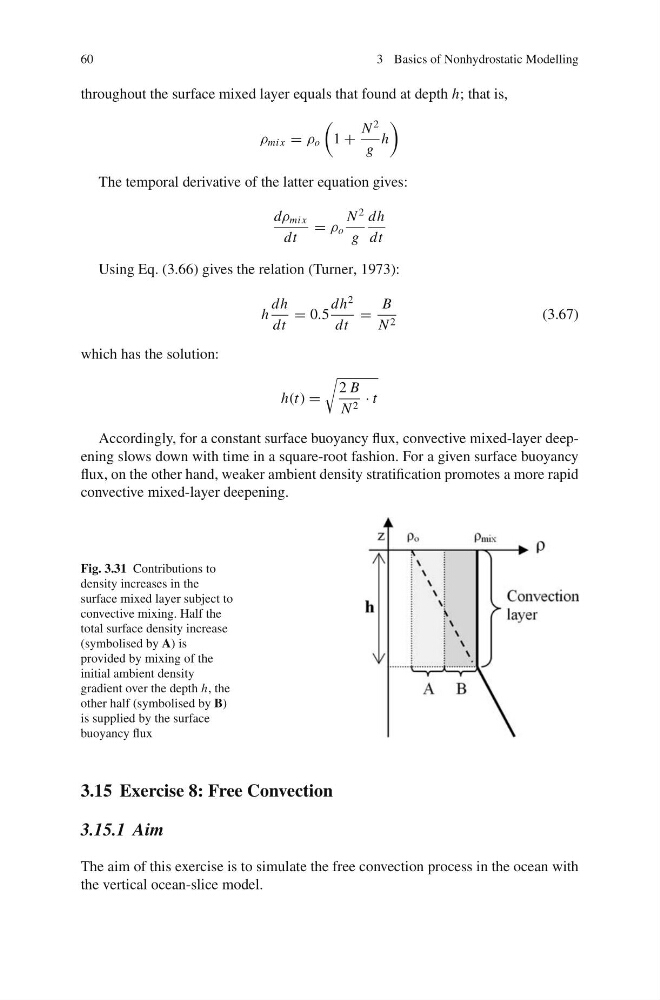
Fig. 3.31 Contributions to
density increases in the
surface mixed layer subject to
convective mixing. Half the
total surface density increase
(symbolised by A) is
provided by mixing of the
initial ambient density
gradient over the depth h, the
other half (symbolised by B)
is supplied by the surface
buoyancy flux
3.15 Exercise 8: Free Convection
3.15.1 Aim
The aim of this exercise is to simulate the free convection process in the ocean with
the vertical ocean-slice model.
3 Basics of Nonhydrostatic Modelling
throughout the surface mixed layer equals that found at depth h; that is,
ρ mi x = ρ o
1 +
N
2
g
h
The temporal derivative of the latter equation gives:
dρ mi x
dt
= ρ o
N
2
g
dh
dt
Using Eq. (3.66) gives the relation (Turner, 1973):
h
dh
dt
= 0.5
dh
2
dt
=
B
N 2
(3.67)
which has the solution:
h(t) =
2 B
N 2 · t
Accordingly, for a constant surface buoyancy flux, convective mixed-layer deepening slows down with time in a square-root fashion. For a given surface buoyancy
flux, on the other hand, weaker ambient density stratification promotes a more rapid
convective mixed-layer deepening.
Fig. 3.31 Contributions to
density increases in the
surface mixed layer subject to
convective mixing. Half the
total surface density increase
(symbolised by A) is
provided by mixing of the
initial ambient density
gradient over the depth h, the
other half (symbolised by B)
is supplied by the surface
buoyancy flux
3.15 Exercise 8: Free Convection
3.15.1 Aim
The aim of this exercise is to simulate the free convection process in the ocean with
the vertical ocean-slice model.