

3.14 Oceanic Convection
59
Considerations of Rayleigh numbers are useful for studies of the onset of convection in laboratory settings and computer-based simulations. Values of critical
flux-Rayleigh numbers in the real situation, however, are not known with any certainty.
3.14.4 Aspect Ratio of Convection Cells
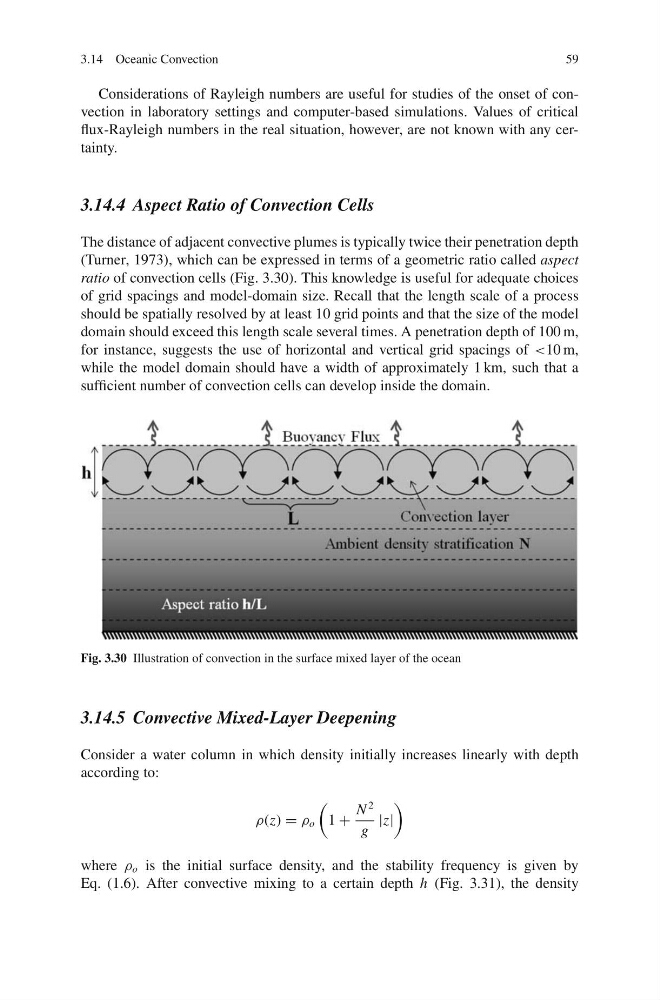
The distance of adjacent convective plumes is typically twice their penetration depth
(Turner, 1973), which can be expressed in terms of a geometric ratio called aspect
ratio of convection cells (Fig. 3.30). This knowledge is useful for adequate choices
of grid spacings and model-domain size. Recall that the length scale of a process
should be spatially resolved by at least 10 grid points and that the size of the model
domain should exceed this length scale several times. A penetration depth of 100 m,
for instance, suggests the use of horizontal and vertical grid spacings of <10 m,
while the model domain should have a width of approximately 1 km, such that a
sufficient number of convection cells can develop inside the domain.
Fig. 3.30 Illustration of convection in the surface mixed layer of the ocean
3.14.5 Convective Mixed-Layer Deepening
Consider a water column in which density initially increases linearly with depth
according to:
ρ(z) = ρ o
1 +
N
2
g
|z|
where ρ o is the initial surface density, and the stability frequency is given by
Eq. (1.6). After convective mixing to a certain depth h (Fig. 3.31), the density
59
Considerations of Rayleigh numbers are useful for studies of the onset of convection in laboratory settings and computer-based simulations. Values of critical
flux-Rayleigh numbers in the real situation, however, are not known with any certainty.
3.14.4 Aspect Ratio of Convection Cells
The distance of adjacent convective plumes is typically twice their penetration depth
(Turner, 1973), which can be expressed in terms of a geometric ratio called aspect
ratio of convection cells (Fig. 3.30). This knowledge is useful for adequate choices
of grid spacings and model-domain size. Recall that the length scale of a process
should be spatially resolved by at least 10 grid points and that the size of the model
domain should exceed this length scale several times. A penetration depth of 100 m,
for instance, suggests the use of horizontal and vertical grid spacings of <10 m,
while the model domain should have a width of approximately 1 km, such that a
sufficient number of convection cells can develop inside the domain.
Fig. 3.30 Illustration of convection in the surface mixed layer of the ocean
3.14.5 Convective Mixed-Layer Deepening
Consider a water column in which density initially increases linearly with depth
according to:
ρ(z) = ρ o
1 +
N
2
g
|z|
where ρ o is the initial surface density, and the stability frequency is given by
Eq. (1.6). After convective mixing to a certain depth h (Fig. 3.31), the density