

44
3 Basics of Nonhydrostatic Modelling
3.8 Internal Waves
3.8.1 Theory
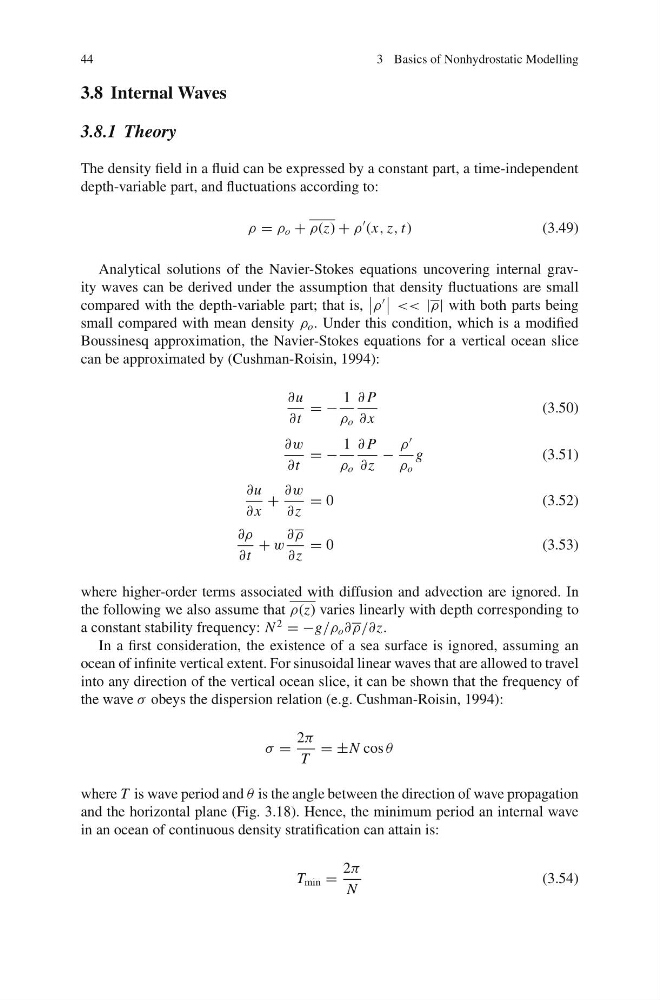
The density field in a fluid can be expressed by a constant part, a time-independent
depth-variable part, and fluctuations according to:
ρ = ρ o + ρ(z) + ρ
(x, z, t)
(3.49)
Analytical solutions of the Navier-Stokes equations uncovering internal gravity waves can be derived under the assumption that density fluctuations are small
compared with the depth-variable part; that is,
ρ
<< |ρ| with both parts being
small compared with mean density ρ o . Under this condition, which is a modified
Boussinesq approximation, the Navier-Stokes equations for a vertical ocean slice
can be approximated by (Cushman-Roisin, 1994):
∂u
∂t
= −
1
ρ o
∂ P
∂ x
(3.50)
∂w
∂t
= −
1
ρ o
∂ P
∂z
−
ρ
ρ o
g
(3.51)
∂u
∂ x
+
∂w
∂z
= 0
(3.52)
∂ρ
∂t
+ w
∂ρ
∂z
= 0
(3.53)
where higher-order terms associated with diffusion and advection are ignored. In
the following we also assume that ρ(z) varies linearly with depth corresponding to
a constant stability frequency: N
2
= −g/ρ o ∂ρ/∂z.
In a first consideration, the existence of a sea surface is ignored, assuming an
ocean of infinite vertical extent. For sinusoidal linear waves that are allowed to travel
into any direction of the vertical ocean slice, it can be shown that the frequency of
the wave σ obeys the dispersion relation (e.g. Cushman-Roisin, 1994):
σ =
2π
T
= ±N cos θ
where T is wave period and θ is the angle between the direction of wave propagation
and the horizontal plane (Fig. 3.18). Hence, the minimum period an internal wave
in an ocean of continuous density stratification can attain is:
T min =
2π
N
(3.54)
3 Basics of Nonhydrostatic Modelling
3.8 Internal Waves
3.8.1 Theory
The density field in a fluid can be expressed by a constant part, a time-independent
depth-variable part, and fluctuations according to:
ρ = ρ o + ρ(z) + ρ
(x, z, t)
(3.49)
Analytical solutions of the Navier-Stokes equations uncovering internal gravity waves can be derived under the assumption that density fluctuations are small
compared with the depth-variable part; that is,
ρ
<< |ρ| with both parts being
small compared with mean density ρ o . Under this condition, which is a modified
Boussinesq approximation, the Navier-Stokes equations for a vertical ocean slice
can be approximated by (Cushman-Roisin, 1994):
∂u
∂t
= −
1
ρ o
∂ P
∂ x
(3.50)
∂w
∂t
= −
1
ρ o
∂ P
∂z
−
ρ
ρ o
g
(3.51)
∂u
∂ x
+
∂w
∂z
= 0
(3.52)
∂ρ
∂t
+ w
∂ρ
∂z
= 0
(3.53)
where higher-order terms associated with diffusion and advection are ignored. In
the following we also assume that ρ(z) varies linearly with depth corresponding to
a constant stability frequency: N
2
= −g/ρ o ∂ρ/∂z.
In a first consideration, the existence of a sea surface is ignored, assuming an
ocean of infinite vertical extent. For sinusoidal linear waves that are allowed to travel
into any direction of the vertical ocean slice, it can be shown that the frequency of
the wave σ obeys the dispersion relation (e.g. Cushman-Roisin, 1994):
σ =
2π
T
= ±N cos θ
where T is wave period and θ is the angle between the direction of wave propagation
and the horizontal plane (Fig. 3.18). Hence, the minimum period an internal wave
in an ocean of continuous density stratification can attain is:
T min =
2π
N
(3.54)