

3.8 Internal Waves
45
which implies purely horizontal propagation. This corresponds to the period of
oscillations experienced by a buoyant object in a stratified fluid (see Sect. 3.10 of
K¨ ampf (2009)). Consequently, such internal waves propagate at a phase speed of:
c =
λ
T
= ±
λN cos (θ)
2π
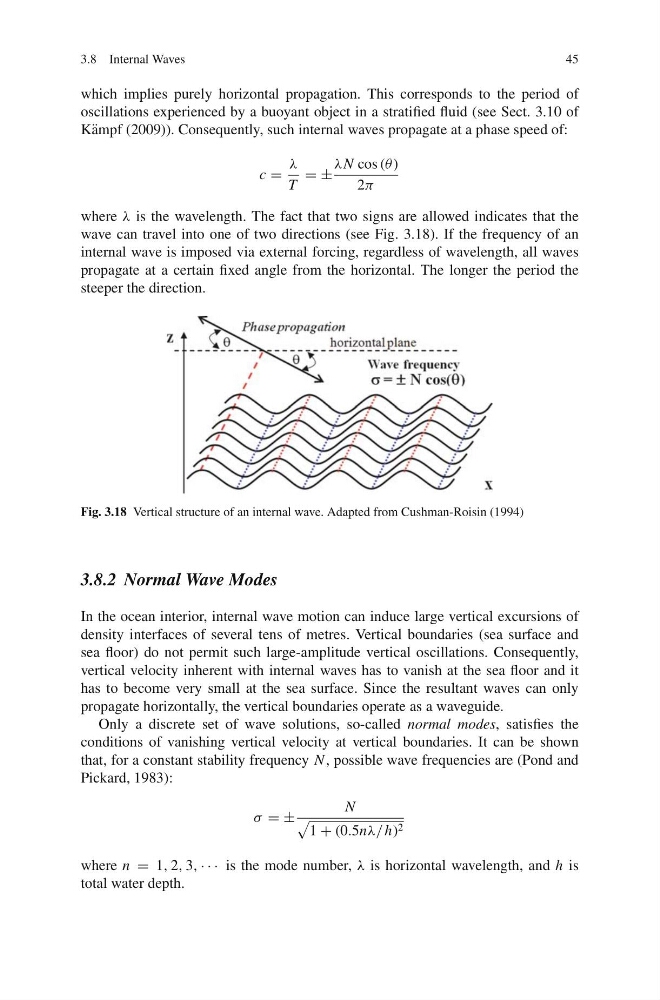
where λ is the wavelength. The fact that two signs are allowed indicates that the
wave can travel into one of two directions (see Fig. 3.18). If the frequency of an
internal wave is imposed via external forcing, regardless of wavelength, all waves
propagate at a certain fixed angle from the horizontal. The longer the period the
steeper the direction.
Fig. 3.18 Vertical structure of an internal wave. Adapted from Cushman-Roisin (1994)
3.8.2 Normal Wave Modes
In the ocean interior, internal wave motion can induce large vertical excursions of
density interfaces of several tens of metres. Vertical boundaries (sea surface and
sea floor) do not permit such large-amplitude vertical oscillations. Consequently,
vertical velocity inherent with internal waves has to vanish at the sea floor and it
has to become very small at the sea surface. Since the resultant waves can only
propagate horizontally, the vertical boundaries operate as a waveguide.
Only a discrete set of wave solutions, so-called normal modes, satisfies the
conditions of vanishing vertical velocity at vertical boundaries. It can be shown
that, for a constant stability frequency N , possible wave frequencies are (Pond and
Pickard, 1983):
σ = ±
N
1 + (0.5nλ/ h) 2
where n = 1, 2, 3, · · · is the mode number, λ is horizontal wavelength, and h is
total water depth.
45
which implies purely horizontal propagation. This corresponds to the period of
oscillations experienced by a buoyant object in a stratified fluid (see Sect. 3.10 of
K¨ ampf (2009)). Consequently, such internal waves propagate at a phase speed of:
c =
λ
T
= ±
λN cos (θ)
2π
where λ is the wavelength. The fact that two signs are allowed indicates that the
wave can travel into one of two directions (see Fig. 3.18). If the frequency of an
internal wave is imposed via external forcing, regardless of wavelength, all waves
propagate at a certain fixed angle from the horizontal. The longer the period the
steeper the direction.
Fig. 3.18 Vertical structure of an internal wave. Adapted from Cushman-Roisin (1994)
3.8.2 Normal Wave Modes
In the ocean interior, internal wave motion can induce large vertical excursions of
density interfaces of several tens of metres. Vertical boundaries (sea surface and
sea floor) do not permit such large-amplitude vertical oscillations. Consequently,
vertical velocity inherent with internal waves has to vanish at the sea floor and it
has to become very small at the sea surface. Since the resultant waves can only
propagate horizontally, the vertical boundaries operate as a waveguide.
Only a discrete set of wave solutions, so-called normal modes, satisfies the
conditions of vanishing vertical velocity at vertical boundaries. It can be shown
that, for a constant stability frequency N , possible wave frequencies are (Pond and
Pickard, 1983):
σ = ±
N
1 + (0.5nλ/ h) 2
where n = 1, 2, 3, · · · is the mode number, λ is horizontal wavelength, and h is
total water depth.