

3.7 Exercise 4: Density-Driven Flows
43
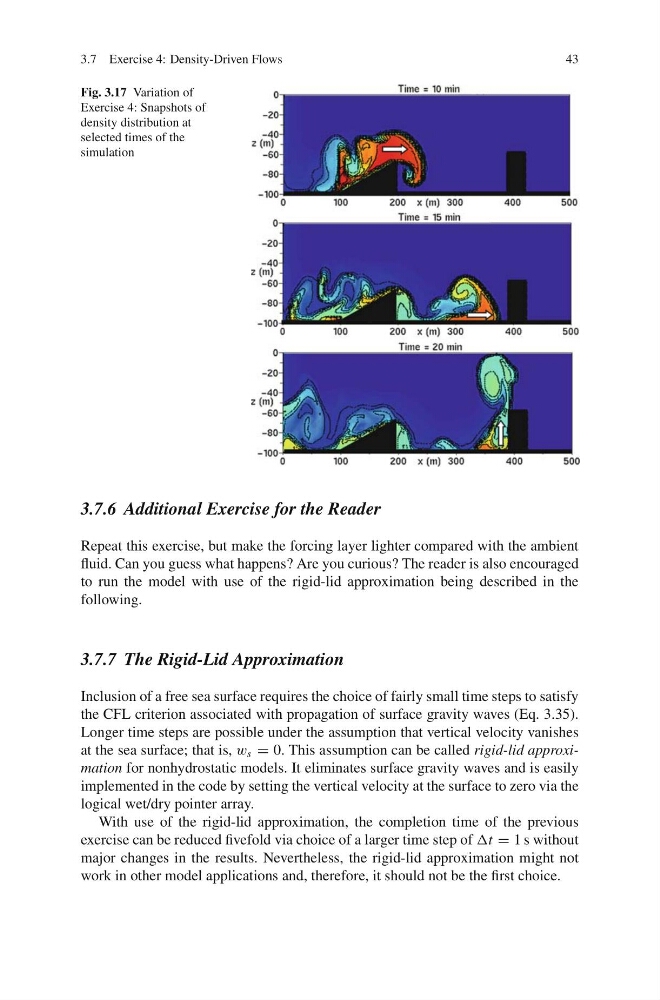
Fig. 3.17 Variation of
Exercise 4: Snapshots of
density distribution at
selected times of the
simulation
3.7.6 Additional Exercise for the Reader
Repeat this exercise, but make the forcing layer lighter compared with the ambient
fluid. Can you guess what happens? Are you curious? The reader is also encouraged
to run the model with use of the rigid-lid approximation being described in the
following.
3.7.7 The Rigid-Lid Approximation
Inclusion of a free sea surface requires the choice of fairly small time steps to satisfy
the CFL criterion associated with propagation of surface gravity waves (Eq. 3.35).
Longer time steps are possible under the assumption that vertical velocity vanishes
at the sea surface; that is, w s = 0. This assumption can be called rigid-lid approximation for nonhydrostatic models. It eliminates surface gravity waves and is easily
implemented in the code by setting the vertical velocity at the surface to zero via the
logical wet/dry pointer array.
With use of the rigid-lid approximation, the completion time of the previous
exercise can be reduced fivefold via choice of a larger time step of Δt = 1 s without
major changes in the results. Nevertheless, the rigid-lid approximation might not
work in other model applications and, therefore, it should not be the first choice.
43
Fig. 3.17 Variation of
Exercise 4: Snapshots of
density distribution at
selected times of the
simulation
3.7.6 Additional Exercise for the Reader
Repeat this exercise, but make the forcing layer lighter compared with the ambient
fluid. Can you guess what happens? Are you curious? The reader is also encouraged
to run the model with use of the rigid-lid approximation being described in the
following.
3.7.7 The Rigid-Lid Approximation
Inclusion of a free sea surface requires the choice of fairly small time steps to satisfy
the CFL criterion associated with propagation of surface gravity waves (Eq. 3.35).
Longer time steps are possible under the assumption that vertical velocity vanishes
at the sea surface; that is, w s = 0. This assumption can be called rigid-lid approximation for nonhydrostatic models. It eliminates surface gravity waves and is easily
implemented in the code by setting the vertical velocity at the surface to zero via the
logical wet/dry pointer array.
With use of the rigid-lid approximation, the completion time of the previous
exercise can be reduced fivefold via choice of a larger time step of Δt = 1 s without
major changes in the results. Nevertheless, the rigid-lid approximation might not
work in other model applications and, therefore, it should not be the first choice.