

34
3 Basics of Nonhydrostatic Modelling
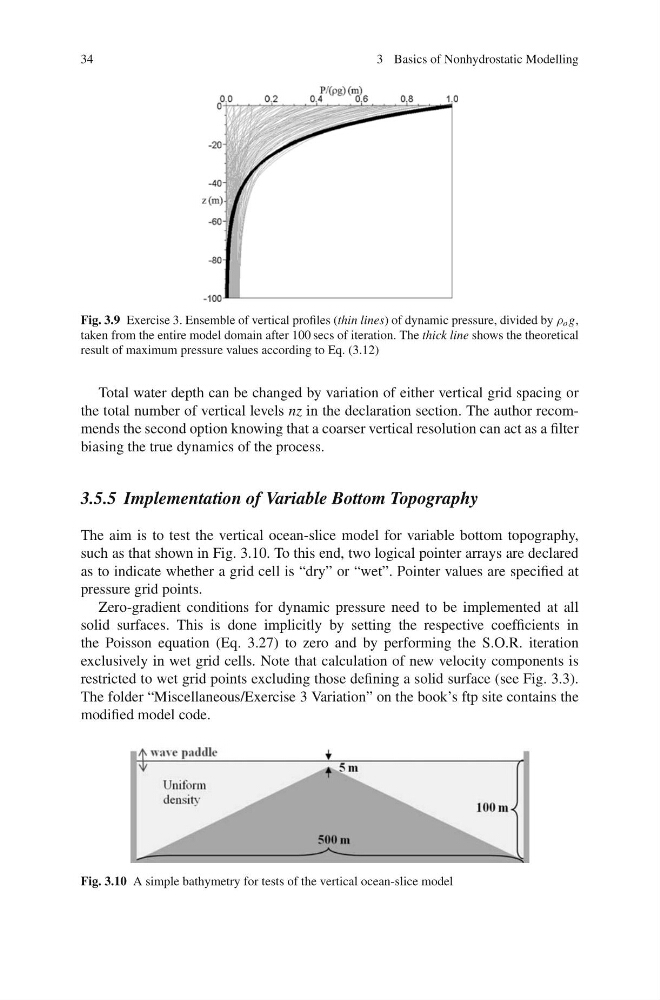
Fig. 3.9 Exercise 3. Ensemble of vertical profiles (thin lines) of dynamic pressure, divided by ρ o g,
taken from the entire model domain after 100 secs of iteration. The thick line shows the theoretical
result of maximum pressure values according to Eq. (3.12)
Total water depth can be changed by variation of either vertical grid spacing or
the total number of vertical levels nz in the declaration section. The author recommends the second option knowing that a coarser vertical resolution can act as a filter
biasing the true dynamics of the process.
3.5.5 Implementation of Variable Bottom Topography
The aim is to test the vertical ocean-slice model for variable bottom topography,
such as that shown in Fig. 3.10. To this end, two logical pointer arrays are declared
as to indicate whether a grid cell is “dry” or “wet”. Pointer values are specified at
pressure grid points.
Zero-gradient conditions for dynamic pressure need to be implemented at all
solid surfaces. This is done implicitly by setting the respective coefficients in
the Poisson equation (Eq. 3.27) to zero and by performing the S.O.R. iteration
exclusively in wet grid cells. Note that calculation of new velocity components is
restricted to wet grid points excluding those defining a solid surface (see Fig. 3.3).
The folder “Miscellaneous/Exercise 3 Variation” on the book’s ftp site contains the
modified model code.
Fig. 3.10 A simple bathymetry for tests of the vertical ocean-slice model
3 Basics of Nonhydrostatic Modelling
Fig. 3.9 Exercise 3. Ensemble of vertical profiles (thin lines) of dynamic pressure, divided by ρ o g,
taken from the entire model domain after 100 secs of iteration. The thick line shows the theoretical
result of maximum pressure values according to Eq. (3.12)
Total water depth can be changed by variation of either vertical grid spacing or
the total number of vertical levels nz in the declaration section. The author recommends the second option knowing that a coarser vertical resolution can act as a filter
biasing the true dynamics of the process.
3.5.5 Implementation of Variable Bottom Topography
The aim is to test the vertical ocean-slice model for variable bottom topography,
such as that shown in Fig. 3.10. To this end, two logical pointer arrays are declared
as to indicate whether a grid cell is “dry” or “wet”. Pointer values are specified at
pressure grid points.
Zero-gradient conditions for dynamic pressure need to be implemented at all
solid surfaces. This is done implicitly by setting the respective coefficients in
the Poisson equation (Eq. 3.27) to zero and by performing the S.O.R. iteration
exclusively in wet grid cells. Note that calculation of new velocity components is
restricted to wet grid points excluding those defining a solid surface (see Fig. 3.3).
The folder “Miscellaneous/Exercise 3 Variation” on the book’s ftp site contains the
modified model code.
Fig. 3.10 A simple bathymetry for tests of the vertical ocean-slice model