

26
3 Basics of Nonhydrostatic Modelling
The folder “Miscellaneous/Dispersion Relation Calculator” on the book’s ftp site
contains a SciLab script with which the reader can compute either phase speed or
period of surface gravity waves from user-specified values of total water depth and
wavelength.
3.3.3 Orbital Motions of Water Particles and Wave Pressure
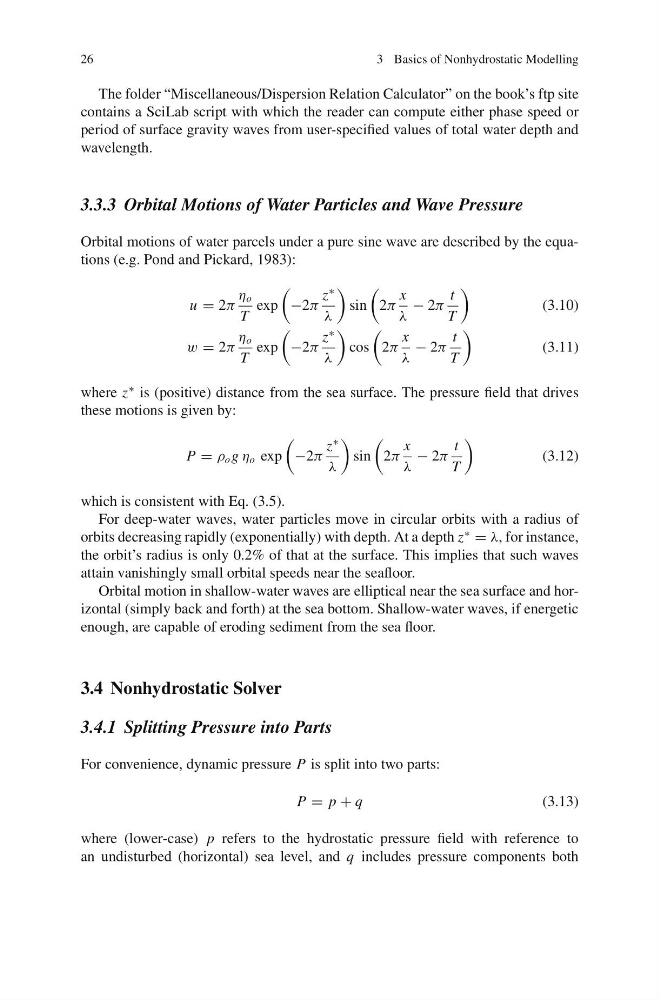
Orbital motions of water parcels under a pure sine wave are described by the equations (e.g. Pond and Pickard, 1983):
u = 2π
η o
T
exp
−2π
z
∗
λ
sin
2π
x
λ
− 2π
t
T
(3.10)
w = 2π
η o
T
exp
−2π
z
∗
λ
cos
2π
x
λ
− 2π
t
T
(3.11)
where z
∗ is (positive) distance from the sea surface. The pressure field that drives
these motions is given by:
P = ρ o g η o exp
−2π
z
∗
λ
sin
2π
x
λ
− 2π
t
T
(3.12)
which is consistent with Eq. (3.5).
For deep-water waves, water particles move in circular orbits with a radius of
orbits decreasing rapidly (exponentially) with depth. At a depth z
∗
= λ, for instance,
the orbit’s radius is only 0.2% of that at the surface. This implies that such waves
attain vanishingly small orbital speeds near the seafloor.
Orbital motion in shallow-water waves are elliptical near the sea surface and horizontal (simply back and forth) at the sea bottom. Shallow-water waves, if energetic
enough, are capable of eroding sediment from the sea floor.
3.4 Nonhydrostatic Solver
3.4.1 Splitting Pressure into Parts
For convenience, dynamic pressure P is split into two parts:
P = p + q
(3.13)
where (lower-case) p refers to the hydrostatic pressure field with reference to
an undisturbed (horizontal) sea level, and q includes pressure components both
3 Basics of Nonhydrostatic Modelling
The folder “Miscellaneous/Dispersion Relation Calculator” on the book’s ftp site
contains a SciLab script with which the reader can compute either phase speed or
period of surface gravity waves from user-specified values of total water depth and
wavelength.
3.3.3 Orbital Motions of Water Particles and Wave Pressure
Orbital motions of water parcels under a pure sine wave are described by the equations (e.g. Pond and Pickard, 1983):
u = 2π
η o
T
exp
−2π
z
∗
λ
sin
2π
x
λ
− 2π
t
T
(3.10)
w = 2π
η o
T
exp
−2π
z
∗
λ
cos
2π
x
λ
− 2π
t
T
(3.11)
where z
∗ is (positive) distance from the sea surface. The pressure field that drives
these motions is given by:
P = ρ o g η o exp
−2π
z
∗
λ
sin
2π
x
λ
− 2π
t
T
(3.12)
which is consistent with Eq. (3.5).
For deep-water waves, water particles move in circular orbits with a radius of
orbits decreasing rapidly (exponentially) with depth. At a depth z
∗
= λ, for instance,
the orbit’s radius is only 0.2% of that at the surface. This implies that such waves
attain vanishingly small orbital speeds near the seafloor.
Orbital motion in shallow-water waves are elliptical near the sea surface and horizontal (simply back and forth) at the sea bottom. Shallow-water waves, if energetic
enough, are capable of eroding sediment from the sea floor.
3.4 Nonhydrostatic Solver
3.4.1 Splitting Pressure into Parts
For convenience, dynamic pressure P is split into two parts:
P = p + q
(3.13)
where (lower-case) p refers to the hydrostatic pressure field with reference to
an undisturbed (horizontal) sea level, and q includes pressure components both