

3.3 Surface Gravity Waves
25
where η o is wave amplitude, λ is wavelength and T is wave period, the solution of
Eqs. (3.3, 3.4, and 3.5) are surface gravity waves that for an ocean of uniform depth
h obey the dispersion relation (e.g. Pond and Pickard, 1983):
c =
λ
T
=
gλ
2π
tanh
2π
h
λ
(3.7)
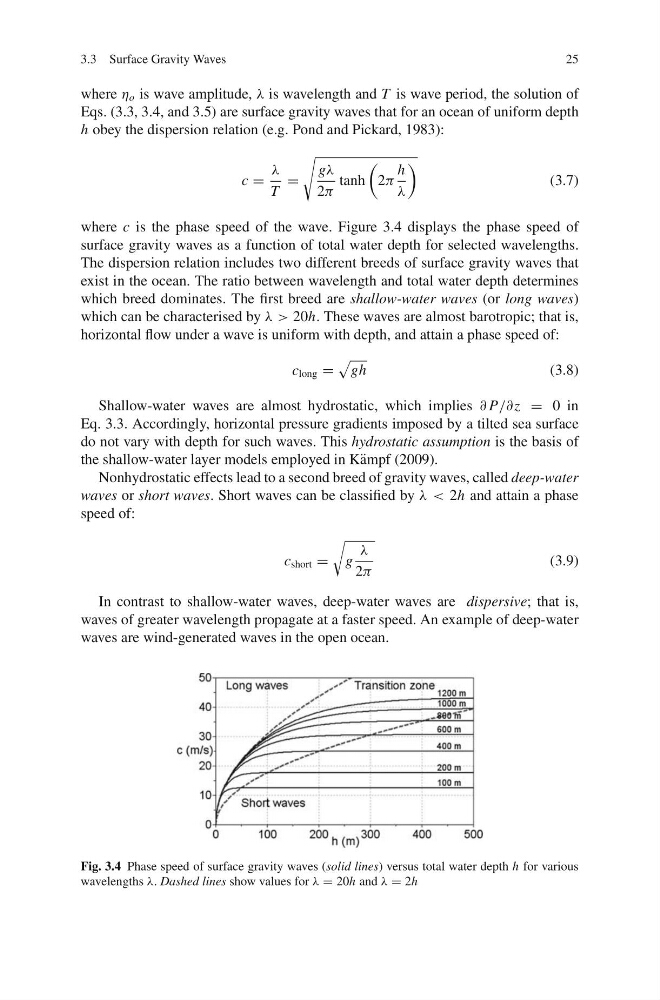
where c is the phase speed of the wave. Figure 3.4 displays the phase speed of
surface gravity waves as a function of total water depth for selected wavelengths.
The dispersion relation includes two different breeds of surface gravity waves that
exist in the ocean. The ratio between wavelength and total water depth determines
which breed dominates. The first breed are shallow-water waves (or long waves)
which can be characterised by λ > 20h. These waves are almost barotropic; that is,
horizontal flow under a wave is uniform with depth, and attain a phase speed of:
c long =
gh
(3.8)
Shallow-water waves are almost hydrostatic, which implies ∂ P/∂z = 0 in
Eq. 3.3. Accordingly, horizontal pressure gradients imposed by a tilted sea surface
do not vary with depth for such waves. This hydrostatic assumption is the basis of
the shallow-water layer models employed in K¨ ampf (2009).
Nonhydrostatic effects lead to a second breed of gravity waves, called deep-water
waves or short waves. Short waves can be classified by λ < 2h and attain a phase
speed of:
c short =
g
λ
2π
(3.9)
In contrast to shallow-water waves, deep-water waves are dispersive; that is,
waves of greater wavelength propagate at a faster speed. An example of deep-water
waves are wind-generated waves in the open ocean.
Fig. 3.4 Phase speed of surface gravity waves (solid lines) versus total water depth h for various
wavelengths λ. Dashed lines show values for λ = 20h and λ = 2h
25
where η o is wave amplitude, λ is wavelength and T is wave period, the solution of
Eqs. (3.3, 3.4, and 3.5) are surface gravity waves that for an ocean of uniform depth
h obey the dispersion relation (e.g. Pond and Pickard, 1983):
c =
λ
T
=
gλ
2π
tanh
2π
h
λ
(3.7)
where c is the phase speed of the wave. Figure 3.4 displays the phase speed of
surface gravity waves as a function of total water depth for selected wavelengths.
The dispersion relation includes two different breeds of surface gravity waves that
exist in the ocean. The ratio between wavelength and total water depth determines
which breed dominates. The first breed are shallow-water waves (or long waves)
which can be characterised by λ > 20h. These waves are almost barotropic; that is,
horizontal flow under a wave is uniform with depth, and attain a phase speed of:
c long =
gh
(3.8)
Shallow-water waves are almost hydrostatic, which implies ∂ P/∂z = 0 in
Eq. 3.3. Accordingly, horizontal pressure gradients imposed by a tilted sea surface
do not vary with depth for such waves. This hydrostatic assumption is the basis of
the shallow-water layer models employed in K¨ ampf (2009).
Nonhydrostatic effects lead to a second breed of gravity waves, called deep-water
waves or short waves. Short waves can be classified by λ < 2h and attain a phase
speed of:
c short =
g
λ
2π
(3.9)
In contrast to shallow-water waves, deep-water waves are dispersive; that is,
waves of greater wavelength propagate at a faster speed. An example of deep-water
waves are wind-generated waves in the open ocean.
Fig. 3.4 Phase speed of surface gravity waves (solid lines) versus total water depth h for various
wavelengths λ. Dashed lines show values for λ = 20h and λ = 2h