

24
3 Basics of Nonhydrostatic Modelling
Bottom topography is implicitly defined by setting velocity components normal
to solid boundaries to zero. This leads to a step-like representation of the sea floor.
3.3 Surface Gravity Waves
3.3.1 The Governing Equations
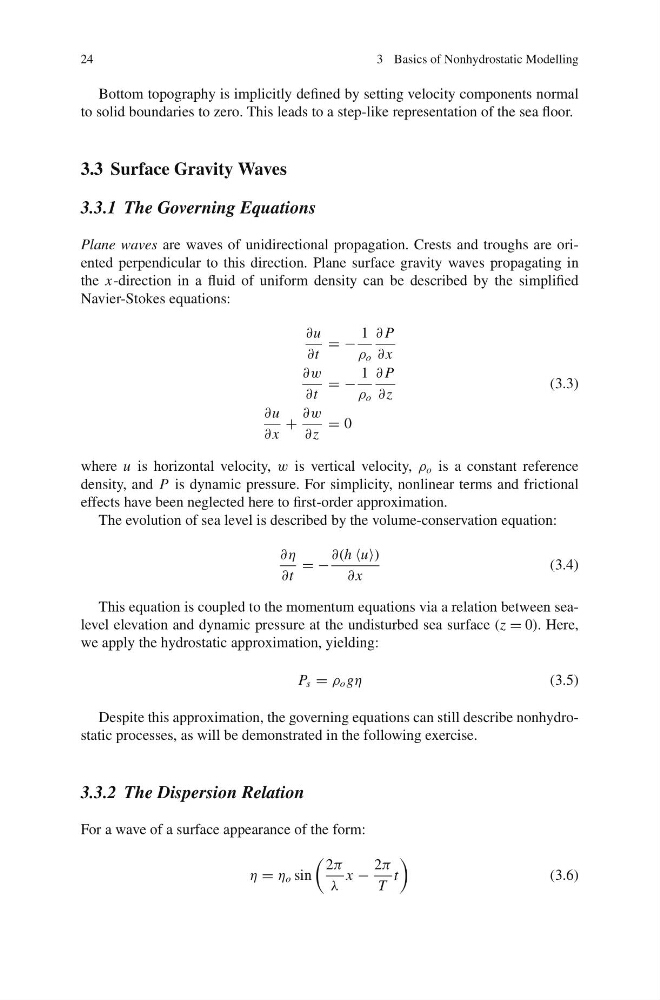
Plane waves are waves of unidirectional propagation. Crests and troughs are oriented perpendicular to this direction. Plane surface gravity waves propagating in
the x-direction in a fluid of uniform density can be described by the simplified
Navier-Stokes equations:
∂u
∂t
= −
1
ρ o
∂ P
∂ x
∂w
∂t
= −
1
ρ o
∂ P
∂z
(3.3)
∂u
∂ x
+
∂w
∂z
= 0
where u is horizontal velocity, w is vertical velocity, ρ o is a constant reference
density, and P is dynamic pressure. For simplicity, nonlinear terms and frictional
effects have been neglected here to first-order approximation.
The evolution of sea level is described by the volume-conservation equation:
∂η
∂t
= −
∂(h u)
∂ x
(3.4)
This equation is coupled to the momentum equations via a relation between sealevel elevation and dynamic pressure at the undisturbed sea surface (z = 0). Here,
we apply the hydrostatic approximation, yielding:
P s = ρ o gη
(3.5)
Despite this approximation, the governing equations can still describe nonhydrostatic processes, as will be demonstrated in the following exercise.
3.3.2 The Dispersion Relation
For a wave of a surface appearance of the form:
η = η o sin
2π
λ
x −
2π
T
t
(3.6)
3 Basics of Nonhydrostatic Modelling
Bottom topography is implicitly defined by setting velocity components normal
to solid boundaries to zero. This leads to a step-like representation of the sea floor.
3.3 Surface Gravity Waves
3.3.1 The Governing Equations
Plane waves are waves of unidirectional propagation. Crests and troughs are oriented perpendicular to this direction. Plane surface gravity waves propagating in
the x-direction in a fluid of uniform density can be described by the simplified
Navier-Stokes equations:
∂u
∂t
= −
1
ρ o
∂ P
∂ x
∂w
∂t
= −
1
ρ o
∂ P
∂z
(3.3)
∂u
∂ x
+
∂w
∂z
= 0
where u is horizontal velocity, w is vertical velocity, ρ o is a constant reference
density, and P is dynamic pressure. For simplicity, nonlinear terms and frictional
effects have been neglected here to first-order approximation.
The evolution of sea level is described by the volume-conservation equation:
∂η
∂t
= −
∂(h u)
∂ x
(3.4)
This equation is coupled to the momentum equations via a relation between sealevel elevation and dynamic pressure at the undisturbed sea surface (z = 0). Here,
we apply the hydrostatic approximation, yielding:
P s = ρ o gη
(3.5)
Despite this approximation, the governing equations can still describe nonhydrostatic processes, as will be demonstrated in the following exercise.
3.3.2 The Dispersion Relation
For a wave of a surface appearance of the form:
η = η o sin
2π
λ
x −
2π
T
t
(3.6)