

3.4 Nonhydrostatic Solver
27
imposed by a tilted sea surface and arising from nonhydrostatic effects. For a
constant-density ocean, the latter equation turns into P = q.
3.4.2 Starting as Simple as Possible
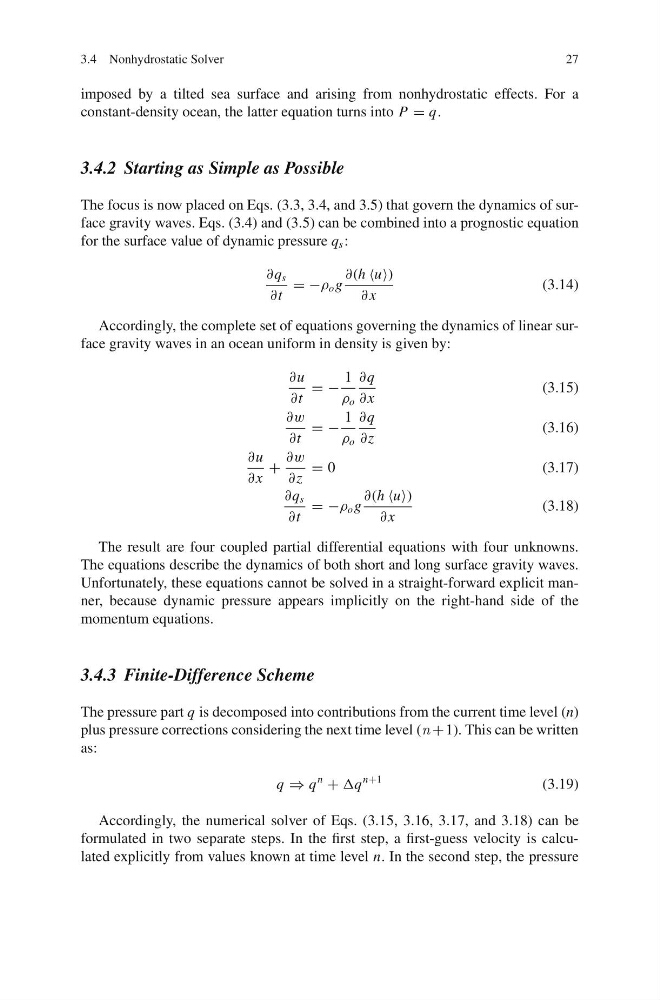
The focus is now placed on Eqs. (3.3, 3.4, and 3.5) that govern the dynamics of surface gravity waves. Eqs. (3.4) and (3.5) can be combined into a prognostic equation
for the surface value of dynamic pressure q s :
∂q s
∂t
= −ρ o g
∂(h u)
∂ x
(3.14)
Accordingly, the complete set of equations governing the dynamics of linear surface gravity waves in an ocean uniform in density is given by:
∂u
∂t
= −
1
ρ o
∂q
∂ x
(3.15)
∂w
∂t
= −
1
ρ o
∂q
∂z
(3.16)
∂u
∂ x
+
∂w
∂z
= 0
(3.17)
∂q s
∂t
= −ρ o g
∂(h u)
∂ x
(3.18)
The result are four coupled partial differential equations with four unknowns.
The equations describe the dynamics of both short and long surface gravity waves.
Unfortunately, these equations cannot be solved in a straight-forward explicit manner, because dynamic pressure appears implicitly on the right-hand side of the
momentum equations.
3.4.3 Finite-Difference Scheme
The pressure part q is decomposed into contributions from the current time level (n)
plus pressure corrections considering the next time level (n +1). This can be written
as:
q ⇒ q
n
+ Δq
n+1
(3.19)
Accordingly, the numerical solver of Eqs. (3.15, 3.16, 3.17, and 3.18) can be
formulated in two separate steps. In the first step, a first-guess velocity is calculated explicitly from values known at time level n. In the second step, the pressure
27
imposed by a tilted sea surface and arising from nonhydrostatic effects. For a
constant-density ocean, the latter equation turns into P = q.
3.4.2 Starting as Simple as Possible
The focus is now placed on Eqs. (3.3, 3.4, and 3.5) that govern the dynamics of surface gravity waves. Eqs. (3.4) and (3.5) can be combined into a prognostic equation
for the surface value of dynamic pressure q s :
∂q s
∂t
= −ρ o g
∂(h u)
∂ x
(3.14)
Accordingly, the complete set of equations governing the dynamics of linear surface gravity waves in an ocean uniform in density is given by:
∂u
∂t
= −
1
ρ o
∂q
∂ x
(3.15)
∂w
∂t
= −
1
ρ o
∂q
∂z
(3.16)
∂u
∂ x
+
∂w
∂z
= 0
(3.17)
∂q s
∂t
= −ρ o g
∂(h u)
∂ x
(3.18)
The result are four coupled partial differential equations with four unknowns.
The equations describe the dynamics of both short and long surface gravity waves.
Unfortunately, these equations cannot be solved in a straight-forward explicit manner, because dynamic pressure appears implicitly on the right-hand side of the
momentum equations.
3.4.3 Finite-Difference Scheme
The pressure part q is decomposed into contributions from the current time level (n)
plus pressure corrections considering the next time level (n +1). This can be written
as:
q ⇒ q
n
+ Δq
n+1
(3.19)
Accordingly, the numerical solver of Eqs. (3.15, 3.16, 3.17, and 3.18) can be
formulated in two separate steps. In the first step, a first-guess velocity is calculated explicitly from values known at time level n. In the second step, the pressure