

18
2 1D Models of Ekman Layers
2.4 The Bottom Ekman Layer
2.4.1 Boundary-Layer Equations
A bottom Ekman layer develops owing to frictional effects experienced by a flow in
contact with the sea floor. For simplicity, this ambient (geostrophic) flow of vector
components u geo and v geo is assumed to be horizontally uniform and the sea floor is
assumed to be plane. With horizontal homogeneity of all variables, the boundarylayer equations can then be formulated as:
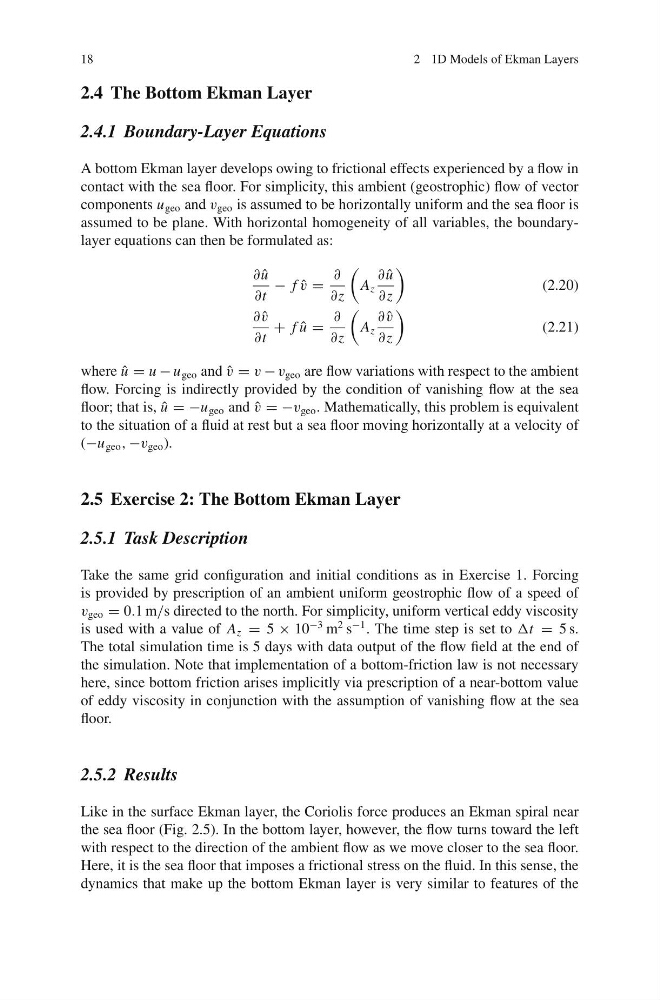
∂ ˆ
u
∂t
− f ˆ
v =
∂
∂z
A z
∂ ˆ
u
∂z
(2.20)
∂ ˆ
v
∂t
+ f ˆ
u =
∂
∂z
A z
∂ ˆ
v
∂z
(2.21)
where ˆ
u = u − u geo and ˆ
v = v − v geo are flow variations with respect to the ambient
flow. Forcing is indirectly provided by the condition of vanishing flow at the sea
floor; that is, ˆ
u = −u geo and ˆ
v = −v geo . Mathematically, this problem is equivalent
to the situation of a fluid at rest but a sea floor moving horizontally at a velocity of
(−u geo , −v geo ).
2.5 Exercise 2: The Bottom Ekman Layer
2.5.1 Task Description
Take the same grid configuration and initial conditions as in Exercise 1. Forcing
is provided by prescription of an ambient uniform geostrophic flow of a speed of
v geo = 0.1 m/s directed to the north. For simplicity, uniform vertical eddy viscosity
is used with a value of A z = 5 × 10
−3 m
2 s
−1 . The time step is set to Δt = 5 s.
The total simulation time is 5 days with data output of the flow field at the end of
the simulation. Note that implementation of a bottom-friction law is not necessary
here, since bottom friction arises implicitly via prescription of a near-bottom value
of eddy viscosity in conjunction with the assumption of vanishing flow at the sea
floor.
2.5.2 Results
Like in the surface Ekman layer, the Coriolis force produces an Ekman spiral near
the sea floor (Fig. 2.5). In the bottom layer, however, the flow turns toward the left
with respect to the direction of the ambient flow as we move closer to the sea floor.
Here, it is the sea floor that imposes a frictional stress on the fluid. In this sense, the
dynamics that make up the bottom Ekman layer is very similar to features of the
2 1D Models of Ekman Layers
2.4 The Bottom Ekman Layer
2.4.1 Boundary-Layer Equations
A bottom Ekman layer develops owing to frictional effects experienced by a flow in
contact with the sea floor. For simplicity, this ambient (geostrophic) flow of vector
components u geo and v geo is assumed to be horizontally uniform and the sea floor is
assumed to be plane. With horizontal homogeneity of all variables, the boundarylayer equations can then be formulated as:
∂ ˆ
u
∂t
− f ˆ
v =
∂
∂z
A z
∂ ˆ
u
∂z
(2.20)
∂ ˆ
v
∂t
+ f ˆ
u =
∂
∂z
A z
∂ ˆ
v
∂z
(2.21)
where ˆ
u = u − u geo and ˆ
v = v − v geo are flow variations with respect to the ambient
flow. Forcing is indirectly provided by the condition of vanishing flow at the sea
floor; that is, ˆ
u = −u geo and ˆ
v = −v geo . Mathematically, this problem is equivalent
to the situation of a fluid at rest but a sea floor moving horizontally at a velocity of
(−u geo , −v geo ).
2.5 Exercise 2: The Bottom Ekman Layer
2.5.1 Task Description
Take the same grid configuration and initial conditions as in Exercise 1. Forcing
is provided by prescription of an ambient uniform geostrophic flow of a speed of
v geo = 0.1 m/s directed to the north. For simplicity, uniform vertical eddy viscosity
is used with a value of A z = 5 × 10
−3 m
2 s
−1 . The time step is set to Δt = 5 s.
The total simulation time is 5 days with data output of the flow field at the end of
the simulation. Note that implementation of a bottom-friction law is not necessary
here, since bottom friction arises implicitly via prescription of a near-bottom value
of eddy viscosity in conjunction with the assumption of vanishing flow at the sea
floor.
2.5.2 Results
Like in the surface Ekman layer, the Coriolis force produces an Ekman spiral near
the sea floor (Fig. 2.5). In the bottom layer, however, the flow turns toward the left
with respect to the direction of the ambient flow as we move closer to the sea floor.
Here, it is the sea floor that imposes a frictional stress on the fluid. In this sense, the
dynamics that make up the bottom Ekman layer is very similar to features of the