

2.5 Exercise 2: The Bottom Ekman Layer
19
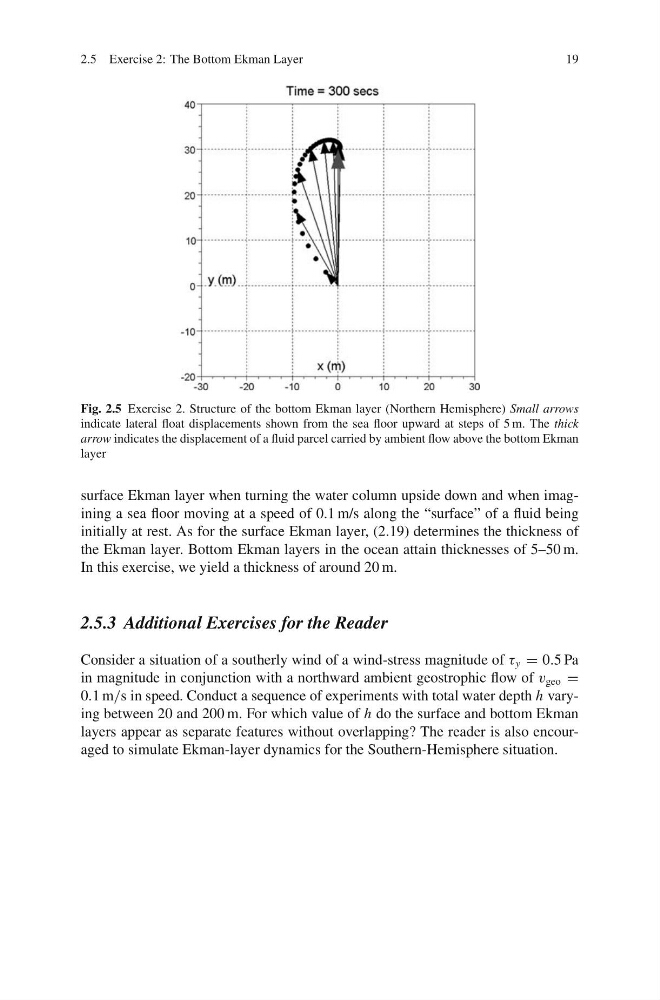
Fig. 2.5 Exercise 2. Structure of the bottom Ekman layer (Northern Hemisphere) Small arrows
indicate lateral float displacements shown from the sea floor upward at steps of 5 m. The thick
arrow indicates the displacement of a fluid parcel carried by ambient flow above the bottom Ekman
layer
surface Ekman layer when turning the water column upside down and when imagining a sea floor moving at a speed of 0.1 m/s along the “surface” of a fluid being
initially at rest. As for the surface Ekman layer, (2.19) determines the thickness of
the Ekman layer. Bottom Ekman layers in the ocean attain thicknesses of 5–50 m.
In this exercise, we yield a thickness of around 20 m.
2.5.3 Additional Exercises for the Reader
Consider a situation of a southerly wind of a wind-stress magnitude of τ y = 0.5 Pa
in magnitude in conjunction with a northward ambient geostrophic flow of v geo =
0.1 m/s in speed. Conduct a sequence of experiments with total water depth h varying between 20 and 200 m. For which value of h do the surface and bottom Ekman
layers appear as separate features without overlapping? The reader is also encouraged to simulate Ekman-layer dynamics for the Southern-Hemisphere situation.
19
Fig. 2.5 Exercise 2. Structure of the bottom Ekman layer (Northern Hemisphere) Small arrows
indicate lateral float displacements shown from the sea floor upward at steps of 5 m. The thick
arrow indicates the displacement of a fluid parcel carried by ambient flow above the bottom Ekman
layer
surface Ekman layer when turning the water column upside down and when imagining a sea floor moving at a speed of 0.1 m/s along the “surface” of a fluid being
initially at rest. As for the surface Ekman layer, (2.19) determines the thickness of
the Ekman layer. Bottom Ekman layers in the ocean attain thicknesses of 5–50 m.
In this exercise, we yield a thickness of around 20 m.
2.5.3 Additional Exercises for the Reader
Consider a situation of a southerly wind of a wind-stress magnitude of τ y = 0.5 Pa
in magnitude in conjunction with a northward ambient geostrophic flow of v geo =
0.1 m/s in speed. Conduct a sequence of experiments with total water depth h varying between 20 and 200 m. For which value of h do the surface and bottom Ekman
layers appear as separate features without overlapping? The reader is also encouraged to simulate Ekman-layer dynamics for the Southern-Hemisphere situation.