

2.3 Exercise 1: The Surface Ekman Layer
17
2.3.3 Explanation of the Ekman-Layer Structure
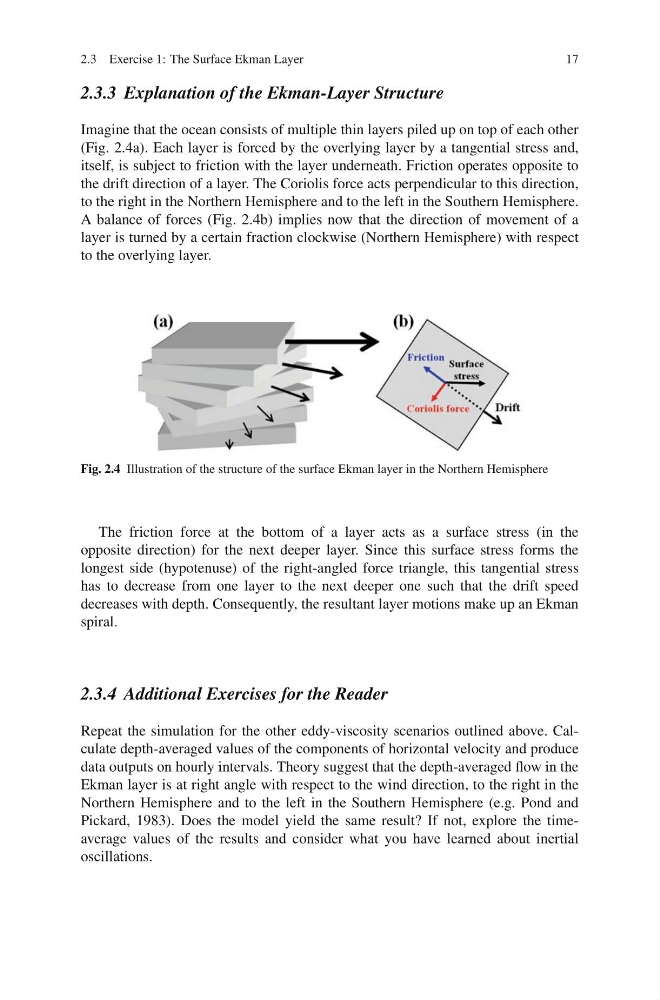
Imagine that the ocean consists of multiple thin layers piled up on top of each other
(Fig. 2.4a). Each layer is forced by the overlying layer by a tangential stress and,
itself, is subject to friction with the layer underneath. Friction operates opposite to
the drift direction of a layer. The Coriolis force acts perpendicular to this direction,
to the right in the Northern Hemisphere and to the left in the Southern Hemisphere.
A balance of forces (Fig. 2.4b) implies now that the direction of movement of a
layer is turned by a certain fraction clockwise (Northern Hemisphere) with respect
to the overlying layer.
Fig. 2.4 Illustration of the structure of the surface Ekman layer in the Northern Hemisphere
The friction force at the bottom of a layer acts as a surface stress (in the
opposite direction) for the next deeper layer. Since this surface stress forms the
longest side (hypotenuse) of the right-angled force triangle, this tangential stress
has to decrease from one layer to the next deeper one such that the drift speed
decreases with depth. Consequently, the resultant layer motions make up an Ekman
spiral.
2.3.4 Additional Exercises for the Reader
Repeat the simulation for the other eddy-viscosity scenarios outlined above. Calculate depth-averaged values of the components of horizontal velocity and produce
data outputs on hourly intervals. Theory suggest that the depth-averaged flow in the
Ekman layer is at right angle with respect to the wind direction, to the right in the
Northern Hemisphere and to the left in the Southern Hemisphere (e.g. Pond and
Pickard, 1983). Does the model yield the same result? If not, explore the timeaverage values of the results and consider what you have learned about inertial
oscillations.
17
2.3.3 Explanation of the Ekman-Layer Structure
Imagine that the ocean consists of multiple thin layers piled up on top of each other
(Fig. 2.4a). Each layer is forced by the overlying layer by a tangential stress and,
itself, is subject to friction with the layer underneath. Friction operates opposite to
the drift direction of a layer. The Coriolis force acts perpendicular to this direction,
to the right in the Northern Hemisphere and to the left in the Southern Hemisphere.
A balance of forces (Fig. 2.4b) implies now that the direction of movement of a
layer is turned by a certain fraction clockwise (Northern Hemisphere) with respect
to the overlying layer.
Fig. 2.4 Illustration of the structure of the surface Ekman layer in the Northern Hemisphere
The friction force at the bottom of a layer acts as a surface stress (in the
opposite direction) for the next deeper layer. Since this surface stress forms the
longest side (hypotenuse) of the right-angled force triangle, this tangential stress
has to decrease from one layer to the next deeper one such that the drift speed
decreases with depth. Consequently, the resultant layer motions make up an Ekman
spiral.
2.3.4 Additional Exercises for the Reader
Repeat the simulation for the other eddy-viscosity scenarios outlined above. Calculate depth-averaged values of the components of horizontal velocity and produce
data outputs on hourly intervals. Theory suggest that the depth-averaged flow in the
Ekman layer is at right angle with respect to the wind direction, to the right in the
Northern Hemisphere and to the left in the Southern Hemisphere (e.g. Pond and
Pickard, 1983). Does the model yield the same result? If not, explore the timeaverage values of the results and consider what you have learned about inertial
oscillations.